1

One Year Bible Challenge, Week 8

bible

Week 8

February 19-25, 2011[1. The notes, summaries and points on this page are intended as bookmarks of important matters which are covered in this week’s readings. They are not intended as complete summaries of readings. Please forgive me if some of my summaries are not 100% on point. Read the manual–i.e. Bible–so that you will get a more clear understanding of the material. Thank you.
–Tom Truex]

This is the “One Year Bible Challenge:” to read the entire Bible in one year. Assuming a normal reading level, this can be done by spending about 10-15 minutes per day, each and every day. It is NOT TOO LATE to join the Challenge! Start with today’s reading and keep reading with us through the end of this year. You’ll have to read a bit more at the beginning of next year to finish. See ReadTheWholeBible.COM for more information. If you would like details so you can join us, or if you have any other questions, please call Tom Truex. Or send an email by using the CONTACT form on K-Line.ORG.

OLD TESTAMENT READINGS: Leviticus 7:28-18:30

Themes and stories: God gives more instructions to Moses about their offerings. Moses carries out God’s instructions regarding consecration of the priests. Moses anoints the Tabernacle and all that was in it with anointing oil. Moses slaughtered a bull as a sin offering; and then other animal sacrifices. Moses put blood from the sacrifice on Aaron and his sons, on the lobe of their right ears, on the thumb of their right hands, and the big toe of their right feet. The priests began their ministry. They sacrificed animals in quantity. Two of Aaron’s sons, Nadab and Abihu, disobeyed God’s instructions by using “unauthorized fire” before the Lord. God consumed (killed) them with the fire. God made another rule: The priest must not drink alcohol before entering the Tabernacle.

God specified which animals were clean and which were “unclean.” There are detailed guidelines. But, in general, if it has divided hoofs and chews its cud, it is most likely acceptable to eat. If it is a scavenger, lizard, carrion bird or snake, it’s probably not fine to eat it. Fish with scales and gills are clean—most other sea creatures are “unclean.” If in doubt, check the label, to see if it’s kosher.

God gave rules for purification after child birth—slightly different if the child is male or female. God also gave rules on how leprosy is to be diagnosed and dealt with.

“[45] The leper who has the disease shall wear torn clothes and let the hair of his head hang loose, and he shall cover his upper lip and cry, `Unclean, unclean.’ [46] He shall remain unclean as long as he has the disease; he is unclean; he shall dwell alone in a habitation outside the camp.” Leviticus 13: 45-46 (RSV)

God gave Moses a procedure for dealing with a leprous person who has been healed. Also rules on dealing with mildew in homes. If the problem couldn’t be cured, the home might have to be torn down. He also gave Moses rules for other medical ailments and conditions.

God gave more instructions on the sacrifices offered at the altar. There were also warnings against the consequences of improper sacrifices. Next God gives rules about certain sexual practices. It’s an interesting list. I don’t think my summary would do it justice. You can read it in Chapter 18 of Leviticus.

Discussion points: Why did God give the Israelites so many rules about “clean” and “unclean” animals?
Psalms: Psalm 37:12-41:13
Proverbs: Proverbs 10:5-16

NEW TESTAMENT READINGS: Mark 3:31-8:10

Themes and stories: Jesus says, “Whoever does the will of God is my brother, and sister, and mother.” Mark 3:35 (RSV)

Parable of the four soils. Jesus explains it’s meaning to the disciples. Specifically, Satan immediately takes away the word from some; in other cases, the word is gladly received, but does not take root. The “cares of the world, and the delight in riches, and the desire for other things” chokes out the word with others. But others hear the word, and it bears fruit with them, many times over. Jesus tells another parable about a growing seed, and one about a mustard seed.
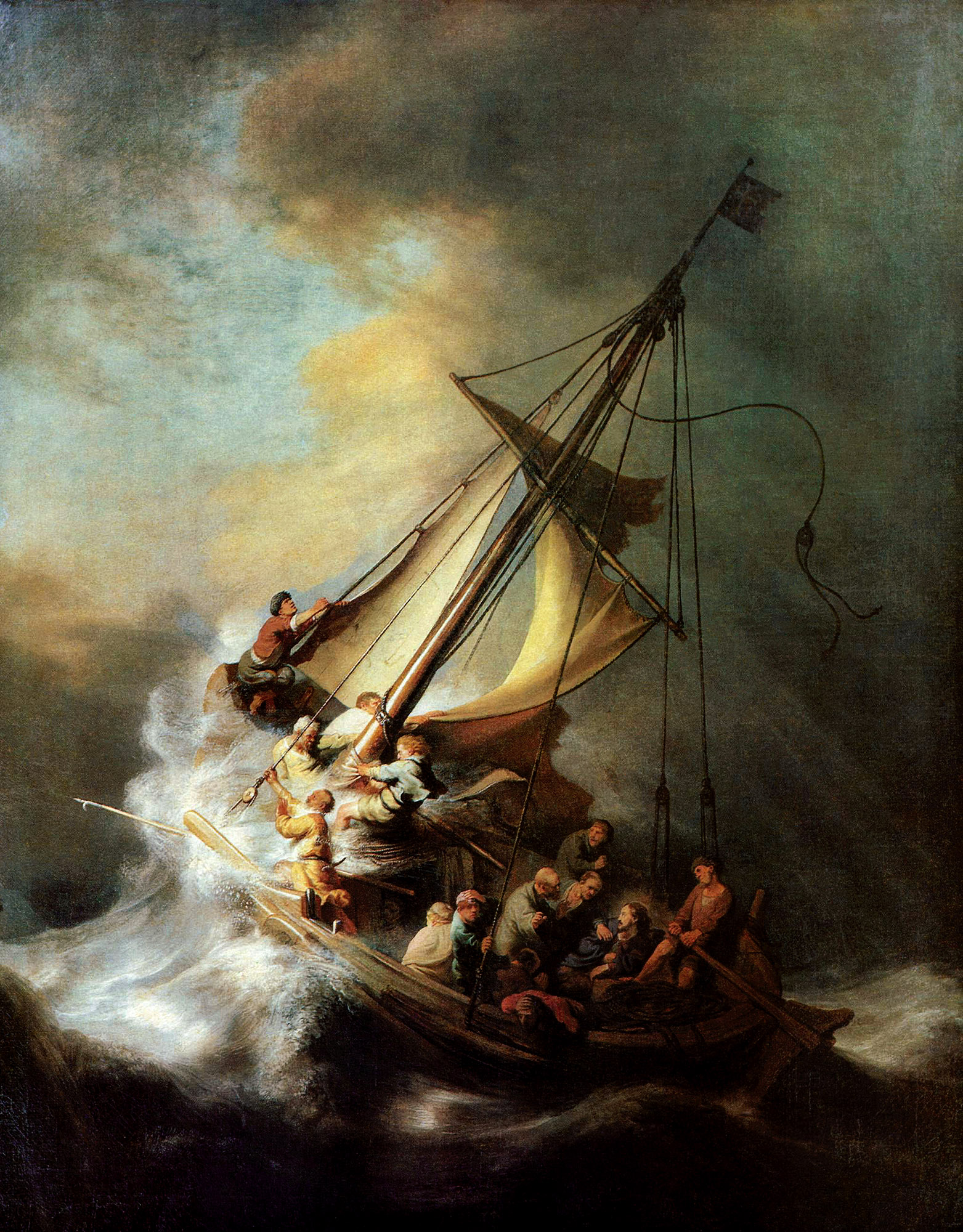
One evening Jesus and his disciples set out in their boat to get away from the crowds. A sudden storm threatened to swamp the ship and drown them all. Jesus calmed the seas. His disciples were amazed.

On the other side of the sea, in Gerasenes, a wild demon possessed man was running in the cemetery between the tombs. He was so crazed that no one could restrain him—not even with chains! Jesus asked the demons their name. They replied “My name is Legion; for we are many.” Mark 5:9 (RSV). The unclean spirits begged Jesus to let them go into a nearby herd of swine. Jesus consented. “And the unclean spirits came out, and entered the swine; and the herd, numbering about two thousand, rushed down the steep bank into the sea, and were drowned in the sea. Mark 5:13. The owners of the pigs didn’t appreciate the significance of the event, and asked Jesus to leave.

Jesus heals a bleeding woman and restores a dead girl to life. The woman, who had been bleeding for years, was healed by her faith, merely by touching Jesus’ garment. The dead girl, whose father was Jairus, was really dead. Completely dead. Dead as a doornail. When Jesus implied she was not dead, the mourners “laughed him to scorn.“ Mark 5:40 (KJV). Jesus took the girl by the hand and said, “Tal’itha cu’mi”; which means, “Little girl, I say to you, arise.” Immediately, the girl, who was 12 years old, got up and began to walk around. Jesus told them to get her something to eat.

The people of Nazareth didn’t accept Jesus. Jesus noted that it is hard for people to believe a man is anything special in his own hometown.

Jesus sent out his disciples to preach. They took no money nor possessions. They cast out demons, anointed with oil and cured the sick.

King Herod had married his brother’s wife. John the Baptist pointed out this marriage was a sin. At the prompting of his wife, Herodias, Herod arrested John. Herodias’ daughter danced at Herod’s party. Herod was so impressed that he made an open promise to her. She cashed in on the promise by demanding the head of John the Baptist on a platter. Beware of pretty dancing girls.

Jesus fed 5,000 men (plus women and children) with five loaves of bread and two fish. There were 12 baskets of leftovers. Jesus walked on water. Jesus continued to heal people.

Jesus reprimanded the religious leaders for following the letter of the law, while ignoring God’s intent of the law. Jesus came to the house of Gentiles. He sent a demon out of a girl. Jesus fed another large crowd with almost no food. This time, it was 4,000 men (plus women and children), with seven loaves of bread, and few small fish. There were 7 baskets of leftovers. Mark 8:1-10

Discussion points:

  1. Is the purpose of the parables to convey the truth? Or to hide the truth? Or both? Or neither?
  2. Imagine you were Jairus, and Jesus brought your child back to life. How do you think you would feel? Why did Jesus tell the people standing by to give the girl something to eat?
REVIEW / STUDY QUESTIONS:
  • Isn’t leprosy incurable? Why was there a procedure in Leviticus, chapter 14 for re-admitting people back into society after being cured of leprosy?
  • What was the “unholy fire” that Nadab and Abihu offered before the Lord?
  • Why did God restrict the foods the Israelites were allowed to eat
  • How did the boat Jesus and the disciples were in get caught at sea? Weren’t they experienced fishermen?
  • Why did Herod’s wife want to kill John the Baptist? Why did Herod agree to do so?
DISCUSSION POINTS AND VERSES — Christian Men’s Breakfast only[2. Subject to change.]

The discussion notes ( PDF / TEXT ) for breakfast on Saturday, February 26, 2011 are now online — ”Clean vs. Unclean”. This week we read more about God’s specific rules for the Israelites. God defines what animals are considered clean and can be eaten. God’s rules for leprosy also use the terms “Clean” and “Unclean.” Discussion verses: Leviticus 11 and Mark 4:10-12. This week’s BACKGROUND is a brief review of the Latin Vulgate Bibles..

WOMEN’S STUDY GROUP

A women’s study group meets in Davie, FL on the 2nd Friday morning of the month. Contact Janet Truex, or use the Contact tab at CONTACT form on ReadTheWholeBible.COM.

FOOTNOTES


Christian Mens Breakfast, February 26, 2011

The discussion notes ( PDF / TEXT ) for breakfast on Saturday, February 26, 2011 are now online — ”Clean vs. Unclean”. This week we read more about God’s specific rules for the Israelites. God defines what animals are considered clean and can be eaten. God’s rules for leprosy also use the terms “Clean” and “Unclean.” Discussion verses: Leviticus 11 and Mark 4:10-12. This week’s BACKGROUND is a brief review of the Latin Vulgate Bibles.


One Year Bible Challenge, Week 7

bible

Week 7

February 12 – 18, 2011[1. The notes, summaries and points on this page are intended as bookmarks of important matters which are covered in this week’s readings. They are not intended as complete summaries of readings. Please forgive me if some of my summaries are not 100% on point. Read the manual–i.e. Bible–so that you will get a more clear understanding of the material. Thank you.
–Tom Truex]

This is the “One Year Bible Challenge:” to read the entire Bible in one year. Assuming a normal reading level, this can be done by spending about 10-15 minutes per day, each and every day. It is NOT TOO LATE to join the Challenge! Start with today’s reading and keep reading with us through the end of this year. You’ll have to read a bit more at the beginning of next year to finish. See ReadTheWholeBible.COM for more information. If you would like details so you can join us, or if you have any other questions, please call Tom Truex. Or send an email by using the CONTACT form on K-Line.ORG.

OLD TESTAMENT READINGS: Exodus 34:1-Leviticus 7:27

Themes and stories: God told Moses to chisel two new stone tablets so God could replace the ones that Moses broke. God renewed his Covenant with the Israelites. He would continue to produce great miracles and would help them defeat their enemies. The Israelites must not make treaties with their enemies, nor worship their false gods. In fact, God told the Israelites to destroy the altars and images of the false gods worshiped by foreigners. God reminded the people to celebrate the Feast of the Unleavened Bread, to give God the firstborn, to celebrate the Sabbath and their other Feasts. Moses brought the new set of tablets, with the Commandments to the Israelites. The skin on his face shone because he had spoken to God.

The Israelites brought together the materials to build the Tabernacle. Moses selected skilled craftsmen and their leaders to make the Tabernacle. Construction of the Tabernacle, Ark, Lampstand, Altar, and Courtyard required a lot of skill and attention to God’s detailed instructions. The inventory of materials used was considerable. Next, the craftsmen made the priestly garments, according to God’s detailed specifications. Finally, when all the work was complete, Moses inspected the Tabernacle, and its accessories. He was pleased, because everything was exactly as God had commanded.

The glory of God filled the Tabernacle. During all of their travels, the Israelites only moved when a cloud lifted from above the Tabernacle.

Leviticus. God instructed Moses on making the burnt offerings. The instructions were passed to the priests. There were instructions for bulls, sheep, goats, doves and pigeons. The animals were to be male and without defect. There were also grain offerings, fellowship offerings (a male or female animal from the herd), sin offering (bull, lamb, goat, doves or pigeons, depending on the sin and the sinner) and guilt offerings. The Israelites were instructed to not eat the fat or blood of any animal.

Discussion points: Why does God caution the Israelites to have nothing to do with the foreigners they will encounter (Exodus 34:11-16)? Is this instruction contrary to what Jesus Christ later says is the second most important commandment–“You shall love your neighbor as yourself” (Matthew 22:39 ESV)?

Psalms: Psalm 33:12-37:11

Proverbs: Proverbs 9:1-10:4

NEW TESTAMENT READINGS: Matthew 27:15-Mark 3:30

Themes and stories: Jesus was brought before Pilate. There was a custom at the Passover festival for the governor to release one prisoner for the crowd—anyone they wanted. Pilate asked the crowd if they wanted him to release Barabbas or Jesus. “[W]hile he was sitting on the judgment seat, his wife sent word to him, ‘Have nothing to do with that righteous man, for I have suffered much over him today in a dream.'” (Matthew 27:19) Too late. The chief priests and elders persuaded the mob to demand Barabbas, and to have Jesus killed. Pilate asked him again. They responded, “crucify him!” Pilate asked what Jesus had done. The mob’s response was to shout all the more, “crucify him!” Mobs haven’t changed much in the past 2,000 years.

[24] So when Pilate saw that he was gaining nothing, but rather that a riot was beginning, he took water and washed his hands before the crowd, saying, “I am innocent of this man’s blood; see to it yourselves.” [25] And all the people answered, “His blood be on us and on our children!” [26] Then he released for them Barab’bas, and having scourged Jesus, delivered him to be crucified. Matthew 27:24-26 (RSV)

The Roman soldiers mocked Jesus. They stripped him. They put a crown of thorns on his head, spat on him, struck him. As they lead him to be crucified, they compelled a man from Cyrene named Simon to carry his cross. They crucified Jesus at a place called Golgotha, which means “Place of the Skull.”

Jesus was crucified between two bandits, who, unlike Jesus, deserved to die for their crimes, according to the criminal laws of the day. People passing by mocked Jesus, as did the other men being crucified. Darkness came early, at noon, that day.

After three hours of daytime darkness, Jesus cried out, “My God, my God, why hast thou forsaken me?” Jesus is quoting from Psalm 22:1. Jesus cried out again in a loud voice before he died. As he did so, there was an earthquake. The curtain in the Temple was torn in two, from top to bottom.

[51b] The earth shook, the rocks split [52] and the tombs broke open. The bodies of many holy people who had died were raised to life. [53] They came out of the tombs after Jesus’ resurrection and went into the holy city and appeared to many people

A rich man from Arimathea, named Joseph, asked Pilate for Jesus’ body. Joseph wrapped Jesus’ body in a clean linen cloth and laid it in his own tomb. He rolled a great stone in front of the door. The religious leaders were afraid that Jesus’ followers would steal the body and claim that Jesus had been resurrected. Have you ever noticed that dishonest people are often the first to accuse others of dishonesty? Pilate placed a guard detail outside the tomb.

On the third day there was a great earthquake. An angel rolled back the stone blocking the door to the tomb. Jesus arose from the dead. He appeared first to the women who had followed him. Later he appeared to the eleven remaining disciples. He gave them a great commission:

[18] And Jesus came and spake unto them, saying, All power is given unto me in heaven and in earth. [19] Go ye therefore, and teach all nations, baptizing them in the name of the Father, and of the Son, and of the Holy Ghost: [20] Teaching them to observe all things whatsoever I have commanded you: and, lo, I am with you alway, even unto the end of the world. Amen. Matthew 28:18-20 (KJV).

Mark. The gospel writer begins by quoting the prophet, Isaiah:

“Behold, I send my messenger before thy face, who shall prepare thy way; the voice of one crying in the wilderness: Prepare the way of the Lord, make his paths straight — ” (Mark 1:2-3, which is quoting Isaiah 40:3)

John the Baptist appeared in the wilderness, proclaiming a baptism of repentance for the forgiveness of sins. John was clothed with camel’s hair, and had a leather girdle around his waist, and ate locusts and wild honey. John baptized Jesus. A dove ascended from Heaven onto Jesus. A voice came from heaven saying, “Thou art my beloved Son; with thee I am well pleased.” Mark 1:11 (RSV). Jesus went to the wilderness for 40 days. Satan tempted Jesus. After John the Baptist was arrested, Jesus began to preach.

Jesus asked two fishermen, Simon and Andrew, to follow Him, saying, “Follow me and I will make you become fishers of men.” Two more fishermen, James and Zebedee, also followed him. Jesus began teaching in the synagogue in Capernaum. He spoke with such great authority that the people were astonished. Jesus healed many people, and cast out demons. He preached throughout Galilee. He healed a man with leprosy. The crowds grew so great, that it was hard to get close to Jesus. One group of friends cut a hole in the roof and lowered a paralyzed man through the roof to Jesus. Jesus healed the paralyzed man. The religious leaders accused Jesus of blasphemy because he told the paralyzed man, “My son, your sins are forgiven.” Mark 2:5 (RSV)

The religious leaders complained that Jesus dined with sinners. Jesus told them that it was the sinners who needed Him most. The religious leaders looked for other ways to criticize Jesus. They complained that his followers weren’t fasting, that the disciples picked wheat on the sabbath, and that Jesus healed a man on the sabbath. Crowds followed Jesus in such large numbers that it was difficult for him to move about. Jesus selected his twelve disciples:

[13]And he goeth up into a mountain, and calleth unto him whom he would: and they came unto him. [14]And he ordained twelve, that they should be with him, and that he might send them forth to preach, [15]And to have power to heal sicknesses, and to cast out devils:  [16]And Simon he surnamed Peter; [17]And James the son of Zebedee, and John the brother of James; and he surnamed them Boanerges, which is, The sons of thunder:  [18]And Andrew, and Philip, and Bartholomew, and Matthew, and Thomas, and James the son of Alphaeus, and Thaddaeus, and Simon the Canaanite, [19]And Judas Iscariot, which also betrayed him: and they went into an house. Mark 3:13-19 (KJV)

The religious leaders continued to deny Jesus. They accused him of being Satan.

Discussion points: What is the importance of the Resurrection to Christians?

REVIEW / STUDY QUESTIONS:
  • Why does God caution the Israelites to have nothing to do with the foreigners they will encounter? (Exodus 34:11-16) Is this instruction contrary to what Jesus Christ later says is the second most important commandment–“You shall love your neighbor as yourself?” (Matthew 22:39)
  • What was the significance of the curtain in the Temple splitting from top to bottom? (Matthew 27:51)
  • What is the importance of the Resurrection to Christians? (Matthew 28:1-10)
  • Why did Jesus need to be baptized, if John’s baptism was for the repentance of sin?
DISCUSSION POINTS AND VERSES — Christian Men’s Breakfast only[2. Subject to change.]

The discussion notes ( PDF / TEXT ) for breakfast on Saturday, February 19, 2011 are now online — ”The Offering”. When the Israelites constructed the Tabernacle in Exodus, they began the formalized system of animal sacrifices. This week we look at those practices and at the crucifixion and resurrection of Jesus Christ, which ended the need for animal sacrifice Discussion verses: Exodus 34:11-16 and Matthew 28:1-10

WOMEN’S STUDY GROUP

A women’s study group meets in Davie, FL on the 2nd Friday morning of the month. Contact Janet Truex, or use the Contact tab at CONTACT form on ReadTheWholeBible.COM.

FOOTNOTES