1

One Year Bible Challenge, Week 15

bible

Week 15

April 9 – 15, 2011[1. The notes, summaries and points on this page are intended as bookmarks of important matters which are covered in this week’s readings. They are not intended as complete summaries of readings. Please forgive me if some of my summaries are not 100% on point. Read the manual–i.e. Bible–so that you will get a more clear understanding of the material. Thank you.
–Tom Truex]

This is the “One Year Bible Challenge:” to read the entire Bible in one year. Assuming a normal reading level, this can be done by spending about 10-15 minutes per day, each and every day. It is NOT TOO LATE to join the Challenge! Start with today’s reading and keep reading with us through the end of this year. You’ll have to read a bit more at the beginning of next year to finish. See ReadTheWholeBible.COM for more information. If you would like details so you can join us, or if you have any other questions, please call Tom Truex. Or send an email by using the CONTACT form on K-Line.ORG.

OLD TESTAMENT READINGS: Deuteronomy 33:1 – Joshua 12:24

Themes and stories: Moses blessed all the tribes. Then Moses went up to Mount Nebo. God pointed out the promised land, but reminded Moses he was not permitted to cross over to it. Moses died and was buried in a valley in the land of Moab. He was 120 years old. No one knows the exact burial site.

[10] And there has not arisen a prophet since in Israel like Moses, whom the LORD knew face to face, [11] none like him for all the signs and the wonders which the LORD sent him to do in the land of Egypt, to Pharaoh and to all his servants and to all his land, [12] and for all the mighty power and all the great and terrible deeds which Moses wrought in the sight of all Israel. Deuteronomy 34:10-12 (RSV)

Escape from Rahab's House , circa 1851-60: Julius Schnorr von Carolsfeld (1794-1872)
Joshua. After Moses’ death, God spoke to Joshua. God told him to cross the Jordan River. God promised that no one would ever be able to defeat Joshua’s armies. Joshua prepared the Israelites to cross into the promised land. First, they sent out two spies to view the land they were about to conquer. The spies entered the house of Rahab, the prostitute. The king found out about the spies, and sent men to inquire as to what Rahab knew. Rahab lied and told the King’s men that the spies had departed. After the king’s men left, Rahab hid the spies on her roof overnight. She told them she had helped them, because she knew the power of the Israelites’ God. She asked them to spare her family when they returned with their army. They agreed, and told her to tie a crimson cord in her window, as a sign to leave her home undisturbed. She helped the spies escape with a rope through her window. Rahab lived in a house on the outer side of the city wall, and she resided within the wall itself.

Back at the Israelites’ camp, Joshua told the people to sanctify themselves. He told the priests to carry the Ark of the Covenant in front of the people. Each of the tribes was to select a man to help carry the Ark. The twelve men carried the Ark into the Jordan river. As they went forward, the water piled upstream, so that there was a dry path across the river. All of Israel crossed the Jordan River on dry ground. Joshua 3:17. They took 12 stones from the middle of the riverbed, and used them to build a monument on the side of the river to honor God. The Israelite’s enemies panicked when they heard about this miraculous crossing of the Jordan River.

Many of the young Israelite men, who were born after the exodus, had not been circumcised. God told Joshua to stop and circumcise them all, before they proceeded forward. They celebrated Passover in that spot. On the day after Passover, they ate produce from the land. The manna ceased that day too.
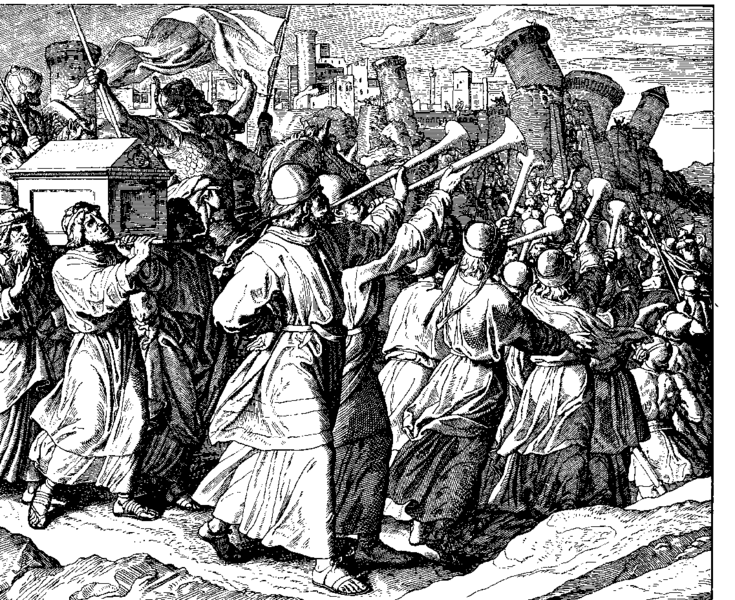
Julius Schnorr von Carolsfeld, 1794-1872, The Battle of Jericho.
As Joshua prepared to lead the Israelites into battle against Jericho, he was met by an angel. God told Joshua to have his army go forward and to march around Jericho once every day for the next six days. On the seventh day, the Israelites were to march around Jericho 7 times. At the seventh time, the trumpets sounded and the people shouted. And the walls of Jericho came tumbling down. The Israelites rushed in and captured the city. Everyone except Rahab, and her family was killed. “[T]hey utterly destroyed all in the city, both men and women, young and old, oxen, sheep, and asses, with the edge of the sword.” Joshua 6:21 (RSV)

Achan disobeyed God’s directions, and keep some of the loot from Jericho. Because of this sin, the Israelites lost their next battle against the city of Ai. God told Joshua that someone had keep property pillaged from Jericho. Joshua investigated. Achan confessed. Achan, his children and livestock were all killed by the Israelites as punishment.

Joshua’s army defeated the people from Ai. Joshua took a break and read all of Moses’ law to the Israelites.

The people from Gibeon tricked Joshua into making a treaty with them. Although the Gibeonites lived on land Joshua was to capture, they told Joshua they lived far away. They wore old tattered clothes and had old, dusty supplies to prove their story. After making the treaty, Joshua learned of their dishonesty. Joshua honored the treaty, but made these people their servants. A deal is a deal.

Some of the Israelites’ other enemies attacked Gibeon. Joshua intervened and killed the aggressors. Joshua asked for the Sun to stand still, so the Israelites would have enough daylight to finish the attack before their enemies could flee. The Sun and Moon stood still, extending the day, and permitting Joshua’s army to rout their enemies. Joshua’s army continued to fight and defeat their other enemies as well.

Discussion points:

  1. The inhabitants of Gibeon tricked Joshua into making a treaty with them. Why did Joshua honor the treaty once he learned it was a trick?
  2. During the battle with the Amorites, God made the Sun and the Moon stand still. What was the point of this occurrence; and are we to take this story literally? (i.e. did the Sun and Moon actually stop moving, or is this just a figure of speech?)

Psalms: Psalm 78:65 – 84:12

Proverbs: Proverbs 12:25 – 13:6

NEW TESTAMENT READINGS: Luke 13:1 – 17:37

Themes and stories: Jesus told the people to repent. Jesus cured a woman with a spirit, who had been crippled for 18 years. The religious leaders were upset that Jesus had healed on the Sabbath—which they considered a serious matter. Jesus taught more about the kingdom of God. Jesus healed another man on the Sabbath. This time the Pharisees were afraid to challenge Jesus.

Jesus told the parable of the man whose honored guests made excuses for not attending his feast. He had his servants bring in random people from off the street to enjoy his feast. Luke 14:15-24. In like manner, many people will refuse God’s offer to enter his kingdom. But God’s offer of salvation is open to all.

Jesus tells his followers that if they follow him, they may expect to suffer for their dedication to him.

Jesus told more parables:

  • The lost sheep. The shepherd leaves his flock to save one lamb.
  • The lost coin. The owner is happy to recover the one that was lost.
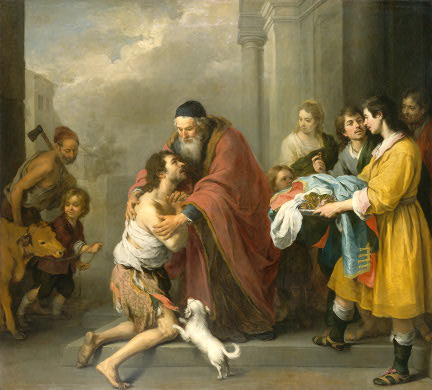
  • The Return of the Prodigal Son, circa 1670 Bartolomé Esteban Murillo (1617 – 1682)

  • The prodigal son. The father was happy at the return of the son who he thought was lost.
  • The shrewd manager. Whoever the master can trust with a little, can be trusted with more.
  • The rich man and the beggar. It was better for the poor man, who went to heaven, than the rich man, who ended up in Hades. It was too late for the rich man to warn his brothers.
    Jesus healed ten men with leprosy. Only one of them took the time to thank Jesus.
  • Jesus told the Pharisees about the coming kingdom of God. He warned them it may happen any time. Be prepared.

Discussion points: The rich man who went to Hades wanted to warn his brothers about this place of torment. Why was his request denied?

DISCUSSION POINTS AND VERSES — Christian Men’s Breakfast only[2. Subject to change.]

The discussion notes ( PDF / TEXT ) for breakfast on Saturday, April 16, 2011 are now online — ”Things Are Not Always What They Seem”. One of our discussion points this week is the treaty Joshua made with the inhabitants of Gibeon. They tricked Joshua into making a treaty with them, which essentially violated God’s instructions to destroy all the inhabitants of the lands the Israelites were to inhabit. Why didn’t Joshua consider the treaty void, after he learned of their deception? Discussion verses: Joshua 9:3-21; Joshua 10:12-14; and Luke 16:19-31

WOMEN’S STUDY GROUP

A women’s study group meets in Davie, FL on the 2nd Friday morning of the month. Contact Janet Truex, or use the Contact tab at CONTACT form on ReadTheWholeBible.COM.

FOOTNOTES


Christian Mens Breakfast, April 16, 2011

The discussion notes ( PDF / TEXT ) for breakfast on Saturday, April 16, 2011 are now online — ”Things Are Not Always What They Seem”. One of our discussion points this week is the treaty Joshua made with the inhabitants of Gibeon. They tricked Joshua into making a treaty with them, which essentially violated God’s instructions to destroy all the inhabitants of the lands the Israelites were to inhabit. Why didn’t Joshua consider the treaty void, after he learned of their deception? Discussion verses: Joshua 9:3-21; Joshua 10:12-14; and Luke 16:19-31


One Year Bible Challenge, Week 14

bible

Week 14

April 2-8, 2011[1. The notes, summaries and points on this page are intended as bookmarks of important matters which are covered in this week’s readings. They are not intended as complete summaries of readings. Please forgive me if some of my summaries are not 100% on point. Read the manual–i.e. Bible–so that you will get a more clear understanding of the material. Thank you.
–Tom Truex]

This is the “One Year Bible Challenge:” to read the entire Bible in one year. Assuming a normal reading level, this can be done by spending about 10-15 minutes per day, each and every day. It is NOT TOO LATE to join the Challenge! Start with today’s reading and keep reading with us through the end of this year. You’ll have to read a bit more at the beginning of next year to finish. See ReadTheWholeBible.COM for more information. If you would like details so you can join us, or if you have any other questions, please call Tom Truex. Or send an email by using the CONTACT form on K-Line.ORG.

OLD TESTAMENT READINGS: Deuteronomy 21:1-32:52

Moses Shown the Promised Land (1801), by Benjamin West
Themes and stories: God gave rules for the case when a dead body was found, but the killer couldn’t be found. God gave rules for marriage and family. It was OK to marry a beautiful captive woman. But she could not be made into a slave later, if the husband divorced her. In the case of multiple wives, the first born son was to receive the appropriate inheritance, even if he was not the son of the “favorite” wife.

The Israelites were obliged to return a neighbor’s wandering cattle (or at least hold the cattle to be picked up by the owner). Women were not to wear men’s clothing and men were not to wear women’s clothing. A virginity test was specified in cases in which a new husband questioned the chastity of his bride.

God forbade eunuchs and illegitimate children from accepting the benefits of the Jewish faith, even to the 10th generation. Certain other nationalities were forbidden from participating in the “assembly of the Lord” as well.

Israelites were forbidden from charging interest on loans to other Israelites. However it was permissible to charge interest to foreigners. Deuteronomy 23:19-20.

It was declared lawful to eat your fill of grapes in your neighbor’s vineyard, so long as you did not carry any out in a container. You could pluck your neighbor’s standing grain with your hands, but could not use a sickle. The idea was to permit travelers to take food in the field for immediate personal consumption. But harvesting the crop was reserved to the owner of the field.

It was permissible to divorce your wife. She could remarry. But if the woman’s second husband divorced her as well, it was decreed abhorrent for the original husband to remarry the woman a second time.

Kidnapping another Israelite was forbidden. If you hired poor workers, they had to be paid their daily wages before sunset. Parents were not to be put to death for the crimes of their children; nor children put to death for the crimes of their parents. Forty lashes was set as the maximum number in cases of punishment by flogging.

When brothers live together, if one man died, his brother was supposed to take the dead brothers wife as his own wife. The firstborn child was to succeed to the deceased brother’s name. And then there was this rule from Deuteronomy 25:11-12 (NASB) to discourage women from intervening with brawling neighbors: “[11] If two men, a man and his countryman, are struggling together, and the wife of one comes near to deliver her husband from the hand of the one who is striking him, and puts out her hand and seizes his genitals, [12] then you shall cut off her hand; you shall not show pity.”

Moses and the elders of Israel reminded the people to keep God’s commandments. They conveyed God’s instructions to build an altar when they arrived in the promised land. Also, the Levites were to shout out curses to those who broke any of twelve enumerated categories of God’s commandments. The Israelites were to be blessed for observing all of God’s Commandments.

Moses reviewed all of God’s commandments. He urged all of his people to observe God’s commandments. When Moses was 120 years old, he wrote down all of God’s law. All of the law was be read to the people by the Levites every seven years. God told Moses that Joshua was to be commissioned to replace Moses and lead the Israelites into the promised land. God knew that the Israelites would end up disobeying Him.

Moses recited a song, which told part of the Israelites’ history. Deuteronomy 32. Then God told Moses that it was his time to die. God allowed Moses to see the promised land from atop a mountain, although Moses was not permitted to actually enter the land of Canaan.

Discussion points: Deuteronomy 23:19-20 prohibits charging interest (usury) on loans to other Israelites (brothers), but permits it as to strangers (foreigners). What is the reason for this rule; and should we extend this rule to prohibit charging interest on a loan to a Christian brother?

Psalms: Psalm 74:1-78:64
Proverbs: Proverbs 12:11 – 12:24

NEW TESTAMENT READINGS: Luke 9:51-12:59

Themes and stories: Jesus continued his ministry on his way to Jerusalem. Jesus said, “Foxes have holes, and birds of the air have nests; but the Son of man has nowhere to lay his head.” Luke 9:58 (RSV). Jesus sent out 70 of his followers:

[1] After this the Lord appointed seventy others, and sent them on ahead of him, two by two, into every town and place where he himself was about to come. [2] And he said to them, “The harvest is plentiful, but the laborers are few; pray therefore the Lord of the harvest to send out laborers into his harvest. [3] Go your way; behold, I send you out as lambs in the midst of wolves. [4] Carry no purse, no bag, no sandals; and salute no one on the road. [5] Whatever house you enter, first say, `Peace be to this house!’ [6] And if a son of peace is there, your peace shall rest upon him; but if not, it shall return to you. [7] And remain in the same house, eating and drinking what they provide, for the laborer deserves his wages; do not go from house to house. [8] Whenever you enter a town and they receive you, eat what is set before you; [9] heal the sick in it and say to them, `The kingdom of God has come near to you.’ [10] But whenever you enter a town and they do not receive you, go into its streets and say, [11] `Even the dust of your town that clings to our feet, we wipe off against you; nevertheless know this, that the kingdom of God has come near.’ [12] I tell you, it shall be more tolerable on that day for Sodom than for that town.” Luke 10:1-12 (RSV).

The seventy followers returned to Jesus and reported they had been successful. Even the demons submitted to them.

Christ in the House of Martha and Mary (1628), by Peter Paul Rubens and Jan Brueghel, the Younger
Jesus told the parable of the good Samaritan. Jesus went to visit two sisters, Mary and Martha. Mary listened to Jesus preach, Her sister, Martha complained that Mary had left her to do all of the work herself. Jesus pointed out that Mary had chosen the more important thing to do. Luke 10:38-41.

Jesus taught his disciples how to pray and gave an example. It’s the basis for our prayer, commonly known as “The Lord’s Prayer,” or “Our Father”:

King James Version of the Bible

[2] …Our Father which art in heaven, Hallowed be thy name. Thy kingdom come. Thy will be done, as in heaven, so in earth. [3] Give us day by day our daily bread. [4] And forgive us our sins; for we also forgive every one that is indebted to us. And lead us not into temptation; but deliver us from evil.

Roman Catholic “Our Father” prayer

Our Father, Who art in heaven, hallowed be Thy name; Thy kingdom come; Thy will be done on earth as it is in heaven. Give us this day our daily bread; and forgive us our trespasses as we forgive those who trespass against us; and lead us not into temptation, but deliver us from evil. Amen.

The 1928 Book of Common Prayer, United States Episcopal Church (a common Protestant variation)

OUR Father, who art in heaven, Hallowed be thy Name. Thy kingdom come. Thy will be done, On earth as it is in heaven. Give us this day our daily bread. And forgive us our trespasses, As we forgive those who trespass against us. And lead us not into temptation, But deliver us from evil. For thine is the kingdom, and the power, and the glory, for ever and ever. Amen.

Jesus cast out demons. Some of Jesus’ accusers said that Jesus did this by authority of the ruler of demons, Beelzebul. Jesus pointed out that he could not be working both for and against demons at the same time. Jesus warned the people about their unbelief. They kept asking for a sign, even after all the miracles He had performed. Jesus also taught that if we are full of the light which comes from God, we should not hide that light.

A Pharisee invited Jesus to dine with him. He was shocked to see that Jesus did not wash before dinner. The Pharisee was concerned about cleanliness for the sake of appearances. Jesus rebuked them for wanting to appear important, but neglecting justice, love of God, and the needs of other people. The Pharisees did not appreciate Jesus’ candor.

Huge crowds gathered to hear Jesus. Jesus spoke about the evil of hypocrisy. He told a parable about a foolish man who was worried about storing up his riches on earth, but died without preparing to meet God. Jesus told his disciples to not worry. God takes care of the birds and plants in nature. So surely he will take care of us, who are much more important to Him.

Jesus told his followers to be ready for the Son of Man to return. No one knows when that time will come, so we must be prepared now. When that day arrives, it will be too late to start preparation.

Discussion points: Why did Jesus tell a potential follower to not take time to even bury his father?

DISCUSSION POINTS AND VERSES — Christian Men’s Breakfast only[2. Subject to change.]

The discussion notes ( PDF / TEXT ) for breakfast on Saturday, April 9, 2011 are now online — ”RULES”. The Old Testament readings cover some old and some updated rules. As the Israelites prepare to enter the Promised Land, Moses prepares for his final days on earth. In the New Testament readings, Jesus continues his public ministry. Discussion verses: Deuteronomy 23:19-20; and Luke 9:57-62

WOMEN’S STUDY GROUP

A women’s study group meets in Davie, FL on the 2nd Friday morning of the month. Contact Janet Truex, or use the Contact tab at CONTACT form on ReadTheWholeBible.COM.

FOOTNOTES