One Year Bible Challenge, Week 17

Week 17
April 23 – 29, 2011[1. The notes, summaries and points on this page are intended as bookmarks of important matters which are covered in this week’s readings. They are not intended as complete summaries of readings. Please forgive me if some of my summaries are not 100% on point. Read the manual–i.e. Bible–so that you will get a more clear understanding of the material. Thank you.
–Tom Truex]
This is the “One Year Bible Challenge:” to read the entire Bible in one year. Assuming a normal reading level, this can be done by spending about 10-15 minutes per day, each and every day. It is NOT TOO LATE to join the Challenge! Start with today’s reading and keep reading with us through the end of this year. You’ll have to read a bit more at the beginning of next year to finish. See ReadTheWholeBible.COM for more information. If you would like details so you can join us, or if you have any other questions, please call Tom Truex. Or send an email by using the CONTACT form on K-Line.ORG.
Themes and stories: Judah and his brother, Simeon, defeated 10,000 Canaanites and Perizzites at Bezek. The Israelites conquered Jerusalem, and other enemies. But they were unable to drive out the inhabitants of the plains, who had iron chariots—a formidable weapon, in it’s day. Also, they did not drive out the Jebusites, who lived in Jerusalem. The Israelites permitted other groups to live among them as well, though some were made to serve as slaves. God’s Angel told the Israelites they would have to live amongst their adversaries, since they had not obeyed God’s command to drive them all out and destroy their altars.
The next generation of Israelites rebelled against God. They abandoned their God and worshiped false idols. God was angry. He raised up Judges to rule the people. Orthniel was such a Judge. He prevailed over the Israelites’ enemies and brought them 40 years of peace.
After Orhniel died, the Israelites rebelled against God again. King Eglon of Moab, in an alliance with others, defeated the Israelites. King Eglon was a very fat man. “[T]he LORD raised up for them a deliverer, Ehud, the son of Gera, the Benjaminite, a left-handed man.” Judges 3:15 (RSV). Ehud has a special two edged sword made, which he concealed under his garments, before paying a visit to King Eglon. Ehud tricked King Eglon into sending all of his attendants out of the room. Then he thrust the sword into King Eglon’s belly. The hilt went in, after the blade, and the fat closed in, over the blade. Ehud and his men escaped before King’s Eglon’s servant’s realized what had happened. Then the rest of Ehud’s men attacked the Moabites. The Israelites killed 10,000 Moabites, who were presumably in disarray, after the death of their king. “So Moab was subdued that day under the hand of Israel. And the land had rest for eighty years.” Judges 3:30 (RSV).
Next came Shamgar, son of Anath, who killed 600 Philistines with an oxgoad.
The next Judge was Deborah, a prophetess. Under her direction, and the direct command of Barak, the Israelites defeated the army of Sisera, previously thought to be invincible because of their 900 iron chariots. All of Sisera’s army was killed in the the battle—except Sisera himself. He fled to the tent of Jael, wife of Heber the Kenite. Sisera was looking for sanctuary. Instead, Jael hammered a tent peg through his brain. Yes, that killed him. Other victories followed.
Deborah and Barak sang a song to celebrate the Israelites’ success in war.
But then the Israelites repeated their cycle of disobedience to God. The Midianites ruled over them for 7 years. When the Israelites cried out to God for relief, God commissioned Gideon as the next Judge. God commanded Gideon to deliver the Israelites from Midian. First Gideon was to tear down the idols and altars to the Midians’ false gods. Gideon obeyed, but under the cover of night, fearful of being discovered. When the people saw what he had done, they were angry.
Gideon asked God for a sign that he should wage war against the Midianites. First, he put a wool fleece outside all night. He told God to put dew on the fleece alone, as a sign. The next morning, only the fleece was wet. Next, he asked for another sign. Gideon told God that he would leave the fleece outside overnight again. As a sign, only the fleece should be dry, on the dew soaked ground. And so, it happened. The fleece was dry, but the ground about it was wet with dew.
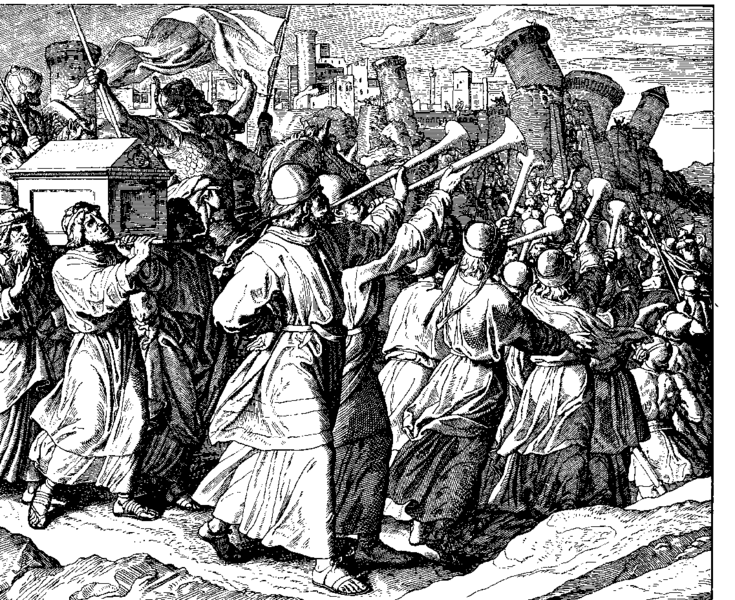
Gideon prepared his troops, but he actually had too many. The Lord told Gideon how to decide which of his troops were to go with him to battle. He brought the troops to get water. The men who lapped the water like a dog, were to go to battle. The men who cupped their hands to scoop up the water were released to go home. Only 300 men remained.5 Gideon’s men divided into three groups of 100 each. They carried empty jars, with torches inside the jars. They approached the Midianite army at night. As each group approached the outskirts of the camp they blew their trumpets and smashed the jars. The Midianites were in such confusion, that they fought and killed one another. Gideon continued to have success in fighting the Midianites. The Israelites wanted to make Gideon their king. Gideon refused, telling them the Lord would rule over them. Judges 8:23.
Gideon died. The Israelites relapsed and sinned. They worshiped false gods again. Abimelach wanted to be King of Israel. He was king of Israel for 3 years.
Several other men served as Judges of the Israelites. They continued cycles of falling into terrible sin, before crying out to God and being saved by him.
Discussion points: During the time of the Judges, the Israelites continued in their cycle of turning from God, suffering the consequences of rebellion; and finally returning to God. Why did the Israelites behave this way? Why did God continue to forgive their serious sins?
Psalms: Psalm 90:1 – 100:5
Proverbs: Proverbs 13:24 – 14:12
Themes and stories: Jesus warned about being vigilant for His return.
Judas Iscariot, under the influence of Satan, and the lure of cold hard cash, agreed to betray Jesus to the religious leaders.
Jesus and his disciples met for their Passover meal. The “last supper.” Jesus said to them,
[15] …”I have earnestly desired to eat this Passover with you before I suffer; [16] for I say to you, I shall never again eat it until it is fulfilled in the kingdom of God.” [17] And when He had taken a cup and given thanks, He said, “Take this and share it among yourselves; [18] for say to you, I will not drink of the fruit of the vine from now on until the kingdom of God comes.” [19] And when He had taken some bread and given thanks, He broke it and gave it to them, saying, “This is My body which is given for you; do this in remembrance of Me.” [20] And in the same way He took the cup after they had eaten, saying, “This cup which is poured out for you is the new covenant in My blood…” Luke 22:15-20 (NASB)
This disciples argued amongst themselves as to which one of them was the greatest. Jesus told them that what makes a person great is that person’s service to others.
Jesus predicted to Peter that he would deny him three times before the rooster crowed in the morning. Then Jesus went to the garden at the Mount of Olives to pray. He prayed with such fervor that he sweat great drops of blood. His disciples were supposed to be standing guard. They fell asleep.
Suddenly a crowd appeared, with Judas Iscariot leading them. They had come to arrest Jesus. One of Jesus’ followers struck the servant of the high priest with a sword, lopping off his ear. Jesus stopped the violence. He also healed the man who’d lost his ear. Jesus asked those who had come to arrest him why they hadn’t arrested him in the light of day, as He was always in the Temple. It was a rhetorical question.
They took Jesus to the high priest’s house. Peter denied Jesus three times before the rooster crowed. As predicted. The men who held Jesus mocked Him and beat him.
The religious leaders questioned Jesus. They asked him if he was the son of God. Jesus answered, “You say that I am.” The religious leaders wanted to kill Jesus, but the law forbade it. Only the Romans could execute a man. So they sent him to the Roman governor, Pontius Pilate.
Pontius Pilate found no crime to have been committed by Jesus. When Pilate heard Jesus was from Galilee, he sent him to the Herod–a Jew who assisted as nominal leader of the Jews in Galilee, under the Romans.
Herod questioned Jesus, but Jesus would not respond. Herod sent Jesus back to Pilate. Before this day, Herod and Pilate were enemies, but this day they became friends.
Pilate said again that Jesus had committed no crime. He offered to have Jesus flogged and released. But the Jewish crowd shouted to crucify Jesus. The mob wanted the criminal, Barabbas (in jail for insurrection and murder), released instead. Pilate released Barabbas, and sent Jesus to be crucified.
After having been beaten and flogged, Jesus was too weak to carry his cross. A man passing by, Simon of Cyrene, was pressed by the guards to carry the cross for Jesus.
They took Jesus to a place called “The Skull,” where he was crucified between two criminals. One of the criminals mocked Jesus. The other showed compassion. Jesus said to him, “Truly, I say to you, today you will be with me in Paradise.”
Jesus died on the cross. He was buried in a tomb, borrowed from Joseph of Arimathea.
Jesus rose from the dead on the third day, Sunday.
Some of the women went to the tomb, intending to use spices on Jesus’ body. But the large stone that sealed the grave was rolled away, and the tomb was empty. Suddenly two men in dazzling clothes stood beside the women. The men said to them, “Why seek ye the living among the dead? He is not here, but is risen.” Luke 24:5-6.
When the women returned from the tomb, they told the eleven remaining apostles. They considered the news a tall tale, and did not believe it. Peter, however, ran to the tomb. He was amazed to see the burial clothes were all that remained in the empty tomb.
Two of the Jesus’ followers were walking on a road to a village called Emmaus. Jesus, walked along with them, though they did not recognize him. When they stopped for dinner, they recognized Jesus. These men returned to Jerusalem within the hour to seek out the eleven apostles, and to tell them that Jesus had indeed risen from the dead.
Later, Jesus appeared to the apostles as they met behind locked doors.
[44] Then [Jesus] said to them, “These are my words which I spoke to you, while I was still with you, that everything written about me in the law of Moses and the prophets and the psalms must be fulfilled.” [45] Then he opened their minds to understand the scriptures, [46] and said to them, “Thus it is written, that the Christ should suffer and on the third day rise from the dead, [47] and that repentance and forgiveness of sins should be preached in his name to all nations, beginning from Jerusalem. [48] You are witnesses of these things. [49] And behold, I send the promise of my Father upon you; but stay in the city, until you are clothed with power from on high.” Luke 24:44-49 (RSV)
Jesus led his followers out to Bethany. Jesus blessed them, as he ascended into Heaven.
Discussion points: Jesus was tried during the day. The crowd shouted to crucify him during the day. And Jesus was crucified in a public place during daylight. So why did the Jewish Leaders have Jesus arrested at night?
The discussion notes ( PDF / TEXT ) for breakfast on Saturday, April 30, 2011 are now online — ”OBEDIENCE -or- ‘Under Cover of Darkness’”. Our Old Testament readings show God’s people in a cycle of disobedience and sin and repentence. Some things never change. Discussion verses: Judges 10:6-16 and Luke 22:47-53
A women’s study group meets in Davie, FL on the 2nd Friday morning of the month. Contact Janet Truex, or use the Contact tab at CONTACT form on ReadTheWholeBible.COM.