1

One Year Bible Challenge, Week 6

bible

Week 6

February 5 to 11, 2011[1. The notes, summaries and points on this page are intended as bookmarks of important matters which are covered in this week’s readings. They are not intended as complete summaries of readings. Please forgive me if some of my summaries are not 100% on point. Read the manual–i.e. Bible–so that you will get a more clear understanding of the material. Thank you.
–Tom Truex]

This is the “One Year Bible Challenge:” to read the entire Bible in one year. Assuming a normal reading level, this can be done by spending about 10-15 minutes per day, each and every day. See ReadTheWholeBible.COM for more information. If you would like details so you can join us, or if you have any other questions, please call Tom Truex. Or send an email by using the CONTACT form on K-Line.ORG.

OLD TESTAMENT READINGS: Exodus 21:22-33:23

Themes and stories: God gives Moses more laws. Some of the laws deal with stealing, carelessness or damaging the property of another. Then there’s the rule about having to to pay the bride-price for enticing a virgin who is not betrothed, to have sex with you. The bride price is paid to the father. Sounds like an odd rule by today’s standards. You might even be inclined to object on the ground that the woman is dealt with as little more than property. But consider the position of the virgin who had been “enticed.” Her chances of being married to another, were now greatly diminished, and society held no place for a single woman. Adam Clarke says:

This was an exceedingly wise and humane law, and must have operated powerfully against seduction and fornication; because the person who might feel inclined to take the advantage of a young woman knew that he must marry her, and give her a dowry, if her parents consented; and if they did not consent that their daughter should wed her seducer, in this case he was obliged to give her the full dowry which could have been demanded had she been still a virgin.

God gives laws letting the land rest every seven years. God instructs the Israelites to maintain three annual feasts: Feast of the Unleavened Bread, Feast of Harvest; and Feast of Ingathering. The Israelites promised to follow all of God’s laws.

Moses went up the mountain for forty days and forty nights. God told Moses about offerings for the Sanctuary. God describes the construction of the Ark. The Ark was a chest, overlaid with gold, in which the two tablets of the law were to be kept. The size was actually about three feet nine inches in length, two feet three inches in breadth.

Next, God gives Moses instructions on how to make the Tabernacle, including it’s altar and the court. It’s a really, really fancy tent where the Israelites could worship God. The Tabernacle was constructed to be taken down and moved, as the Israelites moved.

God also gave specific instructions on the clothing of the priests. Again, very fancy. In fact, these garments made liberal use of valuable gemstones and gold. Next God gave instructions on the dedication of the priests. The Israelites used blood sacrifice. They started with a bull as a sin offering, and continued with other animal sacrifices. God directed that these sacrifices continue through future generations.

God also gave instructions on how to prepare the altar for worship. God told Moses again to rest on the Sabbath. The penalty for profaning the Sabbath was death. This was a sign between God and the Israelites, reminding them how God had made the world in 6 days, and rested on the 7th day. When God finished speaking with Moses, he gave him two tablets of stone, “written with the finger of God.”
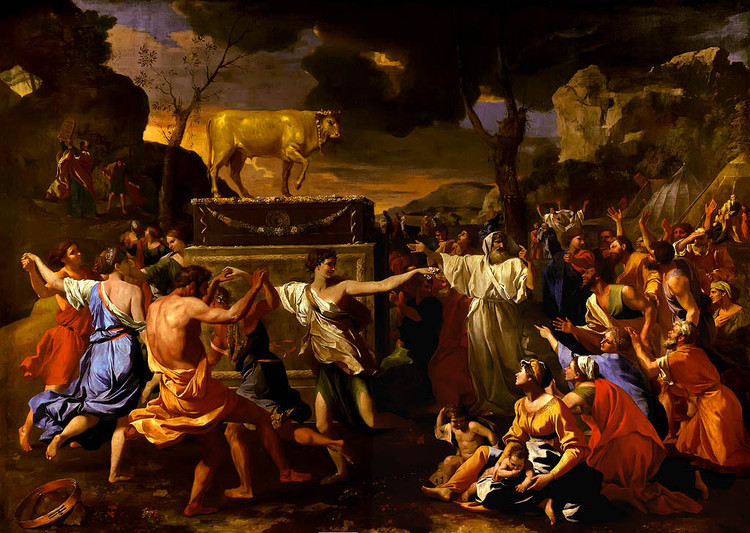
Nicolas Poussin (1594-1665) -- The Adoration of the Golden Calf
While the Israelites were waiting for Moses to return from talking with God, they built an image of a golden calf to worship. This was a serious violation of God’s first and second Commandments – (I) “Thou shalt have no other gods before me;” and (II) “Thou shalt not make unto thee any graven image, or any likeness of any thing that is in heaven above, or that is in the earth beneath, or that is in the water under the earth.” Moses was so mad when he saw this false idol that he threw the tablets God had given him, breaking them at the foot of the mountain. “And he took the calf which they had made, and burnt it with fire, and ground it to powder, and scattered it upon the water, and made the people of Israel drink it.” Exodus 32:20 (RSV)

Moses plead with God to forgive the Israelites for making gods of gold. God sent a plague, as punishment.
Discussion points: What was the purpose of the blood sacrifices in Exodus 29? Why don’t Jews or Christians still sacrifice animals on an altar?
Psalms: Psalm 29:1-33:11
Proverbs: Proverbs 7:6-8:36

NEW TESTAMENT READINGS: Matthew 24:1-27:14

Themes and stories: Jesus tells about the future. Specifically, the destruction of the Temple, the end of the age, persecu­tion, a great tribulation and the coming of the son of man. Jesus cautions that we do not know when he will return. Not even the angels in heaven know when he will return. (Hint: be ready for Jesus’ return ANY time—because you want to be prepared for that day.)
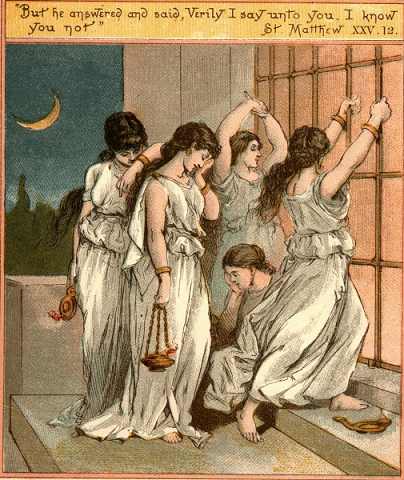
parable of the 10 virgins
Jesus tells the parable of the ten virgins. Five of them didn’t have enough oil in their lamps as they waited for the bridegroom. They were shut out of the wedding banquet.

Jesus told another parable about loaned money (“the parable of the talents”). The servant who was loaned the most money invested it and made the greatest profit for his master. But the man who was lent a small amount was fearful and buried his money. He made NO profit. Upon his return, the master praised the servants who made him a profit. But he was angry with the man who made him no profit. The master cast this “servant into outer darkness: there shall be weeping and gnashing of teeth.”

Jesus tells about the final judgment. He also says that how we treat the least “important” people is how we are treating Him.

A woman anointed Jesus with some very expensive perfume. The disciples denounced the “waste.” Jesus responds that she is preparing him for his earthly death and burial. Judas betrays Jesus for thirty pieces of silver.

Jesus and the disciples ate their “last supper” together. They did not all sit on the same side of the table. Jesus said to them:

[26] Now as they were eating, Jesus took bread, and blessed, and broke it, and gave it to the disciples and said, “Take, eat; this is my body.” [27] And he took a cup, and when he had given thanks he gave it to them, saying, “Drink of it, all of you; [28] for this is my blood of the covenant, which is poured out for many for the forgiveness of sins. [29] I tell you I shall not drink again of this fruit of the vine until that day when I drink it new with you in my Father’s kingdom.”

Jesus predicts that Peter will deny him three times “before the cock crows.” Peter says he would die before he denies Jesus even once.

Jesus goes in the night to pray in the garden called Gethsemane. The disciples can’t stay awake for even a short period of time as Jesus goes off to pray. Judas brings the guards to arrest Jesus. Judas identified Jesus with a kiss. Be careful who you kiss. As the guards moved to arrest Jesus, one of the disciples drew a sword and whacked off the ear of the slave of the High Priest. Jesus disapproved of the sword play, but asked why they had come to arrest him under the cover of darkness. Jesus’ disciples all ran away.

Jesus was taken to the High Priest, Caiaphas. Jesus was accused of blasphemy. Meanwhile, Peter was sitting outside in the courtyard, of the place where Jesus was taken. Peter denied he was with Jesus. He denied Jesus three times before the cock crowed, just as Jesus has predicted.

In the morning the religious leaders condemned Jesus. They plotted Jesus’ execution. But as the religious leaders had no legal authority to execute Jesus, they sent him to the Roman Governor. Pontius Pilate.

Judas showed remorse and tried to give the thirty pieces of silver he’d earned by betraying Jesus, back to the religious leaders. Judas threw the money at the religious leaders, and went off to hang himself. They couldn’t put the money back into the treasury because it was blood money. Instead they used the silver to buy a “potter’s field” as a burial place for strangers.

Jesus was brought before Pontius Pilate to stand trial. Legal rights and rules of procedures were different in those days.

Discussion points: Both Judas and Peter denied Christ. How and why did the consequences of their sins differ so completely?

REVIEW / STUDY QUESTIONS:
  • Why did God institute the law “eye for eye, tooth for tooth, hand for hand, foot for foot, burn for burn, wound for wound, bruise for bruise;” and does this rule still apply to Christians today? (Exodus 21:24-25. See also, Matthew 5:38-48)
  • Why was there a curtain inside the Tabernacle? (Exodus 26:31-33)
  • Why would Judas want to betray Jesus? (Matthew 26:14-15)
DISCUSSION POINTS AND VERSES — Christian Men’s Breakfast only[2. Subject to change.]

The discussion notes ( PDF / TEXT ) for breakfast on Saturday, February 12, 2011 are now online — ”BLOOD”. Judas betrayed Jesus for 30 pieces of silver. Peter denied Jesus three times in one night. Why were the consequences of their sins so different? Discussion verses: Exodus 29:10-22 and Matthew 27:1-10

FOOTNOTES


Christian Mens Breakfast, February 12, 2011

The discussion notes ( PDF / TEXT ) for breakfast on Saturday, February 12, 2011 are now online — ”BLOOD”. Judas betrayed Jesus for 30 pieces of silver. Peter denied Jesus three times in one night. Why were the consequences of their sins so different? Discussion verses: Exodus 29:10-22 and Matthew 27:1-10


One Year Bible Challenge, Week 5

bible

Week 5

January 29 – February 4, 2011[1. The notes, summaries and points on this page are intended as bookmarks of important matters which are covered in this week’s readings. They are not intended as complete summaries of readings. Please forgive me if some of my summaries are not 100% on point. Read the manual–i.e. Bible–so that you will get a more clear understanding of the material. Thank you.
–Tom Truex]

This is the “One Year Bible Challenge:” to read the entire Bible in one year. Assuming a normal reading level, this can be done by spending about 10-15 minutes per day, each and every day. See ReadTheWholeBible.COM for more information. If you would like details so you can join us, or if you have any other questions, please call Tom Truex. Or send an email by using the CONTACT form on K-Line.ORG.

OLD TESTAMENT READINGS: Exodus 8:1-21:21

Themes and stories:

Pharaoh won’t let the Israelites leave Egypt, so God sent a series of plagues upon Egypt. In each case, Moses warned Pharaoh of the impending plague and asked for Pharaoh to let the Israelites leave. These were the Plagues:

I. Blood: The Nile River, sole water supply for Egypt, turned to blood. The fish died. The river stank.

II. Hordes of frogs: Frogs invaded the Egyptians homes, beds, and food. They were everywhere.

III. Gnats: The “dust of the earth turned into gnats.”

IV. Swarms of flies: Flies invaded the homes of Pharaoh and his officials. In all of Egypt the land was ruined because of the flies.

V. Livestock destroyed: All the livestock of the Egyptians died, but of the livestock of the Israelites, not one died.

VI. Boils: “Moses threw [ashes] in the air, and it caused festering boils on humans and animals,” which afflicted all the Egyptians.

VII. Thunder and Hail: Hail with fire flashing continually in the midst of it. The hail struck down everything that was in the open field throughout all Egypt, both human and animal. It also struck down every plant and shattered every tree. Only in the land of Goshen, where the Israelites resided, there was no hail.

VIII.Locusts: “Such a dense swarm of locusts as had never been before, nor ever shall be again.. They covered the surface of the whole land, so that the land was black. Nothing green on any plant or tree was left.

IX. Darkness: There was a dense darkness in Egypt for three days. The Israelites had light where they lived.

X. Death of the firstborn: The firstborn every family (including Pharaoh’s) and every animal died. The Israelites put the blood of a lamb on the door frames of their homes. The blood was a sign, so that when the Lord came to Egypt to strike down the firstborn of the Egyptians and their animals, He would passover the homes of the Israelites.

After the tenth plague, Pharaoh arose in the night and told Moses to leave. The Israelites left at once, not even waiting for the yeast in their bread to rise. The Israelites numbered about 6,000 men, not including their women and children, and a “mixed crowd.” An exact number of people in the group of people leaving Egypt with Moses is unknown, but is estimated by some to have been about two million. The “mixed crowd” may have included Egyptians who where impressed by God’s power.

God led the people by an indirect route through the wilderness so that it would be too hard for the Israelites to change their minds and decide to go back to Egypt. God lead them by a pillar of cloud by day, and a pillar of fire at night. Pharaoh changed his mind, and decided to bring the Israelites back to him as his slaves. As Pharaoh approached, the Israelites were trapped between Pharaoh’s army and the sea. The people were mad at Moses, and told him they wished they’d never left Egypt in the first place.

At God’s command, Moses lifted his staff, and the Red Sea parted. The Israelites walked over the sea bed on dry ground. The Egyptians purused, but after the Israelites had crossed, the sea fell into place again. The Egyptian army drowned. Moses and the Israelites sang a song to God, celebrating their deliverance from bondage.

The Israelites complained to Moses because they had no food or water. God showed them to water. God provided quails for meat. He also gave them “manna” to eat: “it was like coriander seed, white, and the taste of it was like wafers, made with honey.” God provided the manna to the Israelites for forty years, until they left the dessert and entered the land of Canaan.

The Israelites moved, but had no water at their new camp. They complained to Moses. God provided water.

The Amalekites attacked the Israelites. Moses stood on top of a hill with his staff in his hand, while Joshua led the Israelites in battle. As long as Moses held up his hand, Israel prevailed. His hand grew weary, so they propped up his hand with a stone. The Israelites won the battle. Jethro visited Moses. Jethro advised Moses to appoint officials to help him rule the Israelites.

God gave Moses 10 Commandments for his people:

I. Thou shalt have no other gods before me.

II. Thou shalt not make unto thee any graven image, or any likeness of any thing that is in heaven above, or that is in the earth beneath, or that is in the water under the earth. Thou shalt not bow down thyself to them, nor serve them: for I the LORD thy God am a jealous God, visiting the iniquity of the fathers upon the children unto the third and fourth generation of them that hate me; And shewing mercy unto thousands of them that love me, and keep my commandments.

III. Thou shalt not take the name of the LORD thy God in vain; for the LORD will not hold him guiltless that taketh his name in vain.

IV. Remember the sabbath day, to keep it holy. Six days shalt thou labour, and do all thy work: But the seventh day is the sabbath of the LORD thy God: in it thou shalt not do any work, thou, nor thy son, nor thy daughter, thy manservant, nor thy maidservant, nor thy cattle, nor thy stranger that is within thy gates: For in six days the LORD made heaven and earth, the sea, and all that in them is, and rested the seventh day: wherefore the LORD blessed the sabbath day, and hallowed it.

V. Honour thy father and thy mother: that thy days may be long upon the land which the LORD thy God giveth thee.

VI. Thou shalt not kill.

VII. Thou shalt not commit adultery.

VIII. Thou shalt not steal.

IX. Thou shalt not bear false witness against thy neighbour.

X. Thou shalt not covet thy neighbour’s house, thou shalt not covet thy neighbour’s wife; nor his manservant, nor his maidservant, nor his ox, nor his ass, nor any thing that is thy neighbour’s.

Discussion points: What is a “hardened heart?” And why did Pharaoh have one? Exodus 14:1-4
Psalms: Psalm 24:1-28:9
Proverbs: Proverbs 6:1-7:5

NEW TESTAMENT READINGS: Matthew 19:13-23:39

Themes and stories:

Let the children
'Let the children come to me' -- Vogel Von Vogelstein (German, 1788-1868)
Jesus blessed little children. “[13] Then children were brought to him that he might lay his hands on them and pray. The disciples rebuked the people; [14] but Jesus said, ‘Let the children come to me, and do not hinder them; for to such belongs the kingdom of heaven.’” Matthew 19: 14-15 (RSV).

Jesus spoke to the rich young ruler. The young man was sad when Jesus told him to sell his possessions, and give the money to the poor, because the man was wealthy. Some things never change. Jesus told his disciples that it is hard for a rich man to enter the kingdom of heaven.

Jesus tells another parable which he compares to the kingdom of heaven: Workers are hired throughout the day, yet even those hired at the end of the day still receive a full day’s wages. The parable concludes with the observation:  [16] “So the last shall be first, and the first last.” Matthew 20:16 (NASV). Jesus continues to teach. Jesus rides into Jerusalem on a donkey. Palm Sunday. “[8] Most of the crowd spread their garments on the road, and others cut branches from the trees and spread them on the road. [9] And the crowds that went before him and that followed him shouted, “Hosanna to the Son of David! Blessed is he who comes in the name of the Lord! Hosanna in the highest!” Matthew 21:8-9 (RSV).

Jesus throws the people out of the Temple who were dishonestly buying and selling for Temple business. Jesus continues to teach. “[22] And whatever you ask in prayer, you will receive, if you have faith.” Matthew 21:22 (RSV). The religious leaders challenge Jesus authority again. Jesus continues to teach in parables: the Two Sons; the wicked farmers; and the wedding feast. The religious leaders try to trap Jesus about whether the Jews should pay taxes. He tells them, “Render therefore unto Caesar the things which are Caesar’s; and unto God the things that are God’s.” Matthew 21:22 (KJV).

Jesus answers a question from other religious leaders about the greatest commandment: [37] “You shall love the Lord your God with all your heart, and with all your soul, and with all your mind. [38] This is the great and first commandment. [39] And a second is like it, You shall love your neighbor as yourself. [40] On these two commandments depend all the law and the prophets.” Matthew 22:37-40 (RSV).

Jesus condemns the religious leaders. He says, “Woe to you, scribes and Pharisees, hypocrites! For you are like whitewashed tombs, which on the outside look beautiful, but inside they are full of the bones of the dead and of all kinds of filth.” Matthew 23:27 (NRSV).

Discussion points: Is it “fair” for the man who worked a full day to receive only a day’s wage, when that’s the same pay received by the worker who worked only a short time at the very end of the day? Matthew 20:1-16. How does this story relate to the kingdom of heaven?

REVIEW / STUDY QUESTIONS:
  • What were the 10 Plagues that God used against Pharaoh and the Egyptians?
  • What does “Passover” mean?
  • What are the Ten Commandments?
  • Jesus tells the Rich young man to sell all of his possessions (Matthew 19:21). Does this mean that having possessions is bad?
  • Why did Jesus drive out all who were buying and selling in the Temple? (Matthew 21:12-13)
  • What did Jesus say are the first and second most important Commandments? (Matthew 22:34-40)
DISCUSSION POINTS AND VERSES — Christian Men’s Breakfast only[2. Subject to change.]

The discussion notes ( PDF / TEXT ) for breakfast on Saturday, February 5, 2011 are now online — ”Life’s Not Fair”. This week we’ll take a quick look at the Exodus. We’ll also look at the “Parable of the Laborers in the Vineyard.” It turns out that children aren’t the only ones who complain when life (or God) isn’t treating them fairly. In fact, as we see, this behavior has been going on for thousands of years. Discussion verses: Exodus 14:1-4 and Matthew 20:1-16

FOOTNOTES