One Year Bible Challenge, Week 11

Week 11
March 12 to 18, 2011[1. The notes, summaries and points on this page are intended as bookmarks of important matters which are covered in this week’s readings. They are not intended as complete summaries of readings. Please forgive me if some of my summaries are not 100% on point. Read the manual–i.e. Bible–so that you will get a more clear understanding of the material. Thank you.
–Tom Truex]
This is the “One Year Bible Challenge:” to read the entire Bible in one year. Assuming a normal reading level, this can be done by spending about 10-15 minutes per day, each and every day. It is NOT TOO LATE to join the Challenge! Start with today’s reading and keep reading with us through the end of this year. You’ll have to read a bit more at the beginning of next year to finish. See ReadTheWholeBible.COM for more information. If you would like details so you can join us, or if you have any other questions, please call Tom Truex. Or send an email by using the CONTACT form on K-Line.ORG.
Themes and stories: [Last week, in Numbers 16, a group of rebels lead by Korah, tried to get more power. They argued that Moses was no better than them—so why should he be in charge? God punished the Israelites who had rebelled against Moses by swallowing them up in a giant “sinkhole.”]
More of the Israelites rebelled against Moses. As punishment for their latest rebellion against Moses, God killed 14,700 more rebels in a plague.
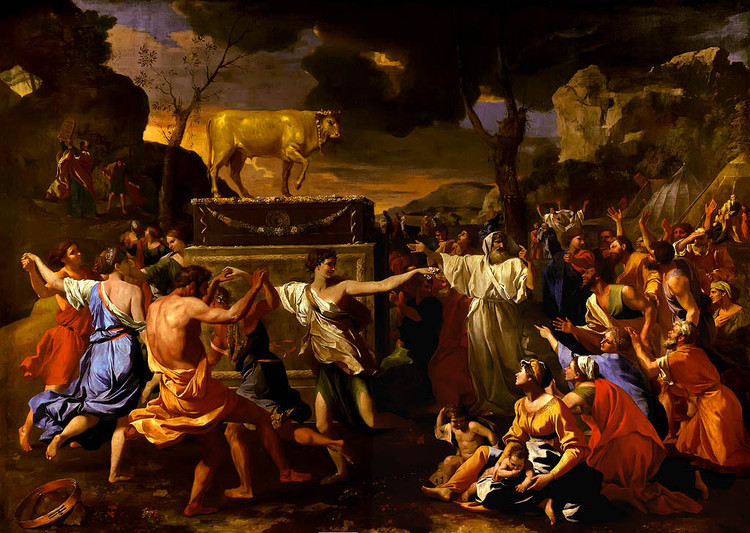
God told Moses how to stop these pointless rebellions against Moses’ (and God’s) authority. Each one of the twelve ancestral houses of the Israelites was to write its name on a staff, and put the staff in the Tabernacle. The next day, all of the staff’s remained dead wood, except for Aaron’s staff, which represented the Levites. His staff was as a living branch. Overnight, it had sprouted buds, blossoms, and bore ripe almonds (Numbers 17:1-11). This was a sign to the other groups, confirming that the Levites were to remain in charge of the Tabernacle.
God further directed that the Levites, and no one else, should perform the duties of the priests. The Levites were to receive a portion of the offerings in the Tabernacle for their upkeep.
God directed that a red heifer, without defect, be sacrificed. God gave directions for purification after touching a dead human’s body.
We don’t know much about the next 37 years as the Israelites wandered in the wilderness. Numbers 20 picks up about 40 years after the Exodus. The Israelites came to another place where they had no water. The Israelites complained to Moses again. Proving that history does repeat itself. Moses and Aaron went into the Tabernacle to pray. God told Moses to take his staff, assemble all of the Israelites and command water to come out of a rock. Moses did as God directed, except instead of simply commanding water to come out of the rock, Moses whacked the rock twice with his staff. Water came out of the rock. God was not pleased with Moses’ theatrical interpretation of his directions. God wants us to follow his instructions, not simply follow his rules as we see fit. Got viewed Moses deviation from His instructions as failure to trust Him. Because of his actions in this matter, God decreed that Moses would not be the person to lead the Israelites into the promised land. The punishment seems harsh. Not following God’s instructions is a serious matter.
Moses asked Kadesh, the King of Edom, if the Israelites could pass on the road through their country. Kadesh said no.
Aaron died at Mount Hor. Aaron’s priestly garments were taken and given to his son, Eleazar, who became the new high priest.

The Israelites continued to move/wander. They asked King Sihon of the Amorites, if they could pass through his lands. The King said no, and went out to defeat the Israelites in battle. Instead, the Israelites won the battle, killed the king and took his land. King Og of Bashan challenged the Israelites in battle too. The Israelites killed King Og and his sons. They took his land too.
By now, people who lived in the path of the Israelites were afraid. Moab said to the elders of Midian, “This horde will now lick up all that is round about us, as the ox licks up the grass of the field.”
Balak, King of Moab, sent for Balaam, to curse the Israelites. Balaam lived at some distance, but had a reputation which had traveled far. The nature and source of Balaam’s power has been debated. Apparently, Balaam had connections to occult practices. But he did have an understanding and belief in the God of the Israelites. God told Balaam not to go with Moab’s messengers. Balak sent more messengers. This time God allowed Balaam to go. God’s angel stood in the road to block Balaam’s path. Balaam couldn’t see the angel, but Balaam’s donkey could see the angel. The Donkey refused to proceed where the angel blocked their path. Balaam was angry, and beat the donkey. The donkey spoke to Balaam, asking why he was being beaten. Finally, God permitted Balaam to see the angel too. Balaam apologized to the angel for going with the men who wanted him to curse the Israelites. The angel told Balaam to go with the messengers, but to speak only according to the angel’s directions.
Balak was happy to see Balaam, when he finally arrived. Balaam explained that he would only say what God told him to say. The next day, Balak took Balaam out to curse the Israelites. Instead, Balaam listened to God and blessed the Israelites. Balak took Balaam to another location, and again asked Balaam to curse the Israelites. Instead, Balaam blessed the Israelites again.
The same thing happened a third time. Balak was angry with Balaam for blessing the Israelites a third time. Balaam was supposed to curse the Israelites, not bless them. Balaam blessed the Israelites a fourth time. Balak sent him home.
Meanwhile, the Israelite men were having sex with the local women of Moab. These women lead the men to worship their false god, Baal. Aaron’s grandson, Phinehas, took a spear and ran it through both an Israelite man and his Moabite woman. 24,000 died in a plague.
God told Moses to take another census of men, age 20 and older. There were 601,730 men, not including women and children. This is almost the same number as originally left Egypt in Exodus. God directed that in the future, land would be apportioned according to the size of the family group.
God gave Moses certain rules about inheritance. The issue was brought to him by the daughters of a deceased man who had no sons. The order of inheritance was: first to the son; but if no son, to the daughter; but if no sons or daughters, then to his brothers; but if none of these, then to his uncles; but if none of these, then to his nearest kin.
Moses followed God’s instructions and appointed Joshua to be his successor.
Psalms: Psalm 55:1-61:8
Proverbs: Proverbs 11:7-17
Themes and stories: [At the end of week 10, Jesus was placed in the tomb]
Easter. On Sunday morning, three women, “Mary Magdalene and Mary the mother of James and Salome bought spices, so that they might go and anoint [Jesus].” Mark 16:1 (ESV). They were concerned about who would roll away the stone from the entrance of the tomb so they could go about their task. But the large stone had already been rolled back. A young man in a white robe was sitting there, and told them not to worry. The young man said Jesus had been raised from the dead. The women fled in “terror and amazement.”
Jesus appeared again to Mary Magdalene and to others. Jesus appeared to the 11 disciples and rebuked them for their lack of faith, because they had not believed the reports that he had arisen. Jesus told them to go and proclaim the gospel to the whole world. After he spoke to the disciples, he was taken up into heaven and sat at the right hand of God. The disciples did go out and proclaim the good news everywhere, just as Jesus had instructed them.
Luke. The book of Luke begins again, before the birth of Jesus. A priest named Zechariah and his wife, Elizabeth had no children, but were getting older. As Zechariah was in the Temple performing his duties, the angel, Gabriel, appeared to him. The angel told him that his wife, Elizabeth would have a son. This son would be a great leader for God. Because Zechariah did not at first believe the angel, he was struck mute.
Later, the angel Gabriel appeared to the Mary. Gabriel told Mary she would conceive and bear a son named Jesus, though she was still a virgin.
Mary visited her cousin, Elizabeth (Zechariah’s wife). When Elizabeth saw Mary, the child leaped in her womb.
[41] And when Elizabeth heard the greeting of Mary, the babe leaped in her womb; and Elizabeth was filled with the Holy Spirit [42] and she exclaimed with a loud cry, “Blessed are you among women, and blessed is the fruit of your womb! [43] And why is this granted me, that the mother of my Lord should come to me? [44] For behold, when the voice of your greeting came to my ears, the babe in my womb leaped for joy. [45] And blessed is she who believed that there would be a fulfillment of what was spoken to her from the Lord.”
When Elizabeth’s son was born, he was named John. Zechariah could speak again after the infant, John, was named. Later, Zechariah prophesied that John would be a great prophet.
The Roman Emperor, Augustus, decreed that a census would be conducted, and that all the Jews had to return to their ancestral home town to be counted. Jesus and Mary were obliged to go to Bethlehem, even though she was about to have her baby. The town was so crowded when they arrived, that there was no room for them in an inn. Jesus was born in a type of stable, and was placed in a manger for a bed. An angel appeared to shepherds in the field, and told them the Messiah had been born. They went to Bethlehem to see Jesus. After eight days, Jesus was taken to the Temple to be circumcised, according to Jewish custom.
A righteous man named Simeon was in the Temple. The Holy Spirit had told Simeon that the Messiah would appear to him before he died. Simeon recognized Jesus as the Messiah.
When Jesus was 12 years old, he traveled with his parents and a large group of people to Jerusalem for the festival Passover. Jesus was separated from his parents. At this age, Jesus might have been expected to travel with either the women and children, or with the men. They were with such a large group, that each parent thought he was with the other. Mary and Joseph traveled a day, before they realized Jesus was not with them. They returned to Jerusalem and found him in the temple. Everyone was amazed at Jesus’ level of understanding of the the topics taught and discussed in the Temple.
John the Baptist. When John grew into a man, he came out of the wilderness and began proclaiming a baptism of repentance for the forgiveness of sin. Crowds came to be baptized. Some of the people thought John might be the messiah. He told them someone much greater than him would follow.
John rebuked the Jewish leader, Herod, because Herod’s wife was actually the wife of his brother. Herod had John arrested.
A women’s study group meets in Davie, FL on the 2nd Friday morning of the month. Contact Janet Truex, or use the Contact tab at CONTACT form on ReadTheWholeBible.COM.