One Year Bible Challenge, Week 20

bible

Week 20

May 14 – 20, 20111

This is the “One Year Bible Challenge:” to read the entire Bible in one year. Assuming a normal reading level, this can be done by spending about 10-15 minutes per day, each and every day. It is NOT TOO LATE to join the Challenge! Start with today’s reading and keep reading with us through the end of this year. You’ll have to read a bit more at the beginning of next year to finish. See ReadTheWholeBible.COM for more information. If you would like details so you can join us, or if you have any other questions, please call Tom Truex. Or send an email by using the CONTACT form on K-Line.ORG.

OLD TESTAMENT READINGS: 1 Samuel 15:1 – 28:25

Themes and stories: Samuel told Saul to slaughter the people of Amalek. Kill every man, woman, child, infant, livestock, (and presumably cats and dogs.) Saul mustered an army and killed the Amalekites. However, Saul spared their king, Agag, as well as some of the sheep and cattle. God does not like it when people do not follow his instructions. Samuel went to Saul to make inquiry. Saul told Samuel that he had saved some of the cattle to sacrifice to God. Samuel responded, “Surely, to obey is better than sacrifice.” 1 Samuel 15:22 (NRSV). By way of emphasizing the point, Samuel had King Agag, King of the Amalekites brought before him. Samuel hacked Agag to death with his sword.

God told Samuel to anoint, as the next king of Israel, one of Jesse’s sons. God did not tell Samuel which one of Jesse’s son was to be king, so Samuel went to interview them. But the LORD said to Samuel, “Do not look on his appearance or on the height of his stature, because I have rejected him; for the LORD sees not as man sees; man looks on the outward appearance, but the LORD looks on the heart.” 1 Samuel 16:7 (RSV).

Samuel passed over Jesse’s first 7 sons and anointed the youngest, David; “and the Spirit of the LORD came mightily upon David from that day forward.” 1 Samuel 16:13 (RSV).

After David was anointed, “the spirit of the Lord departed from Saul, and an evil spirit from the Lord tormented him.” 1 Samuel 16:14 (NRSV). David entered service with Saul to play the lyre to sooth Saul when the evil spirit from the Lord was upon him. David was also Saul’s armor-bearer.
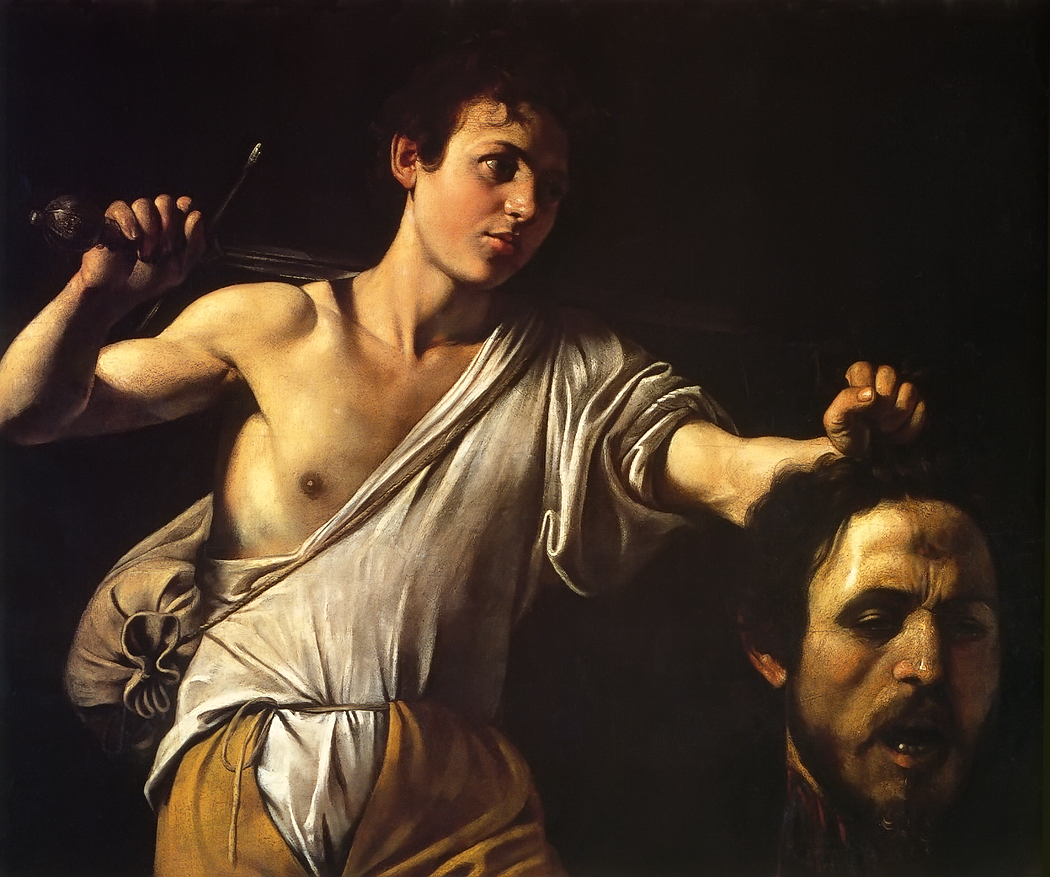
David with Goliaths Head, by Michelangelo Caravaggio
Next is the story of David and Goliath, most of which is well known to even small children. Goliath was a giant in the Philistine’s army. He stood over 9 feet tall. As the Philistine’s army drew near the Israelite’s army, Goliath went out to taunt his adversaries, twice every day. He proposed that rather than a battle between the armies, that he (Goliath) would fight one of the Israelite’s soldiers. And to the victor of this mortal combat, would go the spoils for battle as if the entire armies had fought. Apparently, this was a common arrangement. Goliath made this challenge for more than 40 days. None of the Israelite’s had the courage to take the giant’s challenge. Finally David, who was still a shepherd boy, offered to fight Goliath. David realized what others had overlooked—that he would not be fighting alone. God would be fighting with him. David said, “The LORD who delivered me from the paw of the lion and from the paw of the bear, will deliver me from the hand of this Philistine.” 1 Samuel 17:37 (RSV). Saul offered David his armor to use in battle against Goliath. But the armor was too heavy for the boy. David took only his staff, five smooth stones and a sling. David and Goliath approached each other for battle. They traded insults. David slung a single stone from his sling to Goliath’s forehead. Goliath dropped dead. By way of insuring Goliath’s death, David drew out the giant’s sword and cut his head off. Instead of submitting to the Israelite’s as their conquerors, the Philistines ran away. So much for a deal. The Israelite’s slaughtered the Philistines as they fled.

As they were returning home from their victory, women came out to greet the Israelite’s army, playing musical instruments and singing,

“Saul has slain his thousands,
And David his ten thousands.”
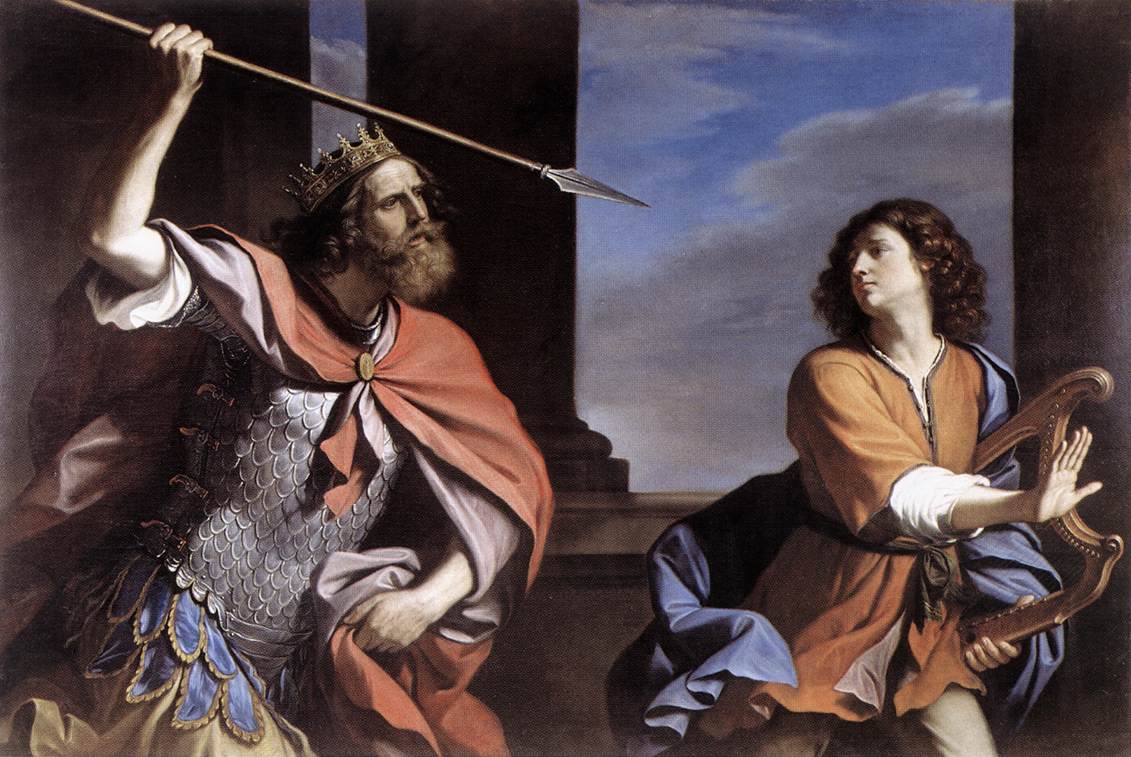
Saul Attacking David, by Giovanni Francesco Barbieri (1591 – 1666)
Saul felt slighted by the numerical comparison. The next day, an evil spirit from God rushed upon Saul. David was summoned to play his lyre. Saul tried to stab David with a spear, but David escaped twice. Saul made David commander over 1,000 men in his army. David had great military success, and all the Israelite’s loved him. Well, not quite all—Saul hated David.

Saul told David he would give him his eldest daughter, Merab, in marriage. But then he gave Merab to Adriel the Meholathite, to be married. Saul promised David another one of his daughters, Michal, as his wife. But as a wedding present, Saul demanded that David kill 100 Philistines, and bring Saul their foreskins as proof. Saul hoped the Philistines would kill David. But David complied with Saul’s demand, and married Michal. In fact, David’s troops continued to defeat the Philistines, every time they met on the battle field.

Saul spoke to his son, Jonathan, and his servants about killing David. Jonathan reported the death threat to David. The two were friends. Saul developed a plan to murder David. David’s wife (Saul’s daughter), Michal, helped David escape. Saul concocted another scheme to kill David, at a banquet. Saul’s son, Jonathan, helped David escape this time.

David fled to Gath. If this town sounds familiar, it was the hometown of Goliath, who David killed years earlier. One can presume that the current inhabitants of Gath must have forgotten the matter; although David must have slept with one eye open, given his history with one of Gath’s favorite sons. David pretended to be crazy so that the King of Gath wouldn’t punish him.

Saul pursued David so that he could kill him. David was on the run. Samuel killed priests of the Lord who had assisted David in his escape. One day as Saul was pursuing David, Saul went into a cave to use it as a restroom. Little did Saul suspect that David and his men were hiding in that cave. David had a perfect chance to kill Saul in the dark, but he would not do so. David was loyal to Saul, even though Saul was trying to kill David. Saul gave up his pursuit of David when he found out that David had passed up a chance to kill him.

Later, Saul again decided to kill David. So, he again set out with his men to find and kill David. David sneaked up on Saul’s encampment at night. He had another chance to kill Saul, but did not do so. Saul gave up this plan to murder David, when he realized his life had again been spared.

David continued his raids on the Philistines, killing everyone as he went. The Philistines assembled as great army. Saul was very worried, but God gave him no direction. Although Saul had expelled almost all of the mediums and wizards, Saul decided to consult one now. His servants located a medium who had been overlooked. God was always clear in his condemnation of dabbling in the occult. You may recall the following examples:

  • Leviticus 19:31 (NASB)– “Do not turn to mediums or spiritists; do not seek them out to be defiled by them. I am the LORD your God.“
  • Leviticus 20:6 (NASB)- “As for the person who turns to mediums and to spiritists, to play the harlot after them, I will also set My face against that person and will cut him off from among his people.”
  • Leviticus 20:27 (NASB)- “Now a man or a woman who is a medium or a spiritist shall surely be put to death. They shall be stoned with stones, their bloodguiltiness is upon them.”
  • Deuteronomy 18:9-15 (NASB) – Spiritism Forbidden . [9] “When you enter the land which the LORD your God gives you, you shall not learn to imitate the detestable things of those nations. [10] “There shall not be found among you anyone who makes his son or his daughter pass through the fire, one who uses divination, one who practices witchcraft, or one who interprets omens, or a sorcerer, [11] or one who casts a spell, or a medium, or a spiritist, or one who calls up the dead. [12] “For whoever does these things is detestable to the LORD; and because of these detestable things the LORD your God will drive them out before you. [13] “You shall be blameless before the LORD your God. [14] “For those nations, which you shall dispossess, listen to those who practice witchcraft and to diviners, but as for you, the LORD your God has not allowed you to do so. [15] “The LORD your God will raise up for you a prophet like me from among you, from your countrymen, you shall listen to him.

The medium to whom Saul went for advice suspected a trap. Saul assured her he would do her no harm. As directed by Saul, the medium brought up the spirit of Samuel. The “ghost of Samuel” did not have good news for Saul:

1 Samuel 28:15-10 (RSV)
[15] Then Samuel said to Saul, “Why have you disturbed me by bringing me up?” Saul answered, “I am in great distress; for the Philistines are warring against me, and God has turned away from me and answers me no more, either by prophets or by dreams; therefore I have summoned you to tell me what I shall do.” [16] And Samuel said, “Why then do you ask me, since the LORD has turned from you and become your enemy? [17] The LORD has done to you as he spoke by me; for the LORD has torn the kingdom out of your hand, and given it to your neighbor, David. [18] Because you did not obey the voice of the LORD, and did not carry out his fierce wrath against Am’alek, therefore the LORD has done this thing to you this day. [19] Moreover the LORD will give Israel also with you into the hand of the Philistines; and tomorrow you and your sons shall be with me; the LORD will give the army of Israel also into the hand of the Philistines.”

Or, to put it another way, the “ghost of Samuel” assured Saul that Saul would be dead by the next day.

Discussion points: A medium consulted Samuel as demanded by Saul. Is this story proof that ghosts (i.e. the disembodied spirits of the dead) really do exist?
Psalms: Psalm 110:1 – 117:2
Proverbs: Proverbs 15:8 – 15:23

NEW TESTAMENT READINGS: John 8:1 – 11:54

Themes and stories: The scribes and Pharisees brought a woman to Jesus who’d been caught in the act of adultery. They asked Jesus what he thought they should do with her. If Jesus said to not stone her, they’d accuse him of violating Moses’ law. But if he said to stone her to death, they could report him to the Romans, who did not permit the Jews to carry out their own executions. Jesus said, “He that is without sin among you, let him first cast a stone at her.” John 8:7 (KJV). The accusers went away one by one, until only Jesus and the woman were left. John 8:10-11 (KJV). “[10] When Jesus had lifted up himself, and saw none but the woman, he said unto her, Woman, where are those thine accusers? hath no man condemned thee? [11] She said, No man, Lord. And Jesus said unto her, Neither do I condemn thee: go, and sin no more.” John 8:10-11 (KJV).

Jesus told his followers, “I am the light of the world; he who follows me will not walk in darkness, but will have the light of life.” John 8:12 (RSV). The Pharisees objected to his statement. Jesus retorted that God supported his views on the matter. Jesus also told the Jews who believed in him, “[31] …If you abide in my word, you are truly my disciples, [32] and you will know the truth, and the truth will set you free.” John 8:31-32 (ESV).

Jesus healed a man who had been blind from birth. When the religious leaders asked the formerly blind man what had happened, he told them how Jesus had given him sight. The leaders condemned Jesus for giving the man sight on the Sabbath. They called Jesus a sinner. But some of the bystanders wondered how a “sinner” could perform such a miracle. The leaders thought they could prove the man hadn’t been blind to begin with. They brought in the man’s parents. The parents acknowledged that their son was born blind, and that he could see now. But they were afraid to admit that Jesus had given him sight, lest they be expelled from the synagogue. The parents told the leaders to ask their son for themselves. He was an adult. So the son told them a second time that Jesus had given him sight. The formerly blind man told the leaders that God did not listen to sinners, and that Jesus must be working under the authority of God to have performed such a miracle. The religious leaders finally dismissed the man, saying he shouldn’t be lecturing them, since he was obviously “born entirely in sins.” John9:34 (NRSV). Jesus continued in his teaching about spiritual blindness and about “the good shepherd.” The religious leaders said Jesus blasphemed when he spoke of his relationship to his Father, God. Jesus left as they were at the point of arresting him.
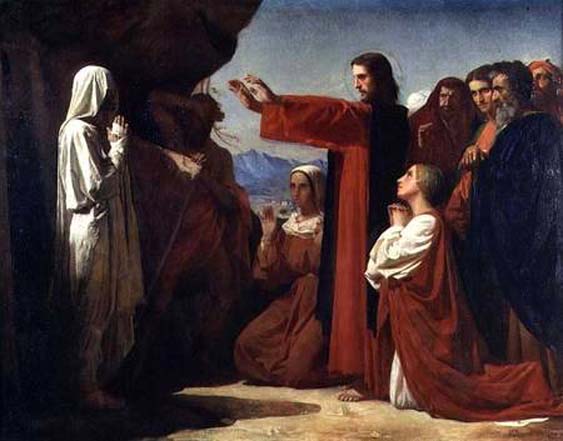
The Raising of Lazarus, 1857, by Léon Bonnat (1833 - 1922)
Jesus received word that his friend Lazarus (brother of Mary and Martha) was sick to the point of death. When Jesus received the news he said, “This illness is not unto death; it is for the glory of God, so that the Son of God may be glorified by means of it.” John 11:4 (RSV.) After hearing that Lazarus was ill, Jesus waited 2 more days before going to him. The disciples cautioned Jesus against going to the home of Lazarus, Martha and Mary. Jesus had only just escaped with his life, the last time he was in their neighborhood. But Jesus returned, finding that Lazarus had been dead and in his tomb for 4 days. Both Mary and Martha, felt that their brother, Lazarus, would not have died if Jesus had been there. Everyone was greatly distressed at the death of Lazarus. Jesus wept.

Jesus went to the tomb of Lazarus. He told the bystanders to take away the stone that sealed the entrance to Lazarus’ tomb. Martha protested that there would be a stench, 4 days after Lazarus’ death. But they obeyed Jesus’ instructions and moved the stone away from the entrance. Jesus cried out in a loud voice, “Lazarus, come forth.” John 11:43 (KJV.) “The dead man came out, his hands and feet bound with bandages, and his face wrapped with a cloth. Jesus said to them, ‘Unbind him, and let him go.'” John 11:44 (RSV).

Many more of the Jews believed in Jesus after they saw or heard how Lazarus had been raised from the dead. But the religious leaders were afraid that if Jesus became too popular it would result in the Romans destroying them.

John 11:49-53 – [49] But one of them, Ca’iaphas, who was high priest that year, said to them, “You know nothing at all; [50] you do not understand that it is expedient for you that one man should die for the people, and that the whole nation should not perish.” [51] He did not say this of his own accord, but being high priest that year he prophesied that Jesus should die for the nation, [52] and not for the nation only, but to gather into one the children of God who are scattered abroad. [53] So from that day on they took counsel how to put him to death.

And ironically, Caiaphas was correct in that Jesus did come to die for his people. Actually he came to die for the sins of the entire world.

Discussion points: The story of Lazarus is the second story in this week’s readings about a dead man being brought back from the grave. But how is the story of Lazarus DIFFERENT than the story of the medium who established contact with Samuel?

REVIEW / STUDY QUESTIONS:

Old Testament

  • Why didn’t David become king as soon as he was anointed?
  • Did either the Israelites or the Philistines intend to honor the agreement to let one combatant decide the fate of the entire army?
  • What was the evil spirit that tormented Saul?
  • Why did Saul consult a medium? Did he really talk to the ghost of Samuel?

New Testament

  • Why didn’t the religious leaders bring the man who had committed adultery to Jesus, as well as the woman.
  • Was Jesus breaking the 10 Commandments when he gave a man sight on the Sabbath?
DISCUSSION POINTS AND VERSES — Christian Men’s Breakfast only2

The discussion notes ( PDF / TEXT ) for breakfast on Saturday, May 21, 2011 are now online — ”Dead Men Talking”. This week we discuss two stories of dead men who are brought back to life from the grave. Or so it would seem. Discussion verses: 1 Samuel 28:15-19; John 11:1-44

WOMEN’S STUDY GROUP

A women’s study group meets in Davie, FL on the 2nd Friday morning of the month. Contact Janet Truex, or use the Contact tab at CONTACT form on ReadTheWholeBible.COM.

FOOTNOTES
  1. The notes, summaries and points on this page are intended as bookmarks of important matters which are covered in this week’s readings. They are not intended as complete summaries of readings. Please forgive me if some of my summaries are not 100% on point. Read the manual–i.e. Bible–so that you will get a more clear understanding of the material. Thank you.
    –Tom Truex
  2. Subject to change.

One Year Bible Challenge, Week 10

bible

Week 10

March 5-11, 20111

This is the “One Year Bible Challenge:” to read the entire Bible in one year. Assuming a normal reading level, this can be done by spending about 10-15 minutes per day, each and every day. It is NOT TOO LATE to join the Challenge! Start with today’s reading and keep reading with us through the end of this year. You’ll have to read a bit more at the beginning of next year to finish. See ReadTheWholeBible.COM for more information. If you would like details so you can join us, or if you have any other questions, please call Tom Truex. Or send an email by using the CONTACT form on K-Line.ORG.

OLD TESTAMENT READINGS: Numbers 4:1-16:40

Themes and stories: God continued to direct the specifics of the census of the divisions of the Levites. God described their duties relating to moving and reconstructing the Tabernacle as the Israelites moved from place to place. Only men in the Levite families who were aged 30 to 50 were qualified for Tabernacle work. The ages might be different now, since modern men are in much better physical condition at age 50, than in Bible times.

God told Moses to keep the unclean (leprous, contact with a dead body, etc.) outside of camp. God directed that if a man committed a wrong against another, he must pay restitution of full damages, plus 20%. God directed a procedure to determine if a women has committed adultery, in suspected cases where there was no proof. The particulars of the test are unclear today. The gist of the procedure was that God revealed to the priest whether the woman was guilty or not.

God gave rules to Moses for the Nazirites. Being a Nazirite required a commitment to refrain from drinking wine or other alcoholic drinks, and cutting one’s hair Nazirites could not touch a dead body, even if it was a relative.

God told Moses how they were to bless the Israelites (Numbers 6:24-26, RSV):

[24] The LORD bless you and keep you:
[25] The LORD make his face to shine upon you, and be gracious to you:
[26] The LORD lift up his countenance upon you, and give you peace.

The Israelites dedicated the Tabernacle. They presented an offering to God each day. It took twelve days. The Israelites celebrated their second Passover. Some of them were away during the passover, or were unclean from having touched a dead body. God let them celebrate Passover a month later. God directed Moses to have two silver trumpets made, for the purpose of various summons and signals to the Israelites.

According to God’s command, the Israelites broke camp and moved when the cloud moved from above the Tabernacle. The people complained. God was angry at their complaining and sent fire to burn some of the outlaying areas of the camp. Moses prayed to God for relief. The fire abated.

The “rabble among them” wanted meat to eat:

[4] The rabble who were among them had greedy desires; and also the sons of Israel wept again and said, ” Who will give us meat to eat?  [5] “We remember the fish which we used to eat free in Egypt, the cucumbers and the melons and the leeks and the onions and the garlic,  [6] but now our appetite is gone. There is nothing at all to look at except this manna.”  [7] Now the manna was like coriander seed, and its appearance like that of bdellium. [Number 11:4-7 (NASV)]

Manna had been fine when the Israelites were hungry and had nothing to eat. People are quick to forget God’s blessings. Some of them even complained they shouldn’t have left Egypt, where they had better food to eat. God was not pleased with their ingratitude, but He promised to give them meat:

 [19] ‘You shall eat, not one day, nor two days, nor five days, nor ten days, nor twenty days,  [20] but a whole month, until it comes out of your nostrils and becomes loathsome to you; because you have rejected the LORD who is among you and have wept before Him, saying, “Why did we ever leave Egypt?”‘”

God provided quails from the sea for the Israelites to eat.

God also sent a plague to kill the people who had been so greedy in their demands of Him.

Aaron and his sister, Miriam, complained about Moses wife, who was a Cushite woman. God gave Miriam leprosy as punishment. Moses begged God to forgive them for their bickering. God removed her leprosy after 7 days.

God told Moses to send out spies to explore the land of Canaan. Each tribe of the Israelites sent one man. After 40 days, the spies returned. The spies reported that Canaan was indeed a land that flowed with milk and honey. However the inhabitants were large, numerous and strong. The Canaanite’s towns were well fortified. Even their fruit was huge. A single cluster of grapes could only be carried on a pole, suspended between two men. Their raisin pies must have been really big and tasty. One of the spies, Caleb, recommended the Israelites go and conquer the land. But the other spies, excepting Joshua, were afraid to fight against the inhabitants of Canaan. Once again, the people bitterly complained:

[2] And all the people of Israel murmured against Moses and Aaron; the whole congregation said to them, “Would that we had died in the land of Egypt! Or would that we had died in this wilderness! [3] Why does the LORD bring us into this land, to fall by the sword? Our wives and our little ones will become a prey; would it not be better for us to go back to Egypt?” [4] And they said to one another, “Let us choose a captain, and go back to Egypt.” Numbers 14:2-4 (RSV).

God did not appreciate the Israelites ingratitude and lack of faith. Moses asked God not to destroy the Israelites. God did not destroy the Israelites, but he condemned them to wander in the wilderness for 40 years. Only Joshua and Caleb, who had remained faithful to God, would see their nation enter the promised land.

When the Israelites realized what they had done, they changed their minds, and wanted to enter the promised land. But by this time, they were too late. Moses told them to forget it. They could not prevail in taking the promised land unless God went with them. They had missed the opportunity that God had given them.

The Israelites caught a man violating the Sabbath by gathering sticks. They followed God’s law and stoned the man to death.

Some of the Israelites’ leaders rebelled against Moses. They were apparently jealous of his power. God opened up the ground beneath the troublemakers. It swallowed them up, together with their households.
Discussion points: Why did the Israelites refuse to go into the land of Canaan after Caleb and the other spies brought back their report?
Psalms: Psalm 48:1-54:7
Proverbs: Proverbs 10:26-11:6

NEW TESTAMENT READINGS: Mark 12:18-15:47

Themes and stories: Some of the Sadducees, who did not believe in the resurrection, tried to trick Jesus. They asked him a question about a widow, who married her late husband’s brother, according to law. She married each of the seven brothers in succession, as they each died. The Sadducees asked Jesus who she would be married to in heaven. Jesus told them, they were wrong and did not understand the scriptures nor the power of God. The rules on earth don’t work the same in Heaven. “He is not God of the dead, but of the living.”

Jesus taught about the two most important commandments:

[29] Jesus answered, “The first is, `Hear, O Israel: The Lord our God, the Lord is one; [30] and you shall love the Lord your God with all your heart, and with all your soul, and with all your mind, and with all your strength.’ [31] The second is this, `You shall love your neighbor as yourself.’ There is no other commandment greater than these.” Mark 12:29-31 (RSV)

Jesus also warned against the religious leaders who made a show of their religion, but actually were trying to benefit from their positions. A poor widow who gave a small amount to the Temple really gave more than most other people, because she gave all that she had.

Jesus warned about difficult times in the future. Jesus said he would return. He told the people to be ready for that day. We should be ready for Jesus’ return at all times, because no one, except God, knows when that day will be.

A woman anointed Jesus with a costly perfume. Some of the people scolded her for such a waste. The perfume could have been sold and the money given to the poor. Jesus responded:

[6] … “Let her alone; why do you trouble her? She has done a beautiful thing to me. [7] For you always have the poor with you, and whenever you will, you can do good to them; but you will not always have me. [8] She has done what she could; she has anointed my body beforehand for burying. [9] And truly, I say to you, wherever the gospel is preached in the whole world, what she has done will be told in memory of her.” Mark 14:12-9 (RSV).

Judas Iscariot went to the chief priest to betray Jesus. Jesus and his disciples gathered to eat at Passover. This was to be their last supper together. Jesus told the disciples that one of them would betray him. Jesus also broke bread and poured out wine for them saying, “Take; this is my body;” and “This is my blood of the covenant, which is poured out for many. Truly, I say to you, I shall not drink again of the fruit of the vine until that day when I drink it new in the kingdom of God.”

After the last supper, Jesus went to pray in the garden called Gethsemane. Peter, James and John went with. Jesus told them to stay awake, but they kept falling asleep. Jesus noted, “…the spirit indeed is willing, but the flesh is weak.”

The chief priests sent men with swords and clubs to arrest Jesus in the garden. Judas pointed Jesus out to them.

They took Jesus to Caiaphas, the high priest. They presented perjury against Jesus, but his accuser’s stories didn’t match up. Finally, Caiaphas asked Jesus if he was the Messiah. Jesus answered, “I am; and you will see the Son of man seated at the right hand of Power, and coming with the clouds of heaven.” Mark 14:62. The high priest had a fit. He accused Jesus of blasphemy because of this answer. Of course, Jesus’ answer would have been blasphemy, except that it was true.

Peter denied Jesus three times before the rooster crowed twice—just as Jesus had predicted.

The religious leaders turned Jesus over to the Romans. They wanted to kill Jesus, but the Roman law did not permit them to do so. The Roman Governor, Pontius Pilate, could find no crime committed by Jesus. There was a custom of releasing one prisoner at the Passover. Pilate, asked the mob if he should release Jesus or the criminal, Barabbas. Pilate gave them an opportunity to release Jesus. But the chief priests incited the mob into shouting to crucify Jesus. Pilate wanted to satisfy the mob, so he turned Jesus over to be crucified.

The Roman soldiers mocked Jesus and subjected him to great pain before leading Christ to be crucified on the cross. When Jesus, weakened by his pain, could not carry the cross, the Romans conscripted a passer-by, Simon of Cyrene, to carry the cross. They walked to the place called Golgotha, which means “the place of the skull.” The soldiers cast lots to divide up Jesus’ garments. They nailed Jesus on the cross at 9 o’clock in the morning, between two thieves. The inscription of the charge against him read, “The King of the Jews.” At noon, darkness fell.

At 3 pm Jesus cried out, “E’lo-i, E’lo-i, la’ma sabach-tha’ni?” which means, “My God, my God, why hast thou forsaken me?” Mark 15:34 (RSV). The Roman centurion who witnessed Jesus’ death recognized that Jesus was the Son of God. Pilate gave Joseph of Arimathea, a respected member of the Jewish Council, permission to take Jesus’ body. Joseph took Jesus’ body down from the cross, wrapped it in a linen cloth, and laid in a tomb hewn in the rock. A large rock was placed in front of the entrance to the tomb.

Discussion points: Why did Jesus say, “E’lo-i, E’lo-i, la’ma sabach-tha’ni?” which means, “My God, my God, why hast thou forsaken me?”

REVIEW / STUDY QUESTIONS:
  • Why were individuals deemed “unclean” to stay outside the Israelites’ camp?
  • Who were the Nazirites, and what role did they play Bible history?
  • What purpose what served by the two silver trumpets described in Numbers 10:1-10?
  • Why didn’t the Israelites what to go into Canaan, after receiving the spies’ report?
  • The Sadducees didn’t believe in the resurrection. So why were they asking Jesus about the widow who married 7 brothers in succession, after each one died?
  • In Mark 12:40, what is wrong with the scribes’ prayers?
  • What did Jesus mean when he said, “My God, my God, why have you forsaken me?”
DISCUSSION POINTS AND VERSES — Christian Men’s Breakfast only2

The discussion notes ( PDF / TEXT ) for breakfast on Saturday, March 12, 2011 are now online — ”Milk and Honey”. This week we read about the Israelites’ plans to enter the Land of Canaan. It didn’t go well for them. In the New Testament, we’ll discuss what Jesus meant when he said from the cross, “My God, my God, why hast thou forsaken me?” Discussion verses: Numbers 13:21 to 14:4; Mark 15:33-37. This week’s BACKGROUND is Wycliffe’s Bible.

WOMEN’S STUDY GROUP

A women’s study group meets in Davie, FL on the 2nd Friday morning of the month. Contact Janet Truex, or use the Contact tab at CONTACT form on ReadTheWholeBible.COM.

FOOTNOTES
  1. The notes, summaries and points on this page are intended as bookmarks of important matters which are covered in this week’s readings. They are not intended as complete summaries of readings. Please forgive me if some of my summaries are not 100% on point. Read the manual–i.e. Bible–so that you will get a more clear understanding of the material. Thank you.
    –Tom Truex
  2. Subject to change.

Christian Mens Breakfast, Saturday, December 11, 2010

The discussion notes ( PDF / TEXT ) for breakfast on Saturday, December 11, 2010 are now online — ”A Bird’s Eye View of the New Testament”. This week we take on the impossible task of reviewing the New Testament in 60 minutes. Actually, we are hitting only the high points of who wrote the New Testament and when. Any by the way, how did it get to be the New Testament anyway??? Study verses: Acts 3:1-10 and Acts 4:5-21.

If you would like details so you can join us, or if you have any other questions, please call Tom Truex. Or send an email by using the CONTACT form on K-Line.ORG.

image_pdfimage_print