Christ the Rock Community Church, Saturday Morning Men’s Bible Study
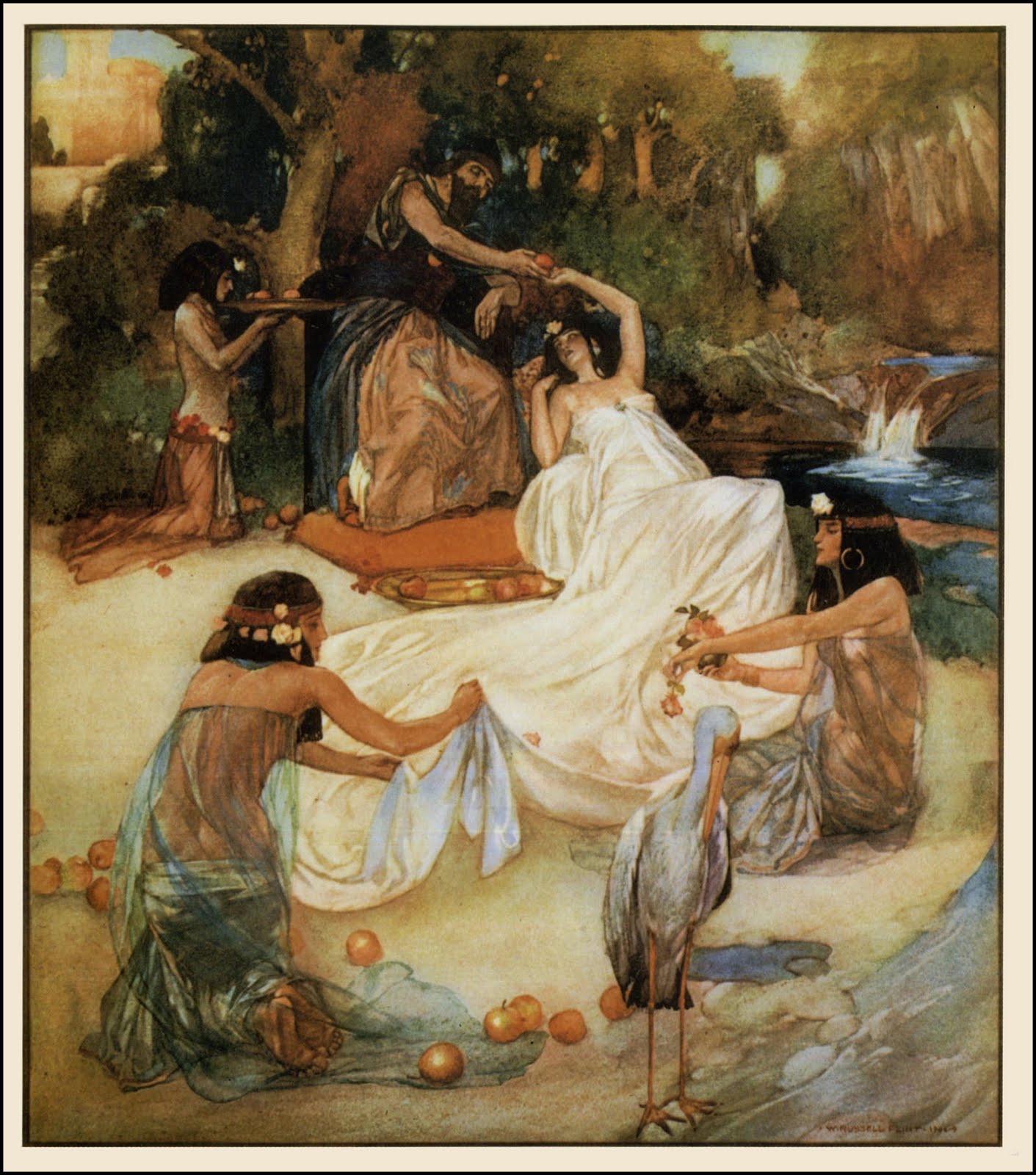
This week’s reading September 3-91 A plate from Sir Wm Russell Flint’s 1909 Song of SolomonEcclesiastes 4:1 to 5:30
2 Corinthians 6:14 to 11:15
Psalm 47:1 to 53:6
Proverbs 22:16 to 22:29
Next Week’s Reading September 10-16
Isaiah 6:1 to Isaiah 24:23
2 Corinthians 11:16 to Galatians 3:9
Psalm 54:1 to Psalm 60:12
Proverbs 23:1 to Proverbs 23:16
If Solomon believed in God, why did he write about so many things that are apparently wrong with the world? Specifically, Ecclesiastes 4?
New Testament
What is the meaning of 2 Corinthians 8:15 (WEB), “As it is written, ‘He who gathered much had nothing left over, and he who gathered little had no lack.’”
FOOTNOTE:
If you are participating in the Saturday morning class, “The One Year Bible Challenge,” you should read the daily materials as set out in “The One Year Bible.” The verses listed on this page will include a couple of extra days each week. ↩
Welcome back from summer break. I hope you are (more or less) current with your Bible Readings. The men’s Bible Study group is starting again this week. You should be hearing about other study groups through normal channels.
This is the “One Year Bible Challenge:” to read the entire Bible in one year. Assuming a normal reading level, this can be done by spending about 10-15 minutes per day, each and every day. See ReadTheWholeBible.COM for more information. If you would like details so you can join us, or if you have any other questions, please call Tom Truex. Or send an email by using the CONTACT form on K-Line.ORG.
OLD TESTAMENT READINGS: Ecclesiastes 4:1 to Isaiah 5:30
Themes and stories: Ecclesiastes is Solomon’s written sermon about his experiences in life and his conclusions. Some readers may avoid the book altogether because they find it pessimistic. Bible believing Christians, obviously, will conclude Ecclesiastes is in the Bible for a reason, difficult as the interpretation of the Book is at times.
Ecclesiastes, Chapter 1 begins,
[1] The words of the Preacher, the son of David, king in Jerusalem. [2] Vanity of vanities, says the Preacher, vanity of vanities! All is vanity. [3] What does man gain by all the toil at which he toils under the sun? [4] A generation goes, and a generation comes, but the earth remains for ever. Ecclesiastes 1:1-4 (RSV).
It is not that the world lacks purpose. But the world, without God, would be without purpose.
Solomon’s estimation of wisdom, for it’s own sake, is no better:
[16] I said to myself, “I have acquired great wisdom, surpassing all who were over Jerusalem before me; and my mind has had great experience of wisdom and knowledge.” [17] And I applied my mind to know wisdom and to know madness and folly. I perceived that this also is but a striving after wind. [18] For in much wisdom is much vexation, and he who increases knowledge increases sorrow. Ecclesiastes 1:16-18. (RSV).
In chapter 2, Solomon condemns pleasures as meaningless.
In chapter 3, Solomon condemns work as meaningless.
Chapter 3 opens with the verses immortalized in popular culture in the Song, “Turn, Turn, Turn.”
Chapter 4 continues with more about oppression and sadness in life.
Again I saw all the oppressions that are practiced under the sun. And behold, the tears of the oppressed, and they had no one to comfort them! On the side of their oppressors there was power, and there was no one to comfort them. Ecclesiastes 1:1-4 (RSV).
Chapter 7 continues with bits of wisdom, with a melancholy tone:
[2] It is better to go to the house of mourning than to go to the house of feasting; for this is the end of all men, and the living will lay it to heart. [3] Sorrow is better than laughter, for by sadness of countenance the heart is made glad. [4] The heart of the wise is in the house of mourning; but the heart of fools is in the house of mirth. [5] It is better for a man to hear the rebuke of the wise than to hear the song of fools. [6] For as the crackling of thorns under a pot, so is the laughter of the fools; this also is vanity. Ecclesiastes 7:2-6 (RSV).
Solomon notes in Ecclesiastes 10:1 (RSV), “[1] Dead flies make the perfumer’s ointment give off an evil odor; so a little folly outweighs wisdom and honor.”
In the end, Solomon gives advice which is easily understood, and in a more hopeful tone:
[13] The end of the matter; all has been heard. Fear God, and keep his commandments; for this is the whole duty of man. [14] For God will bring every deed into judgment, with every secret thing, whether good or evil. Ecclesiastes 12:13-14 (RSV).
Song of Solomon: This book is traditionally attributed to Solomon. It is a love song between Solomon and a beautiful woman he finds working in the vineyard. Some say the book is an allegory of God’s for for Israel and/or the church. Others say it is a literal story about married love and sex. It may be both.
A plate from Sir Wm Russell Flint's 1909 Song of SolomonExample, Song of Solomon 1:2-4 (NIV):
She
[2] Let him kiss me with the kisses of his mouth— for your love is more delightful than wine.
[3] Pleasing is the fragrance of your perfumes; your name is like perfume poured out. No wonder the young women love you!
[4] Take me away with you—let us hurry! Let the king bring me into his chambers. Friends
We rejoice and delight in you we will praise your love more than wine.
Isaiah: Named for the prophet who lived during the time the original nation of Israel had been divided into two kingdoms, Israel in the North, and Judah, in the South. During this time the Israelites had rebelled and broken their covenant with God.
“Ah, sinful nation,
a people laden with iniquity,
offspring of evildoers,
sons who deal corruptly!
They have forsaken the LORD,
they have despised the Holy One of Israel,
they are utterly estranged. “ Isaiah 1:4 (RSV)
In chapter 3, Isaiah warns of judgment on Judah:
“Their partiality witnesses against them; they proclaim their sin like Sodom, they do not hide it. Woe to them! For they have brought evil upon themselves.” Isaiah 3:9 (RSV).
Discussion points: If Solomon believed in God, why did he write about so many things that are apparently wrong with the world? Specifically, Ecclesiastes 4?
Slow Suicide
[1-3] Next I turned my attention to all the outrageous violence that takes place on this planet—the tears of the victims, no one to comfort them; the iron grip of oppressors, no one to rescue the victims from them. So I congratulated the dead who are already dead instead of the living who are still alive. But luckier than the dead or the living is the person who has never even been, who has never seen the bad business that takes place on this earth.
[4] Then I observed all the work and ambition motivated by envy. What a waste! Smoke. And spitting into the wind. Ecclesiastes 4:1-4 (The Message).
Psalms: Psalm 47:1 to 53:6
Proverbs: Proverbs 22:16 to 22:29
NEW TESTAMENT READINGS: 2 Corinthians 6:14 to 11:15
Themes and stories:
“[14] Do not be mismatched with unbelievers. For what partnership have righteousness and iniquity? Or what fellowship has light with darkness?” 2 Corinthians 6:14 (RSV).
Some sources emphasize this prohibition as applying specifically to marriage. But most of the commentators interpret this scripture to apply generally, warning against any close relationship with the unrighteous or unbelievers. Christians run the risk of being lead astray through close, intimate relationships with others. However, don’t take this to mean that we shouldn’t have ANY dealings with non-Christians. If we forsake all contact, how can we witness to unbelievers?
Paul writes about the church in Macedonia. They were facing severe economic trials, which he calls “extreme poverty.” Yet they were still generous in their support of the church. “For they gave according to their means, as I can testify, and beyond their means, of their own free will.”
[6] The point is this: whoever sows sparingly will also reap sparingly, and whoever sows bountifully will also reap bountifully. [7] Each one must give as he has made up his mind, not reluctantly or under compulsion, for God loves a cheerful giver. [8]And God is able to make all grace abound to you, so that having all sufficiency in all things at all times, you may abound in every good work. [9] As it is written, “He has distributed freely, he has given to the poor; his righteousness endures forever.” 2 Corinthians 9:6-9
In 2 Corinthians 11, Paul warns against false apostles.
[10] As surely as the truth of Christ is in me, nobody in the regions of Achaia will stop this boasting of mine. [11] Why? Because I do not love you? God knows I do! [12] And I will keep on doing what I am doing in order to cut the ground from under those who want an opportunity to be considered equal with us in the things they boast about. [13] For such people are false apostles, deceitful workers, masquerading as apostles of Christ. [14] And no wonder, for Satan himself masquerades as an angel of light. [15] It is not surprising, then, if his servants also masquerade as servants of righteousness. Their end will be what their actions deserve.
2 Corinthians 11:10-15 (NIV)
Discussion points: What is the meaning of 2 Corinthians 8:15 (ESV), “As it is written, ‘Whoever gathered much had nothing left over, and whoever gathered little had no lack.’”
DISCUSSION POINTS AND VERSES — Christian Men’s Breakfast only2
The discussion notes ( PDF / TEXT ) for breakfast on Saturday, September 10, 2011 are now online — ”A Time for Every Matter”. Our Old Testament Readings this week begin with Ecclesiates and Song of Solomon — two books which are more difficult to decipher than some other parts of the Bible. We’ll also address Paul’s continuing instructions to the New Testament church in the book of 2 Corinthians Discussion verses: Ecclesiastes 4:1-4; 2 Corinthians 8:15
The notes, summaries and points on this page are intended as bookmarks of important matters which are covered in this week’s readings. They are not intended as complete summaries of readings. Please forgive me if some of my summaries are not 100% on point. Read the manual–i.e. Bible–so that you will get a more clear understanding of the material. Thank you. –Tom Truex↩