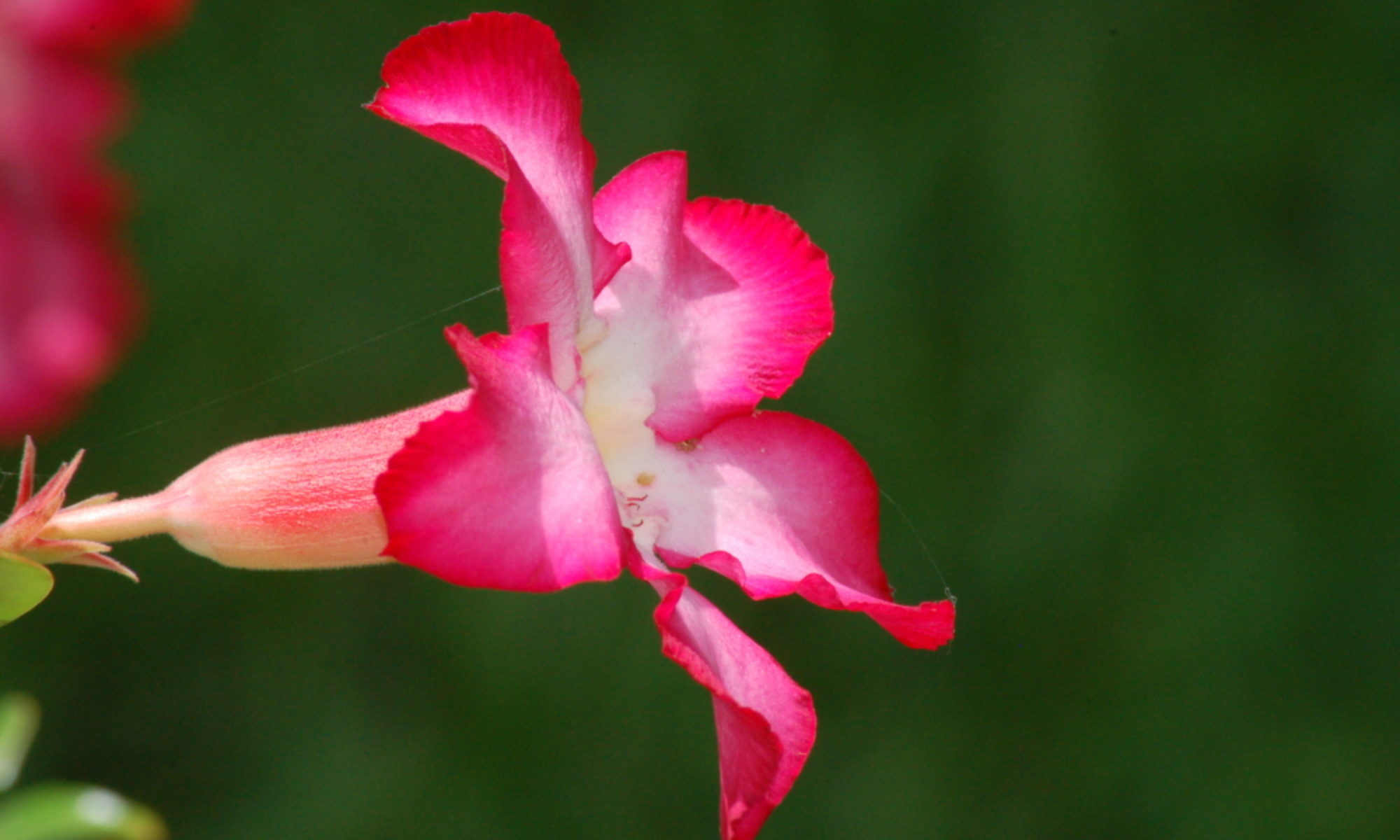
Pink Aloe Plant in Davie, Florida

This pretty pink aloe plant, in our yard in Davie, Florida, is another low maintanance plant that seems to always be in bloom.1 All images here are fairly high resolution. Feel free to click on the photos for a closer look!

Pink Aloe plant in Davie, Florida; © Tom Truex, 2010
The Aloe plant is as useful as it is beautiful. The cactus like leaves have a gooey sap that’s good when applied to minor burns. Commercially it’s used in lots of stuff.
Pink Aloe, © Tom Truex, 2010
At right is another view of the pink aloe in our yard, zoomed out a bit.
Continue reading “Pink Aloe Plant in Davie, Florida”

  1. This plant was originally mentioned in my former blOg at davie.TV, in June 2005, when I was still the Mayor of Davie, FL. As you can see from the photos in this post, taken on July 17, 2010, our clump of aloe plants is still going strong.

Cardinal Airplant in Florida Live Oak (Tillandsia Fasciculata?)

Cardinal Airplant
Cardinal Airplant; © Tom Truex, 2010.
We have several varieties of airplants in the live oak in our yard in Davie, Florida. The one pictured here is a bromeliad (click on images to enlarge). I believe it is the CARDINAL AIRPLANT (Tillandsia Fasciculata), aka GIANT AIRPLANT or STIFF-LEAVED WILD PINE1 I did not climb a ladder to measure, but I estimate the plant pictured here is about 18 to 24 inches from top to bottom. Unfortunately, I can’t tell you much about how these airplants settled in our live oak tree. We planted the oak about 15 years ago. I didn’t put any airplants in the tree myself, so I’m assuming it is the work of birds, hurricane winds, or some of the other many small mammals or reptiles that creep around our yard. These airplants are apparently propagated by seeds. I’m not sure if they can be propagated by other means as well. I notice that they sometimes grow in clumps. When the weather is windy, some of the airplants blow out of the tree. I try my best to throw them back to the higher branches in the tree. My family considers it a great comical sport to watch my efforts in throwing these plants up (they don’t always stick where intended, requiring several throws on my part).

Closeup of Cardinal Airplant
Closeup of Cardinal Airplant; © Tom Truex, 2010.

Giant airplant is a flowering bromeliad. It is a perennial2, epiphytic3 plant that is rarely found growing in cypress swamps and hammocks in Miami-Dade, Brevard, and Monroe Counties (Wunderlin, 2003). Tillandsia fasciculata is listed as a threatened plant in the Preservation of Native Flora of Florida Act. It blooms from summer to fall.

It’s current distribution includes Florida, Puerto Rico, the Virgin Islands and Georgia, though it is rare in the latter (Kartesz, 1999).

SOURCE: Center for Aquatic and Invasive Plants, University of Florida, IFAS, http://plants.ifas.ufl.edu/node/452

The Cardinal Airplant is in danger because of loss of habitat and a bromeliad weevil (Metamasius callizona) that feeds on it.

FOOTNOTES:

  1. Wild Florida Photos, Nature Photograpy by Paul Rebmann (http://www.wildflphoto.com/species.php?k=p&id=81)
  2. Perennial: Having a life cycle lasting more than two years. Source: http://Dictionary.Com
  3. epiphytic: (noun Botany) A plant that grows above the ground, supported nonparasitically by another plant or object, and deriving its nutrients and water from rain, the air, dust, etc.; air plant; aerophyte. Source: http://Dictionary.Com

Crepe Myrtle (aka Crape Myrtle)

Crepe Myrtle
Crepe Myrtle
There are, apparently, many varieties of Crepe Myrtle1, under the scientific names, Lagerstroemia speciosa or Lagerstroemia indica. Our tree, in Davie, Florida, is about 10 or 15 years old and stands no more than 15 feet tall. We bought it in a pot at Flamingo Gardens. Some sources describe a taller variety (40 feet) as the Queen Crepe Myrtle. Our tree blew over in Hurricane Wilma (2005). We tipped it back up, and braced it with a two-by-four for a couple of years. I’m expecting it to be history when we have our next big storm. But until then, it has beautiful pink blooms, pictured here.

According to Tropical Trees (Dorthy and Bob Hargreaves, Ross-Hargreaves, publishers, 1965):

Speciosa comes from the Latin meaning “pleasing to the eye.” This beautiful deciduous tree, native of India, in certainly pleasing to the eye. It is valued for its tough red timber, medicinal use, and ornamental beauty. Many in South Florida, Jamaica, and other Caribbean Islands, Puerto Rico, Trinidad, South America and Mexico.

  1. The spelling seems to be equally correct, if either “Crepe Myrtle” or “Crape Myrtle” is used

image_pdfimage_print