Christ the Rock Community Church, Saturday Morning Men’s Bible Study
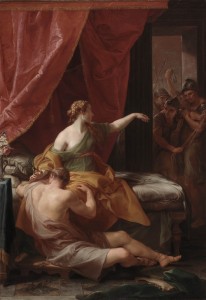
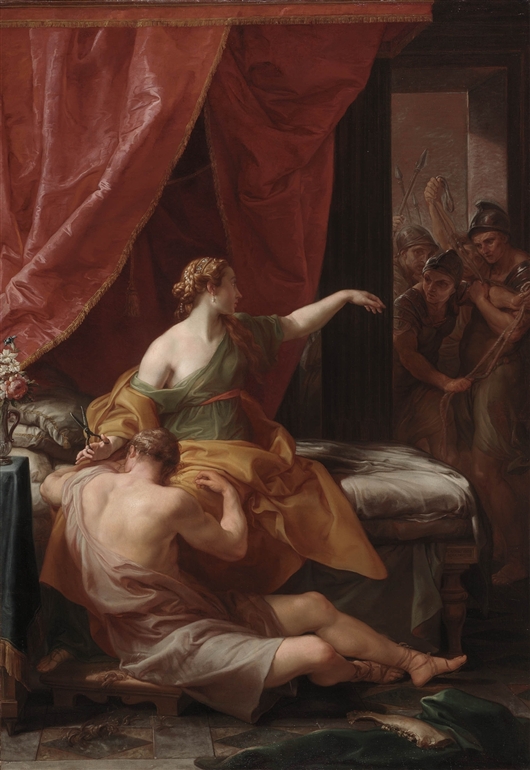
Samson and Delila, by Pompeo Batoni (1708–1787)This week’s reading April 30 to May 61
Judges 11:1 – Ruth 4:22
John 1:1 – 4:54
Psalm 101:1 – 105:36
Proverbs 14:13 – 14:27
Next Week’s Reading May 7 to 13
1 Samuel 1:1 – 14:52
John 5:1 – 7:53
Psalm 105:37 – 109:31
Proverbs 14:28 – 15:7
Discussion Questions: Old Testament
Samson killed himself, together with a lot of Philistines. Should we construe this story to mean that Suicide is sometimes justified?
Who were the “good” and the “bad” people in the story of “the runaway concubine?” Judges, chapters 19-20.
New Testament
What is the significance of the phrase, “And the Word became flesh and dwelt among us?” John 1:14 (RSV).
Why did Nicodemus come to see Jesus at night? Are we ever guilty of behaving the same way for the same reasons?
FOOTNOTE:
If you are participating in the Saturday morning class, “The One Year Bible Challenge,” you should read the daily materials as set out in “The One Year Bible.” The verses listed on this page will include a couple of extra days each week. ↩
This is the “One Year Bible Challenge:” to read the entire Bible in one year. Assuming a normal reading level, this can be done by spending about 10-15 minutes per day, each and every day. It is NOT TOO LATE to join the Challenge! Start with today’s reading and keep reading with us through the end of this year. You’ll have to read a bit more at the beginning of next year to finish. See ReadTheWholeBible.COM for more information. If you would like details so you can join us, or if you have any other questions, please call Tom Truex. Or send an email by using the CONTACT form on K-Line.ORG.
OLD TESTAMENT READINGS: Judges 11:1 – Ruth 4:22
Themes and stories: Jephthah was the son of Gilead and a prostitute. His half brothers, by Gilead’s wife, drove Jephthah away. Jephthah became the leader of a group of bandits. When the Ammonites attacked Israel, the elders asked Jephthah to lead their defense. Jephthah agreed, on the condition that he remain their leader after the battle, assuming the Israelites were victorious.
Jephthah tried to negotiate peace with the Ammonites. It was a waste of time. There was a history of bad blood between the Israelites and the Ammonites, going back to when the Israelites first conquered the promised land. Jephthah made a vow to God:
[30] …”If thou wilt give the Ammonites into my hand, [31] then whoever comes forth from the doors of my house to meet me, when I return victorious from the Ammonites, shall be the LORD’s, and I will offer him up for a burnt offering.” Judges 11:30-31 (RSV)
When Jephthah returned from the battle, victorious, his daughter was the first to rush out the door to meet him. She was Jephthah’s only child. He sent her on a two month vacation in the mountains. When the daughter returned, Jephthah sacrificed her according the vow he made to God. Later, Jephthah defeated other armies. He ruled Israel for 6 years, and then he died.
Ibzan, Elon and Abdon followed Jephthah as Judges.
Samson’s parents were unable to have children. But an angel appeared to them and told them that Samson would be born. He was to be a Nazorite. When Samson was grown, he saw a Philistine woman who he wanted to marry. As Samson and his parents were traveling, they saw a lion. Samson killed the lion with his bare hands. Later, he was passing by and took note that a swarm of honey bees had built their hive in the lion carcass. Samson scooped out some of the sweet honey.
Later, at Samson’s wedding feast, he told some of the young Philistines a riddle: “Out of the eater came something to eat. Out of the strong came something sweet.” Judges 14:14 (RSV). They made a wager as to whether the Philistines would be able to answer the riddle—30 sets of garments. The young Philistines convinced Samson’s new wife to reveal the meaning of the riddle. So they answered the riddle: “What is sweeter than honey? What is stronger than a lion?” Samson was surprised that the Philistines had answered it. He told them, “If you had not plowed with my heifer, you would not have found out my riddle.” Judges 14:14 (RSV). Samson killed 30 Philistines and stripped their clothing in order to pay the bet. His wife’s father gave the new bride to another man.
Later, when Samson went back to get his wife, he found out that her father had given her to another man. Samson was enraged. He tied 300 foxes together by their tails in pairs, with torches between them. The foxes ran about, burning the Philistine’s fields. The Philistines tried to capture Samson. He killed 1,000 of them with a donkey’s jawbone.
Samson and Delila, by Pompeo Batoni (1708–1787)Samson fell in love with Delilah. She found out that the secret of Samson’s great strength was his hair. Delilah had Samson’s head shaved as he slept. The Philistines captured Samson and gouged out his eyes. He was tied between two massive columns. As he performed for them. He pushed out the columns, collapsing the building. Samson, and many of the Philistines were killed. He killed more Philistines at his death, than he had killed during his lifetime.
Next is the peculiar1 tale of “the runaway concubine.2” The wife of a Levite man (actually his “concubine,” which was a secondary wife, with inferior rights) ran away from the Levite to her father’s house. The Levite traveled to collect his concubine from her father. He found the concubine and tried to leave for four days. Each time, the woman’s father persuaded the Levite to stay by offering him food and drink. They finally left on the 5th day, but did not depart until almost evening.
The Levite and his concubine arrived at the city of Gilbeah after dark. No one came out to offer them a place to stay, except an old man. He took the travelers in for the night. “They were enjoying themselves when all of a sudden some sexual perverts from the town surrounded the house and started beating on the door. They said to the old man, Bring out that man that came home with you! We want to have sex with him!” Judges 19:22 (Good News Translation). The old man offered his virgin daughter and the Levite’s concubine to the perverts instead…
[25] But they wouldn’t listen to him. So the Levite took hold of his concubine and pushed her out the door. The men of the town abused her all night, taking turns raping her until morning. Finally, at dawn they let her go. [26] At daybreak the woman returned to the house where her husband was staying. She collapsed at the door of the house and lay there until it was light. [27] When her husband opened the door to leave3, there lay his concubine with her hands on the threshold. [28] He said, “Get up! Let’s go!” But there was no answer. So he put her body on his donkey and took her home. [29] When he got home, he took a knife and cut his concubine’s body into twelve pieces. Then he sent one piece to each tribe throughout all the territory of Israel. [30] Everyone who saw it said, “Such a horrible crime has not been committed in all the time since Israel left Egypt.4 Think about it! What are we going to do? Who’s going to speak up?” Judges 19:25-30 (NLT).
The men who committed the crime against the concubine were from the tribe of Benjamin. The rest of the Israelites demanded that the tribe of Benjamin hand over the perpetrators, so they could be executed. The tribe of Benjamin refused. The Israelites mustered 400,000 warriors to get revenge (or “justice,” depending on your point of view). All but 600 men of the tribe of Benjamin were slaughtered in the battles which followed.
The rest of Israel had pity on the 600 men of Benjamin, because all of their women were killed. However, they had previously vowed that none of their women could marry the Benjamites. They found 400 women from a group which had not taken the vow; and 200 women captured from the locals as they came out to the vineyards to dance at an annual festival.
Naomi entreating Ruth and Orpah to return to the land of Moab, By William Blake (1757-1827)Ruth. In the days of the Judges, a man from Bethlehem moved his family to Moab, because of a famine. He had a wife, Naomi, and two sons, who were each married to a Moabite wife. The father and sons died, leaving three widows. Naomi told her daughters-in-law to return to their families to seek protection and support. One of them, Orpah, did so. The other daughter-in-law, Ruth, refused to leave Naomi alone. Ruth and Naomi returned to Bethlehem, where Ruth eventually married one of Naomi’s relatives. It’s a long story. A popular topic for women’s Bible studies.
Discussion points: Samson killed himself, together with a lot of Philistines. Should we construe this story to mean that Suicide is sometimes justified?
Who were the “good” and the “bad” people in the story of “the runaway concubine???” Judges, chapters 19-20.
John 1:1-14 – [1] In the beginning was the Word, and the Word was with God, and the Word was God. [2] He was in the beginning with God; [3] all things were made through him, and without him was not anything made that was made. [4] In him was life, and the life was the light of men. [5] The light shines in the darkness, and the darkness has not overcome it. [6] There was a man sent from God, whose name was John. [7] He came for testimony, to bear witness to the light, that all might believe through him. [8] He was not the light, but came to bear witness to the light. [9] The true light that enlightens every man was coming into the world. [10] He was in the world, and the world was made through him, yet the world knew him not. [11] He came to his own home, and his own people received him not. [12] But to all who received him, who believed in his name, he gave power to become children of God; [13] who were born, not of blood nor of the will of the flesh nor of the will of man, but of God. [14] And the Word became flesh and dwelt among us, full of grace and truth; we have beheld his glory, glory as of the only Son from the Father.
John, the Baptist, was interrogated by the religious leaders. They wanted to know who he was, and what he was doing. John told them he was neither the Messiah, nor Elijah, nor a prophet. John told them he was baptizing with water. But he foreshadowed the coming of Jesus, telling them that one far greater than him was already among them. Later, John baptized Jesus. The spirit descended from heaven like a dove. Jesus’ first disciples began to follow him.
Jesus turned water into wine at the wedding at Cana. He went to Jerusalem for the passover. He turned over the tables in the temple of the people who where, practicing dishonest commerce among the people who came to offer sacrifices.
A religious leader named Nicodemus came to speak to Jesus at night. No doubt he came at night because he was afraid he would be embarrassed if other religious leaders knew he had visited Jesus. Jesus told him, “[5]…Truly, truly, I say to you, unless one is born of water and the Spirit, he cannot enter the kingdom of God. [6] That which is born of the flesh is flesh, and that which is born of the Spirit is spirit. [7] Do not marvel that I said to you, `You must be born anew…” John 3:5-7 (RSV). Jesus also told Nicodemus, “For God so loved the world, that he gave his only begotten Son, that whosoever believeth in him should not perish, but have everlasting life.” John 3:16 (KJV)
Jesus spoke to a Samaritan woman at a well. This was unusual because Jews and Samaritans did not get along together well. Also men did not ordinarily speak to women to whom they were not acquainted. Jesus told the woman about living water, and the eternal water that he offered. The woman was astounded that Jesus knew her past. This women had been with 5 different men, perhaps through marriage and/or serial relationships. The Samaritan woman believed. She told everyone in the city about Jesus. A large crowd gathered to hear Jesus. Many Samaritans believed in Him because of the woman’s testimony.
Jesus healed the son of a government official. The boy was dying, but Jesus healed him without even seeing the boy. The leader rushed home, and later learned that Jesus had healed the sick boy, precisely when Jesus said he would live.
Discussion points: Why did Nicodemus come to see Jesus at night? Are we ever guilty of behaving the same way for the same reasons?
DISCUSSION POINTS AND VERSES — Christian Men’s Breakfast only2
The discussion notes ( PDF / TEXT ) for breakfast on Saturday, May 7, 2011 are now online — ”UNFORGIVEN”. This week’s readings has a story with elements of both the visit of the Angels in Sodom (Genesis 19); and Clint Eastwood’s movie, Unforgiven, 1992 Discussion verses: Judges 16:25-30; Judges, chapters 19-20; and John 3:1-2
WOMEN’S STUDY GROUP
A women’s study group meets in Davie, FL on the 2nd Friday morning of the month. Contact Janet Truex, or use the Contact tab at CONTACT form on ReadTheWholeBible.COM.
FOOTNOTES
The notes, summaries and points on this page are intended as bookmarks of important matters which are covered in this week’s readings. They are not intended as complete summaries of readings. Please forgive me if some of my summaries are not 100% on point. Read the manual–i.e. Bible–so that you will get a more clear understanding of the material. Thank you. –Tom Truex↩