One Year Bible Challenge, Week 15

bible

Week 15

April 9 – 15, 20111

This is the “One Year Bible Challenge:” to read the entire Bible in one year. Assuming a normal reading level, this can be done by spending about 10-15 minutes per day, each and every day. It is NOT TOO LATE to join the Challenge! Start with today’s reading and keep reading with us through the end of this year. You’ll have to read a bit more at the beginning of next year to finish. See ReadTheWholeBible.COM for more information. If you would like details so you can join us, or if you have any other questions, please call Tom Truex. Or send an email by using the CONTACT form on K-Line.ORG.

OLD TESTAMENT READINGS: Deuteronomy 33:1 – Joshua 12:24

Themes and stories: Moses blessed all the tribes. Then Moses went up to Mount Nebo. God pointed out the promised land, but reminded Moses he was not permitted to cross over to it. Moses died and was buried in a valley in the land of Moab. He was 120 years old. No one knows the exact burial site.

[10] And there has not arisen a prophet since in Israel like Moses, whom the LORD knew face to face, [11] none like him for all the signs and the wonders which the LORD sent him to do in the land of Egypt, to Pharaoh and to all his servants and to all his land, [12] and for all the mighty power and all the great and terrible deeds which Moses wrought in the sight of all Israel. Deuteronomy 34:10-12 (RSV)

Escape from Rahab's House , circa 1851-60: Julius Schnorr von Carolsfeld (1794-1872)
Joshua. After Moses’ death, God spoke to Joshua. God told him to cross the Jordan River. God promised that no one would ever be able to defeat Joshua’s armies. Joshua prepared the Israelites to cross into the promised land. First, they sent out two spies to view the land they were about to conquer. The spies entered the house of Rahab, the prostitute. The king found out about the spies, and sent men to inquire as to what Rahab knew. Rahab lied and told the King’s men that the spies had departed. After the king’s men left, Rahab hid the spies on her roof overnight. She told them she had helped them, because she knew the power of the Israelites’ God. She asked them to spare her family when they returned with their army. They agreed, and told her to tie a crimson cord in her window, as a sign to leave her home undisturbed. She helped the spies escape with a rope through her window. Rahab lived in a house on the outer side of the city wall, and she resided within the wall itself.

Back at the Israelites’ camp, Joshua told the people to sanctify themselves. He told the priests to carry the Ark of the Covenant in front of the people. Each of the tribes was to select a man to help carry the Ark. The twelve men carried the Ark into the Jordan river. As they went forward, the water piled upstream, so that there was a dry path across the river. All of Israel crossed the Jordan River on dry ground. Joshua 3:17. They took 12 stones from the middle of the riverbed, and used them to build a monument on the side of the river to honor God. The Israelite’s enemies panicked when they heard about this miraculous crossing of the Jordan River.

Many of the young Israelite men, who were born after the exodus, had not been circumcised. God told Joshua to stop and circumcise them all, before they proceeded forward. They celebrated Passover in that spot. On the day after Passover, they ate produce from the land. The manna ceased that day too.
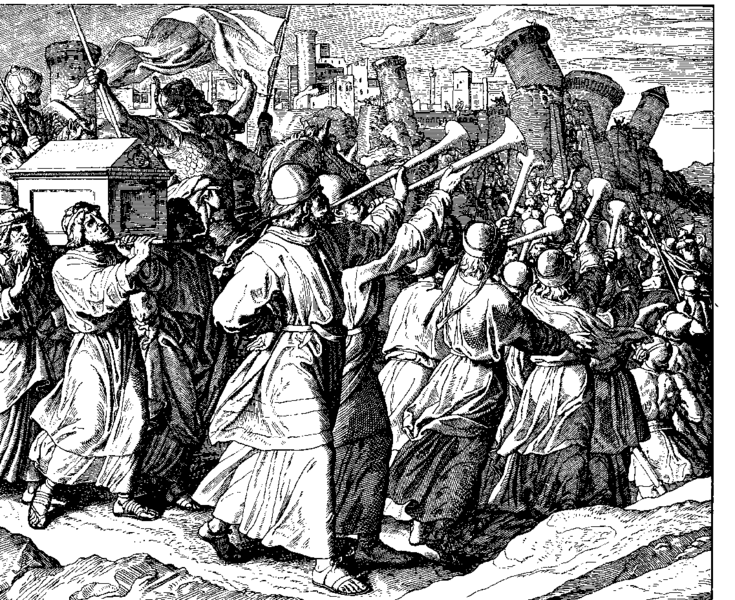
Julius Schnorr von Carolsfeld, 1794-1872, The Battle of Jericho.
As Joshua prepared to lead the Israelites into battle against Jericho, he was met by an angel. God told Joshua to have his army go forward and to march around Jericho once every day for the next six days. On the seventh day, the Israelites were to march around Jericho 7 times. At the seventh time, the trumpets sounded and the people shouted. And the walls of Jericho came tumbling down. The Israelites rushed in and captured the city. Everyone except Rahab, and her family was killed. “[T]hey utterly destroyed all in the city, both men and women, young and old, oxen, sheep, and asses, with the edge of the sword.” Joshua 6:21 (RSV)

Achan disobeyed God’s directions, and keep some of the loot from Jericho. Because of this sin, the Israelites lost their next battle against the city of Ai. God told Joshua that someone had keep property pillaged from Jericho. Joshua investigated. Achan confessed. Achan, his children and livestock were all killed by the Israelites as punishment.

Joshua’s army defeated the people from Ai. Joshua took a break and read all of Moses’ law to the Israelites.

The people from Gibeon tricked Joshua into making a treaty with them. Although the Gibeonites lived on land Joshua was to capture, they told Joshua they lived far away. They wore old tattered clothes and had old, dusty supplies to prove their story. After making the treaty, Joshua learned of their dishonesty. Joshua honored the treaty, but made these people their servants. A deal is a deal.

Some of the Israelites’ other enemies attacked Gibeon. Joshua intervened and killed the aggressors. Joshua asked for the Sun to stand still, so the Israelites would have enough daylight to finish the attack before their enemies could flee. The Sun and Moon stood still, extending the day, and permitting Joshua’s army to rout their enemies. Joshua’s army continued to fight and defeat their other enemies as well.

Discussion points:

  1. The inhabitants of Gibeon tricked Joshua into making a treaty with them. Why did Joshua honor the treaty once he learned it was a trick?
  2. During the battle with the Amorites, God made the Sun and the Moon stand still. What was the point of this occurrence; and are we to take this story literally? (i.e. did the Sun and Moon actually stop moving, or is this just a figure of speech?)

Psalms: Psalm 78:65 – 84:12

Proverbs: Proverbs 12:25 – 13:6

NEW TESTAMENT READINGS: Luke 13:1 – 17:37

Themes and stories: Jesus told the people to repent. Jesus cured a woman with a spirit, who had been crippled for 18 years. The religious leaders were upset that Jesus had healed on the Sabbath—which they considered a serious matter. Jesus taught more about the kingdom of God. Jesus healed another man on the Sabbath. This time the Pharisees were afraid to challenge Jesus.

Jesus told the parable of the man whose honored guests made excuses for not attending his feast. He had his servants bring in random people from off the street to enjoy his feast. Luke 14:15-24. In like manner, many people will refuse God’s offer to enter his kingdom. But God’s offer of salvation is open to all.

Jesus tells his followers that if they follow him, they may expect to suffer for their dedication to him.

Jesus told more parables:

  • The lost sheep. The shepherd leaves his flock to save one lamb.
  • The lost coin. The owner is happy to recover the one that was lost.
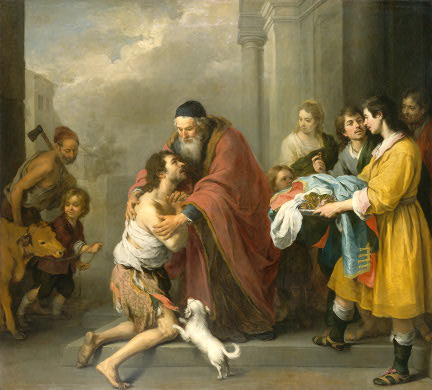
  • The Return of the Prodigal Son, circa 1670 Bartolomé Esteban Murillo (1617 – 1682)
  • The prodigal son. The father was happy at the return of the son who he thought was lost.
  • The shrewd manager. Whoever the master can trust with a little, can be trusted with more.
  • The rich man and the beggar. It was better for the poor man, who went to heaven, than the rich man, who ended up in Hades. It was too late for the rich man to warn his brothers.
    Jesus healed ten men with leprosy. Only one of them took the time to thank Jesus.
  • Jesus told the Pharisees about the coming kingdom of God. He warned them it may happen any time. Be prepared.

Discussion points: The rich man who went to Hades wanted to warn his brothers about this place of torment. Why was his request denied?

DISCUSSION POINTS AND VERSES — Christian Men’s Breakfast only2

The discussion notes ( PDF / TEXT ) for breakfast on Saturday, April 16, 2011 are now online — ”Things Are Not Always What They Seem”. One of our discussion points this week is the treaty Joshua made with the inhabitants of Gibeon. They tricked Joshua into making a treaty with them, which essentially violated God’s instructions to destroy all the inhabitants of the lands the Israelites were to inhabit. Why didn’t Joshua consider the treaty void, after he learned of their deception? Discussion verses: Joshua 9:3-21; Joshua 10:12-14; and Luke 16:19-31

WOMEN’S STUDY GROUP

A women’s study group meets in Davie, FL on the 2nd Friday morning of the month. Contact Janet Truex, or use the Contact tab at CONTACT form on ReadTheWholeBible.COM.

FOOTNOTES

  1. The notes, summaries and points on this page are intended as bookmarks of important matters which are covered in this week’s readings. They are not intended as complete summaries of readings. Please forgive me if some of my summaries are not 100% on point. Read the manual–i.e. Bible–so that you will get a more clear understanding of the material. Thank you.
    –Tom Truex
  2. Subject to change.

Christian Mens Breakfast, April 9, 2011

The discussion notes ( PDF / TEXT ) for breakfast on Saturday, April 9, 2011 are now online — ”RULES”. The Old Testament readings cover some old and some updated rules. As the Israelites prepare to enter the Promised Land, Moses prepares for his final days on earth. In the New Testament readings, Jesus continues his public ministry. Discussion verses: Deuteronomy 23:19-20; and Luke 9:57-62

One Year Bible Challenge, Week 13

bible

Week 13

March 26 to April 1, 20111

This is the “One Year Bible Challenge:” to read the entire Bible in one year. Assuming a normal reading level, this can be done by spending about 10-15 minutes per day, each and every day. It is NOT TOO LATE to join the Challenge! Start with today’s reading and keep reading with us through the end of this year. You’ll have to read a bit more at the beginning of next year to finish. See ReadTheWholeBible.COM for more information. If you would like details so you can join us, or if you have any other questions, please call Tom Truex. Or send an email by using the CONTACT form on K-Line.ORG.

OLD TESTAMENT READINGS: Deuteronomy 5:1 – 20:20

Themes and stories: Moses reviewed the 10 Commandments. The greatest commandment is “[4] Hear, O Israel: The LORD our God, the LORD is one. [5] You shall love the LORD your God with all your heart and with all your soul and with all your might.” Deuteronomy 6:4-5 (ESV) God emphasized how important this commandment was in Deuteronomy 6:7-9:

[6] And these words that I command you today shall be on your heart. [ 7] You shall teach them diligently to your children, and shall talk of them when you sit in your house, and when you walk by the way, and when you lie down, and when you rise. [8] You shall bind them as a sign on your hand, and they shall be as frontlets between your eyes. [9] You shall write them on the doorposts of your house and on your gates.

Verse 9 is cited as the scripture directing Jews to maintain a mezuzah on their doorposts.

God told the Israelites to take care to remember Him and to not follow other gods.

God prepared the Israelites for the coming battles. They would conquer, “the Hittites, Girgashites, Amorites, Canaanites, Perizzites, Hivites and Jebusites, seven nations larger and stronger than you.” Deuteronomy 7:1 (NIV). These nations must be completely vanquished:

[2] and when the LORD your God gives them over to you, and you defeat them; then you must utterly destroy them; you shall make no covenant with them, and show no mercy to them. [3] You shall not make marriages with them, giving your daughters to their sons or taking their daughters for your sons. [4] For they would turn away your sons from following me, to serve other gods; then the anger of the LORD would be kindled against you, and he would destroy you quickly. Deuteronomy 7:2-4 (RSV).

God told the people not to be afraid of the nations they must defeat. He reminds them of what He did to Pharaoh and Egypt. He told them not to forget Him. God told the Israelites he will defeat their enemies not because of the righteousness of the Israelites, but because of the wickedness of their enemies.

God told Moses that if the Israelites only remember, love, and serve, God with all their heart and soul, that He would provide for their needs.

God gave Moses rules for worship. There should be only one altar for sacrifice. All of the other altars, to other gods should be destroyed. God warned the people again to not worship other gods, or to follow false prophets. One sure way to spot a false prophet is if he says, “Let’s follow other gods.” Also they should beware of even family members trying to entice them to worship false gods. God told Moses again about “clean” and “unclean” foods.

God tells Moses they must have a second tithe (the first tithe being the one mentioned in Numbers 18:24, for maintenance of the Levites). The second tithe was to be set aside for the owner’s own consumption—grain, wine, old, and livestock. Except that every third year the second tithe was to be set aside for charity.

Every seventh year, debts from other Israelites were to be cancelled. Debts from foreigners remained in place. You were supposed to be generous in lending to others, in need, reguardless of the nearness of the seventh year. Hebrew slaves were to be released in the seventh year as well. God reviewed the festivals with Moses.

God directed appointment of Judges and other officials. They were to be fair, and not accept bribes. The death penalty was prescribed for worshiping other gods—but only after thorough inquiry, and upon the testimony of two or more witnesses. The witnesses had to cast the first stones. This rule made witnesses part of the punishment, as well as the trial. It would discourage trivial or false charges. Also, perjury carried the same punishment as the crime of the accused. Difficult cases could be referred to the Priest.

God announced that he would set a king over the people when they reached the promised land. Guidelines for the future king were descibed as well, to prevent excesses. Among the rules, no foreigner as king,14 and not acquiring too many horses or wives.

God warns against practicing “abhorrent practices” of other nations. Deuteronomy 18:9 (NRSV). In particular,

[10] Let no one be found among you who sacrifices their son or daughter in the fire, who practices divination or sorcery, interprets omens, engages in witchcraft, [11] or casts spells, or who is a medium or spiritist or who consults the dead. Deuteronomy 18:10-11 (NIV)

God told them about a prophet to come, and tells the Israelites how they will recognize him. Many people say this passage refers to Jesus. God specifies cities of refuge in the promised land.

God gave instructions for soldiers. They are not to be afraid of the enemy. The priest and the officials were to speak to the troops before they go into battle. Certain personal and business affairs must be attended to before the battle, lest the soldier be killed and the matter left undone. As the army approached a town which was not in the land they were to settle, the Israelites were to offer peace terms: surrender and become slaves; or all males will be killed in battle. Women, children, livestock, and other property could be taken as spoils of war. But as to the land in which the Israelites would actually settle, they were to destroy everything that breathes, so those people would not corrupt the Israelites–”that they may not teach you to do according to all their abominable practices which they have done in the service of their gods, and so to sin against the LORD your God.” Deuteronomy 20:18 (RSV).

Discussion points: Deuteronomy describes a system for dealing with the poor and others in need. How does the Israelite’s system compare with modern notions on this matter? Would the Israelite’s system work if implemented in our modern society?

Psalms: Psalm 68:19 – 73:28
Proverbs: Proverbs 11:29 – 12:10

NEW TESTAMENT READINGS: Luke 7:11 – 9:50

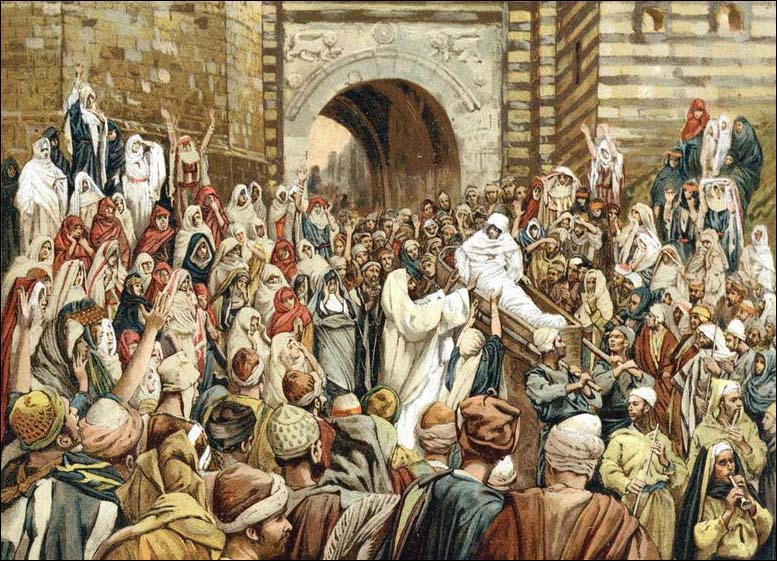
Jesus raising the widow's son at Nain
Jesus raising the widow's son at Nain -- James Tissot (1836 - 1902)
Themes and stories: Jesus went to a Town called Nain. A large crowd followed him. As they were approaching the gate to the town, a funeral procession passed them. It was for the only son of a widow. A woman with no husband or son to take care of her would be in a bad position. Jesus had compassion for her. “He came up and touched the coffin; and the bearers came to a halt. And He said, ‘Young man, I say to you, arise!’ Luke 7:14 (RSV). The dead man sat up and began to speak. Everyone was afraid, but knew that what they had witnessed was to glorify God.

Some men said to Jesus, “John the Baptist has sent us to you, saying, `Are you he who is to come, or shall we look for another?'” Luke 7:20 (RSV). Jesus answered them,

“[22] …Go and tell John what you have seen and heard: the blind receive their sight, the lame walk, lepers are cleansed, and the deaf hear, the dead are raised up, the poor have good news preached to them. [23] And blessed is he who takes no offense at me.” Luke 7:22-23 (RSV).

Jesus was invited to dine in the home of a Pharisee. While he was there, a woman who had been a sinner, joined him. She stood behind Jesus at his feet, weeping. As she cried, her tears washed His feet. She began to dry his feet with her hair. She continued kissing his feet, and anointing them with ointment. The Pharisees, knowing the woman’s reputation, thought the display unseemly. Jesus explained that because her sin was great, so was her gratitude for the forgiveness of her sins great. Jesus told the woman that her sins were forgiven and that her faith had saved her. The people at the table asked who this was that could forgive sins.

Certain women, among them “Mary, called Mag’dalene, from whom seven demons had gone out, and Joan’na, the wife of Chuza, Herod’s steward, and Susanna, and many others,” followed Jesus and his disciples to provide for them out of their resources.

Jesus told the parable of the four soils, and explained it’s meaning. Luke 8:4-15. He described the meaning of a true family—not blood relatives, but those who hear the word of God and do it.

Jesus and his disciples were crossing a lake when a storm blew up. Jesus was asleep. The disciples frantically awoke him. He calmed the sea. The disciples were amazed. They landed at a place called Gerasenes, near the cemetery. A man plagued by many demons ran about the tombs with no clothes on. The demons recognized Jesus, and said, “What have you to do with me, Jesus, Son of the Most High God? I beseech you, do not torment me.” Luke 8:28. Jesus asked who the demons were. They answered their name was Legion, for they were many. They begged Jesus to not send them back to the abyss. Instead send them into a nearby herd of pigs. Jesus consented. The demons entered the pigs, and the pigs promptly ran into the lake and drowned. The man who had been delivered from the demons was happy. The pigs’ owners were not happy. They asked Jesus to leave. Jesus left.

A woman with chronic bleeding touched the fringe of Jesus garment. She was instantly healed, because of her faith. A young girl died. She was the daughter of Jairus, a leader in the synagogue. Jesus restored Jairus’ daughter to life, and asked the people standing by to give the girl something to eat.

Jesus sent his 12 disciples out “and gave them power and authority over all demons and to cure diseases, and he sent them out to preach the kingdom of God and to heal.” Luke 9:1-6. The people in some places welcomed the disciples. Others did not.

Jesus fed 5,000 men, plus the women and children with them, with 5 loaves of bread and 2 fish. There were twelve baskets of leftovers.

Peter finally realized that Jesus was the Messiah. Jesus warned his disciples that he would undergo great suffering, be rejected by the religious leaders, be killed, and arise on the third day. Jesus told them, that to be his followers they had to take up their crosses daily and follow him.

Jesus went up a mountain, with Peter, John and James in order to pray. Jesus’ face changed, and his clothes became a dazzling white. The “Transfiguration.” Jesus met Moses and Elijah. A cloud passed overhead, and a voice from it proclaimed, “This is my Son, my Chosen; listen to him!” Luke 9:35.

Jesus healed a demon possessed boy. He predicted that he would be betrayed. The disciples argued amongst them as to who would be the greatest of them The disciple, John, wanted to prevent another man from casting out demons in Jesus’ name. Jesus told him not to stop the man.

Discussion points: How was Jesus’ attitude toward women unexpected among the Jews? Why was he criticized and why did he treat women as he did?

DISCUSSION POINTS AND VERSES — Christian Men’s Breakfast only2

The discussion notes ( PDF / TEXT ) for breakfast on Saturday, April 2, 2011 are now online — ”Equal Rights”. In Biblical times, views on treatment of the poor, and the place of women in society, were quite different than today. This week we’ll discuss some of those differences. Discussion verses: Deut. 14:28-29; Deut. 15:1-11; Luke 7:36-50; and Luke 8:1-3

WOMEN’S STUDY GROUP

A women’s study group meets in Davie, FL on the 2nd Friday morning of the month. Contact Janet Truex, or use the Contact tab at CONTACT form on ReadTheWholeBible.COM.

FOOTNOTES
  1. The notes, summaries and points on this page are intended as bookmarks of important matters which are covered in this week’s readings. They are not intended as complete summaries of readings. Please forgive me if some of my summaries are not 100% on point. Read the manual–i.e. Bible–so that you will get a more clear understanding of the material. Thank you.
    –Tom Truex
  2. Subject to change.

image_pdfimage_print