One Year Bible Challenge, Week 9

bible

Week 9

Feb. 26 to Mar. 4, 20111

This is the “One Year Bible Challenge:” to read the entire Bible in one year. Assuming a normal reading level, this can be done by spending about 10-15 minutes per day, each and every day. It is NOT TOO LATE to join the Challenge! Start with today’s reading and keep reading with us through the end of this year. You’ll have to read a bit more at the beginning of next year to finish. See ReadTheWholeBible.COM for more information. If you would like details so you can join us, or if you have any other questions, please call Tom Truex. Or send an email by using the CONTACT form on K-Line.ORG.

OLD TESTAMENT READINGS: Leviticus 19:1-Numbers 3:51

Themes and stories: God gives the Israelites miscellaneous rules for their daily lives. Examples: When you harvest your crops, leave a bit of it in the field for the poor and for foreigners to eat. Don’t steal or defraud others. Don’t make your daughter a prostitute. Don’t turn to mediums or wizards. Etcetera.

God specifies punishments for various sins. The death penalty is specified for sins such as cursing your parents, adultery, incest, and bestiality. Also for variations and combinations of the above.
God gives the priest rules for their conduct and the offerings in the Tabernacle. The standards for animals acceptable for sacrifice are described. Generally, you couldn’t give a sick or damaged animal to God as a sacrifice. God demands only our best.

God spelled out certain seasons and festivals, including Passover, offering of the first fruits, festival of weeks, the day of atonement, and the festival of booths. God described the memorial offering. God does not like when you curse him. The penalty was to be taken outside the camp and stoned to death.

Every seventh year the fields were allowed to rest with no crop. Every 50th year was the Year of Jubilee. Trumpets were sounded to start the celebration. No one could sow or reap during the Jubilee. Ancestral land was returned to everyone, even if it had been sold. Slaves who became slaves to satisfy debt were to be freed. The Year of Jubilee prevented the rich from becoming too rich, and the poor from becoming permanently destitute.

God promised to bless the Israelites if they obey him, and punish them if they disobey Him.

Numbers. God told Moses to take a census. God told him how to report the census and who should assist Moses. The total number of Israelite men, 20 years or older was 603,000. The various tribes of the Israelites camped according to the families of their ancestors. The Levites were designated to assist Aaron as priest. God directed that Moses take another census of Levites whose age was a month or more. The number was 22,000. God directed a census of all firstborn males of the Israelites. The total was found to be 22,273. There were 273 more firstborn than Levites. Moses had to pay money to Aaron and his sons to redeem the 273 by which the firstborns exceeded the Levites.

Discussion points: What is the Year of Jubilee? How does it work, and what is the point of it?
Psalms: Psalm 42:1-47:9
Proverbs: Proverbs 10:17-25

NEW TESTAMENT READINGS: Mark 8:11-12:17

Themes and stories: The Pharisees wanted to argue with Jesus. They asked him for a sign. Jesus told them there’d be no sign. Other than, of course, curing the lame, the blind, the sick; bringing the dead back to life; and being crucified and resurrected on the third day.

Jesus restored sight to a blind man. Peter realized that Jesus was the Messiah, but Jesus asked him to keep this information to himself. Jesus told his followers he would be killed. His followers did not want to hear this kind of talk.

Jesus climbed a high mountain with Peter, James and John. Jesus clothes became a dazzling white. Elijah and Moses appeared to them and spoke to Jesus.

Jesus healed a demon possessed boy. The disciples had been unsuccessful with this boy. Jesus told them, “This kind cannot be driven out by anything but prayer.” Mark 9:29 (RSV).

The disciples argued about which one of them would be the greatest. Jesus told them that if they want to be first, they must be a servant to all.

John told someone who was not part of their group to stop casting out demons in Jesus’ name. Jesus told them it was fine for anyone who wished to follow him, to cast out demons in his name.
Jesus used strong words in speaking about temptation. He said it is better to gouge out your own eye, if that eye causes you to stumble—it is better to enter heaven with one eye, than be cast into Hell with two eyes.

Jesus spoke against divorce. When a man and woman are married they become one flesh.
Jesus blesses the little children. He told a rich man not to put his possessions ahead of God. The man was sad when Jesus told him to sell all of his possessions, and give the money to the poor.

Jesus predicted his death a third and final time. He also taught about serving. Jesus lead by example. Jesus himself came to serve others. Even to the point of sacrificing his life as “a ransom for many.”

Jesus healed a blind beggar. He entered Jerusalem riding on the back of a donkey. The crowds spread their clothes and palm branches on the road ahead of him. Palm Sunday. They shouted, “[9] …Hosanna! Blessed is he who comes in the name of the Lord! [10] Blessed is the kingdom of our father David that is coming! Hosanna in the highest!” Mark 11:9-10 (RSV).

Jesus was angry with the moneychangers and people selling doves for sacrificing in the Temple. They were cheating the people who came to the Temple to honor God. Jesus overturned their tables and drove them out of the Temple, telling them, “Is it not written, `My house shall be called a house of prayer for all the nations’? But you have made it a den of robbers.” Strong actions. Strong words. Too strong for the religious leaders. They wanted to kill Jesus.

Jesus and his disciples left Jerusalem. When they returned, the religious leaders challenged Jesus authority. They asked Jesus where he got the authority for the things he said and did. Jesus responded with a question of his own. Did the baptism of John come from heaven or humans. They couldn’t answer him, because if they said “from heaven,” they’d be in trouble because they did not believe in him. But if they said “from humans,” the people would be angry because they belived that John was a prophet. They said they didn’t know, so Jesus refused to answer their question, about his authority, as well.

Jesus told a parable about some tenants who rented a landlord’s vineyard. When the landlord sent a slave to collect the rent, the tenants beat him. They did the same to the second slave the landlord sent. The tenants killed the third slave. Finally the landlord sent his own son to collect the rent. The tenants killed the son too. The landlord will kill the tenants and rent the fields to others.

The religious leaders tried to trick Jesus by asking him if they should pay taxes. They thought he would either anger the Romans, who demanded payment of taxes; or the Jews, who didn’t want to pay taxes. Jesus noted that Ceasar’s image was on the coin. Jesus told them, “Render to Ceasar the things that are Caesar’s, and to God the things that are God’s.”

Discussion points: Why did Jesus lay his hands on the blind man twice, in order to heal him?

REVIEW / STUDY QUESTIONS:
  • Does God permit (or approve of) slavery? (Leviticus 25:44)
  • Why did God tell Moses to take a census? Was their census like our modern census? (Numbers 1:2-15)
  • What is the meaning of the parable about the landlord and tenants of the vineyard? (Mark 12:1-12)
  • Why did the Pharisees demand a sign from heaven? (Mark 8:11) Why did Jesus decline.
  • What is the significance of the transfiguration? (Mark 9:3-8)
  • Are Christians allowed to divorce? (Mark 10:3-9)
DISCUSSION POINTS AND VERSES — Christian Men’s Breakfast only2

The discussion notes ( PDF / TEXT ) for breakfast on Saturday, March 5, 2011 are now online — ”Jubilant”. One of our discussion points this week is the Year of Jubilee. It is an odd concept, by modern standards. Yet the idea does have a present day counterpart. Discussion verses: Leviticus 25:8-34 and Mark 8:22-26.This week’s BACKGROUND is The Book of Numbers.

WOMEN’S STUDY GROUP

A women’s study group meets in Davie, FL on the 2nd Friday morning of the month. Contact Janet Truex, or use the Contact tab at CONTACT form on ReadTheWholeBible.COM.

FOOTNOTES
  1. The notes, summaries and points on this page are intended as bookmarks of important matters which are covered in this week’s readings. They are not intended as complete summaries of readings. Please forgive me if some of my summaries are not 100% on point. Read the manual–i.e. Bible–so that you will get a more clear understanding of the material. Thank you.
    –Tom Truex
  2. Subject to change.

Christian Mens Breakfast, March 5, 2011

The discussion notes ( PDF / TEXT ) for breakfast on Saturday, March 5, 2011 are now online — ”Jubilant”. One of our discussion points this week is the Year of Jubilee. It is an odd concept, by modern standards. Yet the idea does have a present day counterpart. Discussion verses: Leviticus 25:8-34 and Mark 8:22-26. This week’s BACKGROUND is The Book of Numbers.

One Year Bible Challenge, Week 8

bible

Week 8

February 19-25, 20111

This is the “One Year Bible Challenge:” to read the entire Bible in one year. Assuming a normal reading level, this can be done by spending about 10-15 minutes per day, each and every day. It is NOT TOO LATE to join the Challenge! Start with today’s reading and keep reading with us through the end of this year. You’ll have to read a bit more at the beginning of next year to finish. See ReadTheWholeBible.COM for more information. If you would like details so you can join us, or if you have any other questions, please call Tom Truex. Or send an email by using the CONTACT form on K-Line.ORG.

OLD TESTAMENT READINGS: Leviticus 7:28-18:30

Themes and stories: God gives more instructions to Moses about their offerings. Moses carries out God’s instructions regarding consecration of the priests. Moses anoints the Tabernacle and all that was in it with anointing oil. Moses slaughtered a bull as a sin offering; and then other animal sacrifices. Moses put blood from the sacrifice on Aaron and his sons, on the lobe of their right ears, on the thumb of their right hands, and the big toe of their right feet. The priests began their ministry. They sacrificed animals in quantity. Two of Aaron’s sons, Nadab and Abihu, disobeyed God’s instructions by using “unauthorized fire” before the Lord. God consumed (killed) them with the fire. God made another rule: The priest must not drink alcohol before entering the Tabernacle.

God specified which animals were clean and which were “unclean.” There are detailed guidelines. But, in general, if it has divided hoofs and chews its cud, it is most likely acceptable to eat. If it is a scavenger, lizard, carrion bird or snake, it’s probably not fine to eat it. Fish with scales and gills are clean—most other sea creatures are “unclean.” If in doubt, check the label, to see if it’s kosher.

God gave rules for purification after child birth—slightly different if the child is male or female. God also gave rules on how leprosy is to be diagnosed and dealt with.

“[45] The leper who has the disease shall wear torn clothes and let the hair of his head hang loose, and he shall cover his upper lip and cry, `Unclean, unclean.’ [46] He shall remain unclean as long as he has the disease; he is unclean; he shall dwell alone in a habitation outside the camp.” Leviticus 13: 45-46 (RSV)

God gave Moses a procedure for dealing with a leprous person who has been healed. Also rules on dealing with mildew in homes. If the problem couldn’t be cured, the home might have to be torn down. He also gave Moses rules for other medical ailments and conditions.

God gave more instructions on the sacrifices offered at the altar. There were also warnings against the consequences of improper sacrifices. Next God gives rules about certain sexual practices. It’s an interesting list. I don’t think my summary would do it justice. You can read it in Chapter 18 of Leviticus.

Discussion points: Why did God give the Israelites so many rules about “clean” and “unclean” animals?
Psalms: Psalm 37:12-41:13
Proverbs: Proverbs 10:5-16

NEW TESTAMENT READINGS: Mark 3:31-8:10

Themes and stories: Jesus says, “Whoever does the will of God is my brother, and sister, and mother.” Mark 3:35 (RSV)

Parable of the four soils. Jesus explains it’s meaning to the disciples. Specifically, Satan immediately takes away the word from some; in other cases, the word is gladly received, but does not take root. The “cares of the world, and the delight in riches, and the desire for other things” chokes out the word with others. But others hear the word, and it bears fruit with them, many times over. Jesus tells another parable about a growing seed, and one about a mustard seed.

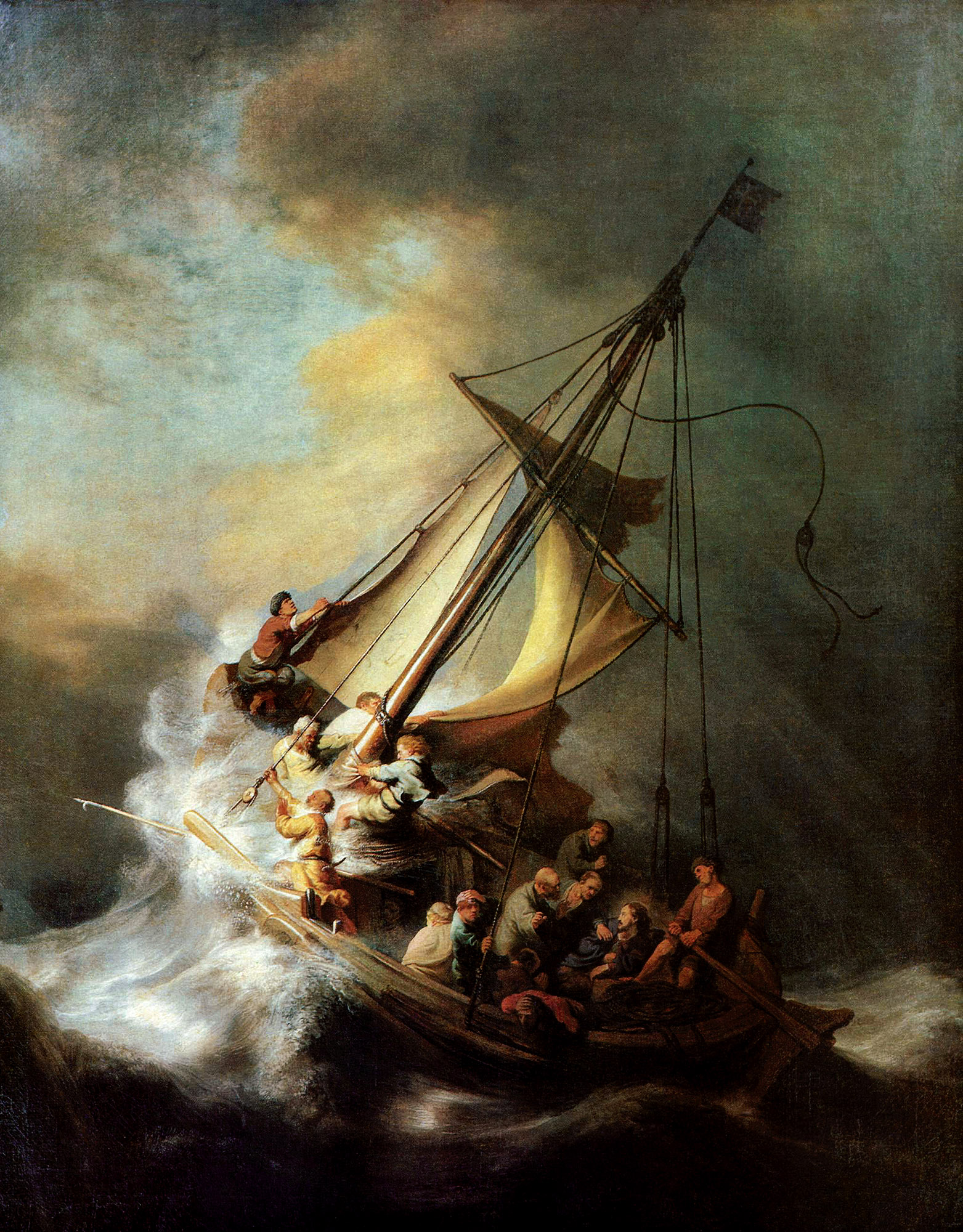
One evening Jesus and his disciples set out in their boat to get away from the crowds. A sudden storm threatened to swamp the ship and drown them all. Jesus calmed the seas. His disciples were amazed.

On the other side of the sea, in Gerasenes, a wild demon possessed man was running in the cemetery between the tombs. He was so crazed that no one could restrain him—not even with chains! Jesus asked the demons their name. They replied “My name is Legion; for we are many.” Mark 5:9 (RSV). The unclean spirits begged Jesus to let them go into a nearby herd of swine. Jesus consented. “And the unclean spirits came out, and entered the swine; and the herd, numbering about two thousand, rushed down the steep bank into the sea, and were drowned in the sea. Mark 5:13. The owners of the pigs didn’t appreciate the significance of the event, and asked Jesus to leave.

Jesus heals a bleeding woman and restores a dead girl to life. The woman, who had been bleeding for years, was healed by her faith, merely by touching Jesus’ garment. The dead girl, whose father was Jairus, was really dead. Completely dead. Dead as a doornail. When Jesus implied she was not dead, the mourners “laughed him to scorn.“ Mark 5:40 (KJV). Jesus took the girl by the hand and said, “Tal’itha cu’mi”; which means, “Little girl, I say to you, arise.” Immediately, the girl, who was 12 years old, got up and began to walk around. Jesus told them to get her something to eat.

The people of Nazareth didn’t accept Jesus. Jesus noted that it is hard for people to believe a man is anything special in his own hometown.

Jesus sent out his disciples to preach. They took no money nor possessions. They cast out demons, anointed with oil and cured the sick.

King Herod had married his brother’s wife. John the Baptist pointed out this marriage was a sin. At the prompting of his wife, Herodias, Herod arrested John. Herodias’ daughter danced at Herod’s party. Herod was so impressed that he made an open promise to her. She cashed in on the promise by demanding the head of John the Baptist on a platter. Beware of pretty dancing girls.

Jesus fed 5,000 men (plus women and children) with five loaves of bread and two fish. There were 12 baskets of leftovers. Jesus walked on water. Jesus continued to heal people.

Jesus reprimanded the religious leaders for following the letter of the law, while ignoring God’s intent of the law. Jesus came to the house of Gentiles. He sent a demon out of a girl. Jesus fed another large crowd with almost no food. This time, it was 4,000 men (plus women and children), with seven loaves of bread, and few small fish. There were 7 baskets of leftovers. Mark 8:1-10

Discussion points:

  1. Is the purpose of the parables to convey the truth? Or to hide the truth? Or both? Or neither?
  2. Imagine you were Jairus, and Jesus brought your child back to life. How do you think you would feel? Why did Jesus tell the people standing by to give the girl something to eat?
REVIEW / STUDY QUESTIONS:
  • Isn’t leprosy incurable? Why was there a procedure in Leviticus, chapter 14 for re-admitting people back into society after being cured of leprosy?
  • What was the “unholy fire” that Nadab and Abihu offered before the Lord?
  • Why did God restrict the foods the Israelites were allowed to eat
  • How did the boat Jesus and the disciples were in get caught at sea? Weren’t they experienced fishermen?
  • Why did Herod’s wife want to kill John the Baptist? Why did Herod agree to do so?
DISCUSSION POINTS AND VERSES — Christian Men’s Breakfast only2

The discussion notes ( PDF / TEXT ) for breakfast on Saturday, February 26, 2011 are now online — ”Clean vs. Unclean”. This week we read more about God’s specific rules for the Israelites. God defines what animals are considered clean and can be eaten. God’s rules for leprosy also use the terms “Clean” and “Unclean.” Discussion verses: Leviticus 11 and Mark 4:10-12. This week’s BACKGROUND is a brief review of the Latin Vulgate Bibles..

WOMEN’S STUDY GROUP

A women’s study group meets in Davie, FL on the 2nd Friday morning of the month. Contact Janet Truex, or use the Contact tab at CONTACT form on ReadTheWholeBible.COM.

FOOTNOTES
  1. The notes, summaries and points on this page are intended as bookmarks of important matters which are covered in this week’s readings. They are not intended as complete summaries of readings. Please forgive me if some of my summaries are not 100% on point. Read the manual–i.e. Bible–so that you will get a more clear understanding of the material. Thank you.
    –Tom Truex
  2. Subject to change.

image_pdfimage_print