One Year Bible Challenge, Week 21

bible

Week 21

May 21 to 27, 20111

This is the “One Year Bible Challenge:” to read the entire Bible in one year. Assuming a normal reading level, this can be done by spending about 10-15 minutes per day, each and every day. It is NOT TOO LATE to join the Challenge! Start with today’s reading and keep reading with us through the end of this year. You’ll have to read a bit more at the beginning of next year to finish. See ReadTheWholeBible.COM for more information. If you would like details so you can join us, or if you have any other questions, please call Tom Truex. Or send an email by using the CONTACT form on K-Line.ORG.

OLD TESTAMENT READINGS: 1 Samuel 29:1 – 2 Samuel 12:31

Themes and stories: The Philistines prepared to attack Saul and the Israelite army. Meanwhile, David and his men loitered behind the lines of the Philistines. This made some of the Philistine commanders nervous, because they remembered that David had previously fought against them. They were afraid that David would turn against them during the battle. The Philistine King, Achish, found no fault with David, nor his loyalties. Nonetheless, the commanders prevailed upon Achish to send David away from the battle. Actually, this was probably the best thing that could have happened to David. It meant he would not be faced with fighting against Saul or the Israelites.

While David and his men were gone, the Amalekites had attacked their cities, including Ziklag. They burned down Ziklag, and took the women captive, including David’s two wives. David put on the ephod, which was a sort of ceremonial sacred vest.3 David pursued the Amalekites with 600 men. At one point, they had to leave 200 of these men behind, because they were too tired to move further. When David caught up with the Amalekites, they were eating, drinking and dancing, in celebration of the spoils they had taken in their raids. David attacked the Amalekites and killed all of them but 400, who escaped on camels. He recovered all the Amalekites had stolen, including his two wives. Some of David’s 400 men who had continued with David said that the 200 exhausted men who did not fight in the battle, should not recover anything but their wives and children. Specifically they did not want to share the spoils of war. David made them share with the 200 who’d stayed behind.

The Philistines fought against the Israelites. They killed Saul’s sons. Saul was wounded in battle, and told his armor-bearer to kill him with his sword. The armor-bearer refused, so Saul killed himself before the Philistines could kill him. The Philistines cut off Saul’s head and tacked his body to the city wall. Some of the Israelite men took the body of Saul and his son off the wall. They burned the bodies, and buried the bones.

2 Samuel. A young Amalekite man from Saul’s camp told David that Saul and his sons had been killed. He added that he came upon Saul as he lay dying, and Saul asked him to kill him. The young man claimed, “So I stood beside him and killed him, because I was sure that he could not live after he had fallen. And I took the crown that was on his head and the armlet that was on his arm, and I have brought them here to my lord.” 2 Samuel 1:10 Obviously, the young man was lying. His story does not match what we read about the death of Saul. See 1 Samuel 31. David had the young man killed for “supposedly” killing the king, Saul. David wrote a song to lament the deaths of Saul and Jonathon.

David and his two wives moved to Hebron. The people of Judah anointed him as their king. But a competing faction made Mahanaim, son of Saul, king of part of the region. A civil war broke out. “There was a long war between the house of Saul and the house of David; and David grew stronger and stronger, while the house of Saul became weaker and weaker. ” 2 Samuel 3:1 (RSV).

The commander of Saul’s army, Abner, was accused by one of Saul’s sons, Ishbaal, of impropriety with one of Saul’s concubines. Abner did not care for the suggestion, saying “Am I a dog’s head of Judah? This day I keep showing loyalty to the house of Saul your father, to his brothers, and to his friends, and have not given you into the hand of David; and yet you charge me today with a fault concerning a woman. ” 2 Samuel 8 (RSV). Abner made peace with David. For his part, David made Abner promise to bring him his wife Machal (Saul’s daughter) as a condition of peace. Michal hadn’t seen David for a long time, and had been given to another man as his wife. Her new husband was sad to lose her. Abner, as a commander of Saul’s army, was not popular with David’s followers. One of David’s commanders, Joab killed Abner. David’s men quashed the remaining forces in Saul’s army and became king over all of Israel.

David and his men marched into Jerusalem, and conquered it. He renamed it “The City of David.” David took more wives and concubines, and had more children.

When the Philistines heard that David was made king of all of Israel, they set out to look for him. David’s army defeated the Philistines. David brought the Ark to Jerusalem. He danced with all his might in celebration of the event. His wife, Michal, did not care for the dance. She told him, “How the king of Israel honored himself today, uncovering himself today before the eyes of his servants’ maids, as one of the vulgar fellows shamelessly uncovers himself!” 2 Samuel 6:20 (RSV).

David’s men attacked and subdued the surrounding nations. David located Saul’s grandson, Mephilosheth, and restored to him all that had belonged to Saul. David’s armies continued to make war with the other nations.

Then David met Bathsheba. 2 Samuel 11:1-5 (RSV).

[1] In the spring of the year, the time when kings go forth to battle, David sent Jo’ab, and his servants with him, and all Israel; and they ravaged the Ammonites, and besieged Rabbah. But David remained at Jerusalem. [2] It happened, late one afternoon, when David arose from his couch and was walking upon the roof of the king’s house, that he saw from the roof a woman bathing; and the woman was very beautiful. [3] And David sent and inquired about the woman. And one said, “Is not this Bathshe’ba, the daughter of Eli’am, the wife of Uri’ah the Hittite?” [4] So David sent messengers, and took her; and she came to him, and he lay with her. (Now she was purifying herself from her uncleanness.) Then she returned to her house. [5] And the woman conceived; and she sent and told David, “I am with child.”

In order to cover up his sin, David sent for Bathsheba’s husband, Uriah, the Hittite. David figured he had better provide a conjugal visit, so that no one would know that Bathsheba’s child belonged to him. This plan was before DNA testing came into vogue. Uriah refused to sleep with his own wife while his men were suffering the hardships of war. David repeated this plan the next night, but this time saw to it that Uriah was drunk. The plan failed a second time. Uriah returned to battle. David commanded that he be sent to the worst part of the fighting. This plan worked. Uriah was killed in battle a short time latter. After a period of mourning, for her husband, Bathsheba married David.

David’s actions with regard to Bathsheba and Uriah displeased God. God sent his prophet, Nathan, to speak to David. Nathan chastised David for his behavior. Nathan also told David that his first child with Bathsheba would die. The baby died. “Then David comforted his wife, Bathshe’ba, and went in to her, and lay with her; and she bore a son, and he called his name Solomon.” 2 Samuel 12:24.

Discussion points: God himself called David “a man after his own heart.” How do we reconcile God’s proclamation with the terrible sins committed by David?
1 Samuel 13:13-14 (RSV) – [13] And Samuel said to Saul, “You have done foolishly; you have not kept the commandment of the LORD your God, which he commanded you; for now the LORD would have established your kingdom over Israel for ever. [14] But now your kingdom shall not continue; the LORD has sought out a man after his own heart; and the LORD has appointed him to be prince over his people, because you have not kept what the LORD commanded you.”
Acts 13:22 (RSV) – And when he had removed him, he raised up David to be their king; of whom he testified and said, `I have found in David the son of Jesse a man after my heart, who will do all my will.’

Psalms: Psalm 118:1 – 119:80
Proverbs: Proverbs 15:24 – 16:5

NEW TESTAMENT READINGS: John 11:55 – 16:33

Themes and stories: About a week before the passover feast, Jesus visited Lazarus, Martha, and Mary. This was the same Lazarus who Jesus had raised from the dead.6 Mary anointed Jesus’ feet with very expensive perfume, and wiped them with her hair. Judas Iscariot complained that the perfume could have been sold, and the money given to the poor. Actually the perfume’s value was nearly a year’s wages for a laborer. Jesus told him, “[7] …Let her alone, let her keep it for the day of my burial. [8] The poor you always have with you, but you do not always have me.” John 12:7-8 (RSV)
.
John 12:12-13 – [12] The next day a great crowd who had come to the feast heard that Jesus was coming to Jerusalem. [13] So they took branches of palm trees and went out to meet him, crying, “Hosanna! Blessed is he who comes in the name of the Lord, even the King of Israel!” Jesus rode on a donkey, as prophesied in Zechariah9:9 – “Rejoice greatly, O daughter of Zion! Shout aloud, O daughter of Jerusalem! behold, your king is coming to you; righteous and having salvation is he, humble and mounted on a donkey, on a colt, the foal of a donkey.” This was Palm Sunday.

Jesus explained why he must die. He used a grain of wheat as an illustration.

John 12:24-26 – “[24] Truly, truly, I say to you, unless a grain of wheat falls into the earth and dies, it remains alone; but if it dies, it bears much fruit. [25] He who loves his life loses it, and he who hates his life in this world will keep it for eternal life. [26] If any one serves me, he must follow me; and where I am, there shall my servant be also; if any one serves me, the Father will honor him.”

Most people did not believe in Jesus, even after all the amazing things he said and the miracles he had performed. Jesus told his followers, “I have come as light into the world, so that everyone who believes in me should not remain in the darkness.” John 12:46 (NRSV).

The devil put into the heart of Judas Iscariot to betray Jesus. During the passover supper, Jesus washed the disciples’ feet, as a showing of humility. Jesus then told them frankly that one of them would betray him. Jesus told Judas to go and do what he had to do. Judas left immediately, though none of the disciples realized what had happened.

Jesus predicted that Peter would deny him three times before the rooster crowed the next morning.

Jesus assured his disciples that there was room for all of them in heaven:  John 14:2 “In my Father’s house are many mansions: if it were not so, I would have told you. I go to prepare a place for you.”

Jesus also told them that the only way to God, was through Him. “[6] Jesus saith unto him, I am the way, the truth, and the life: no man cometh unto the Father, but by me. [7] If ye had known me, ye should have known my Father also: and from henceforth ye know him, and have seen him.” John 14:6-7 (KJV).

Jesus promised to give his disciples the Holy Spirit8: John 14:15-16 (Contemporary English Version) – “[15] Jesus said to his disciples: If you love me, you will do as I command. [16] Then I will ask the Father to send you the Holy Spirit who will help you and always be with you.”

Jesus likened God to a vinegrower. He removes every branch that does not bear fruit. He prunes the branches that bear fruit, so that they will bear more fruit. Jesus reminded his disciples to love one another. John 15:12-13 – “[12] This is my commandment, that you love one another as I have loved you. [13] Greater love has no man than this, that a man lay down his life for his friends.”

Jesus taught the disciples more about the Holy Spirit. He also told them to pray to God using Jesus’ name: John 16:23-24 – “[23] In that day you will ask nothing of me. Truly, truly, I say to you, if you ask anything of the Father, he will give it to you in my name. [24] Hitherto you have asked nothing in my name; ask, and you will receive, that your joy may be full.”

Discussion points: Why was it that most of the people did not believe in Jesus, even though he had performed so many miracles right before them?

John 12: 37-43 (RSV) – [37] Though he had done so many signs before them, yet they did not believe in him; [38] it was that the word spoken by the prophet Isaiah might be fulfilled: “Lord, who has believed our report, and to whom has the arm of the Lord been revealed?” [39] Therefore they could not believe. For Isaiah again said, [40] “He has blinded their eyes and hardened their heart,lest they should see with their eyes and perceive with their heart, and turn for me to heal them.” [41] Isaiah said this because he saw his glory and spoke of him. [42] Nevertheless many even of the authorities believed in him, but for fear of the Pharisees they did not confess it, lest they should be put out of the synagogue: [43] for they loved the praise of men more than the praise of God.

DISCUSSION POINTS AND VERSES — Christian Men’s Breakfast only2

The discussion notes ( PDF / TEXT ) for breakfast on Saturday, May 28, 2011 are now online — ”Nobody’s Perfect”. Most of our Old Testament reading this week involves David. He was paradoxically capable of shocking since, while the the person God called a “man after His own heart.” Discussion verses: 1 Samuel 13:13-14; Acts 13:22; and John 12: 37-43

WOMEN’S STUDY GROUP

A women’s study group meets in Davie, FL on the 2nd Friday morning of the month. Contact Janet Truex, or use the Contact tab at CONTACT form on ReadTheWholeBible.COM.

FOOTNOTES
  1. The notes, summaries and points on this page are intended as bookmarks of important matters which are covered in this week’s readings. They are not intended as complete summaries of readings. Please forgive me if some of my summaries are not 100% on point. Read the manual–i.e. Bible–so that you will get a more clear understanding of the material. Thank you.
    –Tom Truex
  2. Subject to change.

One Year Bible Challenge, Week 20

bible

Week 20

May 14 – 20, 20111

This is the “One Year Bible Challenge:” to read the entire Bible in one year. Assuming a normal reading level, this can be done by spending about 10-15 minutes per day, each and every day. It is NOT TOO LATE to join the Challenge! Start with today’s reading and keep reading with us through the end of this year. You’ll have to read a bit more at the beginning of next year to finish. See ReadTheWholeBible.COM for more information. If you would like details so you can join us, or if you have any other questions, please call Tom Truex. Or send an email by using the CONTACT form on K-Line.ORG.

OLD TESTAMENT READINGS: 1 Samuel 15:1 – 28:25

Themes and stories: Samuel told Saul to slaughter the people of Amalek. Kill every man, woman, child, infant, livestock, (and presumably cats and dogs.) Saul mustered an army and killed the Amalekites. However, Saul spared their king, Agag, as well as some of the sheep and cattle. God does not like it when people do not follow his instructions. Samuel went to Saul to make inquiry. Saul told Samuel that he had saved some of the cattle to sacrifice to God. Samuel responded, “Surely, to obey is better than sacrifice.” 1 Samuel 15:22 (NRSV). By way of emphasizing the point, Samuel had King Agag, King of the Amalekites brought before him. Samuel hacked Agag to death with his sword.

God told Samuel to anoint, as the next king of Israel, one of Jesse’s sons. God did not tell Samuel which one of Jesse’s son was to be king, so Samuel went to interview them. But the LORD said to Samuel, “Do not look on his appearance or on the height of his stature, because I have rejected him; for the LORD sees not as man sees; man looks on the outward appearance, but the LORD looks on the heart.” 1 Samuel 16:7 (RSV).

Samuel passed over Jesse’s first 7 sons and anointed the youngest, David; “and the Spirit of the LORD came mightily upon David from that day forward.” 1 Samuel 16:13 (RSV).

After David was anointed, “the spirit of the Lord departed from Saul, and an evil spirit from the Lord tormented him.” 1 Samuel 16:14 (NRSV). David entered service with Saul to play the lyre to sooth Saul when the evil spirit from the Lord was upon him. David was also Saul’s armor-bearer.

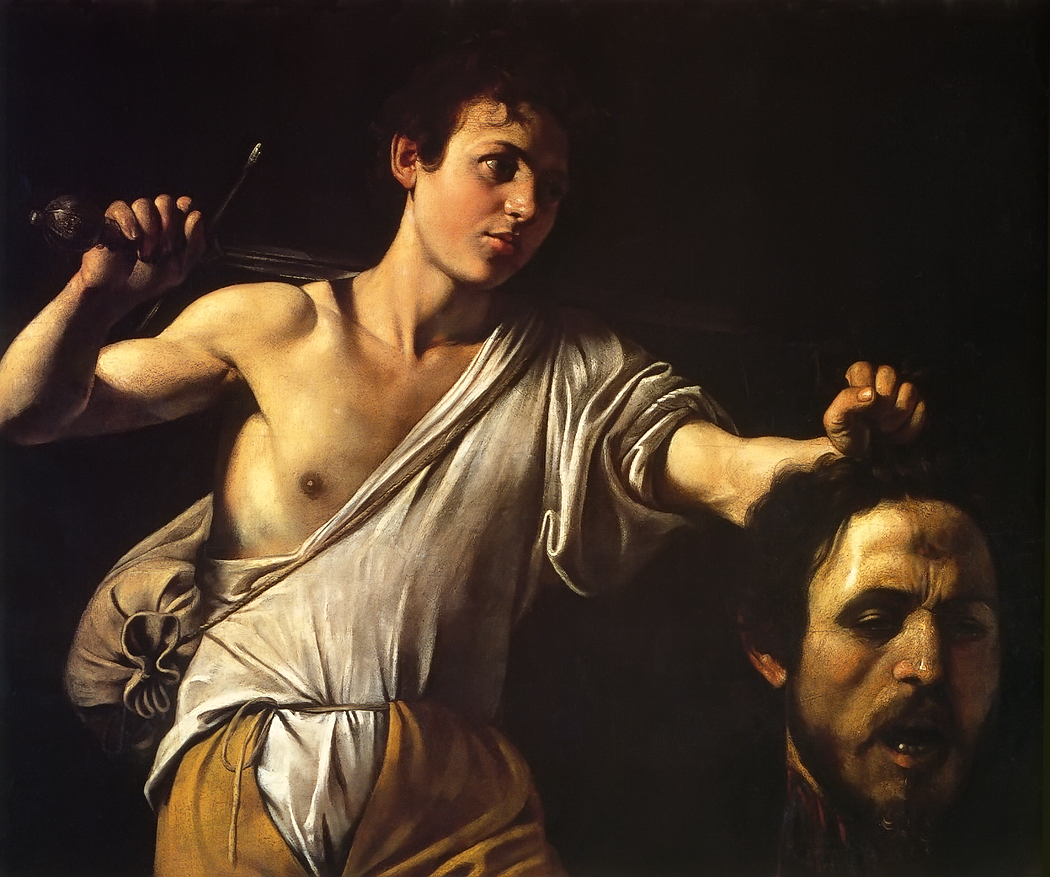
David with Goliaths Head, by Michelangelo Caravaggio
Next is the story of David and Goliath, most of which is well known to even small children. Goliath was a giant in the Philistine’s army. He stood over 9 feet tall. As the Philistine’s army drew near the Israelite’s army, Goliath went out to taunt his adversaries, twice every day. He proposed that rather than a battle between the armies, that he (Goliath) would fight one of the Israelite’s soldiers. And to the victor of this mortal combat, would go the spoils for battle as if the entire armies had fought. Apparently, this was a common arrangement. Goliath made this challenge for more than 40 days. None of the Israelite’s had the courage to take the giant’s challenge. Finally David, who was still a shepherd boy, offered to fight Goliath. David realized what others had overlooked—that he would not be fighting alone. God would be fighting with him. David said, “The LORD who delivered me from the paw of the lion and from the paw of the bear, will deliver me from the hand of this Philistine.” 1 Samuel 17:37 (RSV). Saul offered David his armor to use in battle against Goliath. But the armor was too heavy for the boy. David took only his staff, five smooth stones and a sling. David and Goliath approached each other for battle. They traded insults. David slung a single stone from his sling to Goliath’s forehead. Goliath dropped dead. By way of insuring Goliath’s death, David drew out the giant’s sword and cut his head off. Instead of submitting to the Israelite’s as their conquerors, the Philistines ran away. So much for a deal. The Israelite’s slaughtered the Philistines as they fled.

As they were returning home from their victory, women came out to greet the Israelite’s army, playing musical instruments and singing,

“Saul has slain his thousands,
And David his ten thousands.”

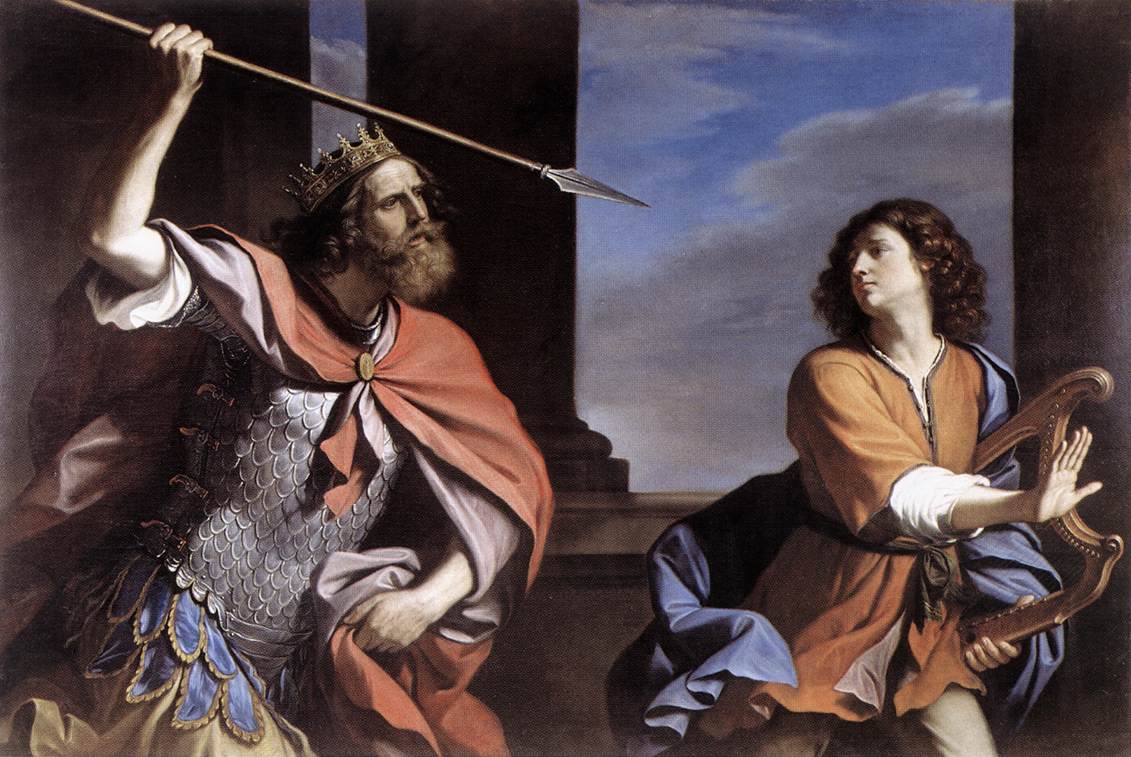
Saul Attacking David, by Giovanni Francesco Barbieri (1591 – 1666)
Saul felt slighted by the numerical comparison. The next day, an evil spirit from God rushed upon Saul. David was summoned to play his lyre. Saul tried to stab David with a spear, but David escaped twice. Saul made David commander over 1,000 men in his army. David had great military success, and all the Israelite’s loved him. Well, not quite all—Saul hated David.

Saul told David he would give him his eldest daughter, Merab, in marriage. But then he gave Merab to Adriel the Meholathite, to be married. Saul promised David another one of his daughters, Michal, as his wife. But as a wedding present, Saul demanded that David kill 100 Philistines, and bring Saul their foreskins as proof. Saul hoped the Philistines would kill David. But David complied with Saul’s demand, and married Michal. In fact, David’s troops continued to defeat the Philistines, every time they met on the battle field.

Saul spoke to his son, Jonathan, and his servants about killing David. Jonathan reported the death threat to David. The two were friends. Saul developed a plan to murder David. David’s wife (Saul’s daughter), Michal, helped David escape. Saul concocted another scheme to kill David, at a banquet. Saul’s son, Jonathan, helped David escape this time.

David fled to Gath. If this town sounds familiar, it was the hometown of Goliath, who David killed years earlier. One can presume that the current inhabitants of Gath must have forgotten the matter; although David must have slept with one eye open, given his history with one of Gath’s favorite sons. David pretended to be crazy so that the King of Gath wouldn’t punish him.

Saul pursued David so that he could kill him. David was on the run. Samuel killed priests of the Lord who had assisted David in his escape. One day as Saul was pursuing David, Saul went into a cave to use it as a restroom. Little did Saul suspect that David and his men were hiding in that cave. David had a perfect chance to kill Saul in the dark, but he would not do so. David was loyal to Saul, even though Saul was trying to kill David. Saul gave up his pursuit of David when he found out that David had passed up a chance to kill him.

Later, Saul again decided to kill David. So, he again set out with his men to find and kill David. David sneaked up on Saul’s encampment at night. He had another chance to kill Saul, but did not do so. Saul gave up this plan to murder David, when he realized his life had again been spared.

David continued his raids on the Philistines, killing everyone as he went. The Philistines assembled as great army. Saul was very worried, but God gave him no direction. Although Saul had expelled almost all of the mediums and wizards, Saul decided to consult one now. His servants located a medium who had been overlooked. God was always clear in his condemnation of dabbling in the occult. You may recall the following examples:

  • Leviticus 19:31 (NASB)– “Do not turn to mediums or spiritists; do not seek them out to be defiled by them. I am the LORD your God.“
  • Leviticus 20:6 (NASB)- “As for the person who turns to mediums and to spiritists, to play the harlot after them, I will also set My face against that person and will cut him off from among his people.”
  • Leviticus 20:27 (NASB)- “Now a man or a woman who is a medium or a spiritist shall surely be put to death. They shall be stoned with stones, their bloodguiltiness is upon them.”
  • Deuteronomy 18:9-15 (NASB) – Spiritism Forbidden . [9] “When you enter the land which the LORD your God gives you, you shall not learn to imitate the detestable things of those nations. [10] “There shall not be found among you anyone who makes his son or his daughter pass through the fire, one who uses divination, one who practices witchcraft, or one who interprets omens, or a sorcerer, [11] or one who casts a spell, or a medium, or a spiritist, or one who calls up the dead. [12] “For whoever does these things is detestable to the LORD; and because of these detestable things the LORD your God will drive them out before you. [13] “You shall be blameless before the LORD your God. [14] “For those nations, which you shall dispossess, listen to those who practice witchcraft and to diviners, but as for you, the LORD your God has not allowed you to do so. [15] “The LORD your God will raise up for you a prophet like me from among you, from your countrymen, you shall listen to him.

The medium to whom Saul went for advice suspected a trap. Saul assured her he would do her no harm. As directed by Saul, the medium brought up the spirit of Samuel. The “ghost of Samuel” did not have good news for Saul:

1 Samuel 28:15-10 (RSV)
[15] Then Samuel said to Saul, “Why have you disturbed me by bringing me up?” Saul answered, “I am in great distress; for the Philistines are warring against me, and God has turned away from me and answers me no more, either by prophets or by dreams; therefore I have summoned you to tell me what I shall do.” [16] And Samuel said, “Why then do you ask me, since the LORD has turned from you and become your enemy? [17] The LORD has done to you as he spoke by me; for the LORD has torn the kingdom out of your hand, and given it to your neighbor, David. [18] Because you did not obey the voice of the LORD, and did not carry out his fierce wrath against Am’alek, therefore the LORD has done this thing to you this day. [19] Moreover the LORD will give Israel also with you into the hand of the Philistines; and tomorrow you and your sons shall be with me; the LORD will give the army of Israel also into the hand of the Philistines.”

Or, to put it another way, the “ghost of Samuel” assured Saul that Saul would be dead by the next day.

Discussion points: A medium consulted Samuel as demanded by Saul. Is this story proof that ghosts (i.e. the disembodied spirits of the dead) really do exist?
Psalms: Psalm 110:1 – 117:2
Proverbs: Proverbs 15:8 – 15:23

NEW TESTAMENT READINGS: John 8:1 – 11:54

Themes and stories: The scribes and Pharisees brought a woman to Jesus who’d been caught in the act of adultery. They asked Jesus what he thought they should do with her. If Jesus said to not stone her, they’d accuse him of violating Moses’ law. But if he said to stone her to death, they could report him to the Romans, who did not permit the Jews to carry out their own executions. Jesus said, “He that is without sin among you, let him first cast a stone at her.” John 8:7 (KJV). The accusers went away one by one, until only Jesus and the woman were left. John 8:10-11 (KJV). “[10] When Jesus had lifted up himself, and saw none but the woman, he said unto her, Woman, where are those thine accusers? hath no man condemned thee? [11] She said, No man, Lord. And Jesus said unto her, Neither do I condemn thee: go, and sin no more.” John 8:10-11 (KJV).

Jesus told his followers, “I am the light of the world; he who follows me will not walk in darkness, but will have the light of life.” John 8:12 (RSV). The Pharisees objected to his statement. Jesus retorted that God supported his views on the matter. Jesus also told the Jews who believed in him, “[31] …If you abide in my word, you are truly my disciples, [32] and you will know the truth, and the truth will set you free.” John 8:31-32 (ESV).

Jesus healed a man who had been blind from birth. When the religious leaders asked the formerly blind man what had happened, he told them how Jesus had given him sight. The leaders condemned Jesus for giving the man sight on the Sabbath. They called Jesus a sinner. But some of the bystanders wondered how a “sinner” could perform such a miracle. The leaders thought they could prove the man hadn’t been blind to begin with. They brought in the man’s parents. The parents acknowledged that their son was born blind, and that he could see now. But they were afraid to admit that Jesus had given him sight, lest they be expelled from the synagogue. The parents told the leaders to ask their son for themselves. He was an adult. So the son told them a second time that Jesus had given him sight. The formerly blind man told the leaders that God did not listen to sinners, and that Jesus must be working under the authority of God to have performed such a miracle. The religious leaders finally dismissed the man, saying he shouldn’t be lecturing them, since he was obviously “born entirely in sins.” John9:34 (NRSV). Jesus continued in his teaching about spiritual blindness and about “the good shepherd.” The religious leaders said Jesus blasphemed when he spoke of his relationship to his Father, God. Jesus left as they were at the point of arresting him.

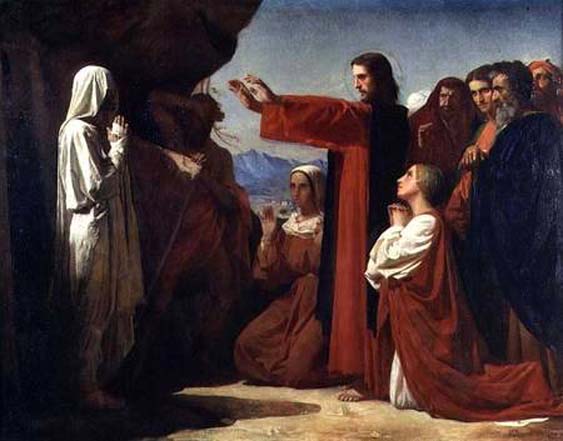
The Raising of Lazarus, 1857, by Léon Bonnat (1833 - 1922)
Jesus received word that his friend Lazarus (brother of Mary and Martha) was sick to the point of death. When Jesus received the news he said, “This illness is not unto death; it is for the glory of God, so that the Son of God may be glorified by means of it.” John 11:4 (RSV.) After hearing that Lazarus was ill, Jesus waited 2 more days before going to him. The disciples cautioned Jesus against going to the home of Lazarus, Martha and Mary. Jesus had only just escaped with his life, the last time he was in their neighborhood. But Jesus returned, finding that Lazarus had been dead and in his tomb for 4 days. Both Mary and Martha, felt that their brother, Lazarus, would not have died if Jesus had been there. Everyone was greatly distressed at the death of Lazarus. Jesus wept.

Jesus went to the tomb of Lazarus. He told the bystanders to take away the stone that sealed the entrance to Lazarus’ tomb. Martha protested that there would be a stench, 4 days after Lazarus’ death. But they obeyed Jesus’ instructions and moved the stone away from the entrance. Jesus cried out in a loud voice, “Lazarus, come forth.” John 11:43 (KJV.) “The dead man came out, his hands and feet bound with bandages, and his face wrapped with a cloth. Jesus said to them, ‘Unbind him, and let him go.'” John 11:44 (RSV).

Many more of the Jews believed in Jesus after they saw or heard how Lazarus had been raised from the dead. But the religious leaders were afraid that if Jesus became too popular it would result in the Romans destroying them.

John 11:49-53 – [49] But one of them, Ca’iaphas, who was high priest that year, said to them, “You know nothing at all; [50] you do not understand that it is expedient for you that one man should die for the people, and that the whole nation should not perish.” [51] He did not say this of his own accord, but being high priest that year he prophesied that Jesus should die for the nation, [52] and not for the nation only, but to gather into one the children of God who are scattered abroad. [53] So from that day on they took counsel how to put him to death.

And ironically, Caiaphas was correct in that Jesus did come to die for his people. Actually he came to die for the sins of the entire world.

Discussion points: The story of Lazarus is the second story in this week’s readings about a dead man being brought back from the grave. But how is the story of Lazarus DIFFERENT than the story of the medium who established contact with Samuel?

REVIEW / STUDY QUESTIONS:

Old Testament

  • Why didn’t David become king as soon as he was anointed?
  • Did either the Israelites or the Philistines intend to honor the agreement to let one combatant decide the fate of the entire army?
  • What was the evil spirit that tormented Saul?
  • Why did Saul consult a medium? Did he really talk to the ghost of Samuel?

New Testament

  • Why didn’t the religious leaders bring the man who had committed adultery to Jesus, as well as the woman.
  • Was Jesus breaking the 10 Commandments when he gave a man sight on the Sabbath?
DISCUSSION POINTS AND VERSES — Christian Men’s Breakfast only2

The discussion notes ( PDF / TEXT ) for breakfast on Saturday, May 21, 2011 are now online — ”Dead Men Talking”. This week we discuss two stories of dead men who are brought back to life from the grave. Or so it would seem. Discussion verses: 1 Samuel 28:15-19; John 11:1-44

WOMEN’S STUDY GROUP

A women’s study group meets in Davie, FL on the 2nd Friday morning of the month. Contact Janet Truex, or use the Contact tab at CONTACT form on ReadTheWholeBible.COM.

FOOTNOTES
  1. The notes, summaries and points on this page are intended as bookmarks of important matters which are covered in this week’s readings. They are not intended as complete summaries of readings. Please forgive me if some of my summaries are not 100% on point. Read the manual–i.e. Bible–so that you will get a more clear understanding of the material. Thank you.
    –Tom Truex
  2. Subject to change.

image_pdfimage_print