Christ the Rock Community Church, Saturday Morning Men’s Bible Study
Baby Moses rescued from the Nile (1638), by Nicolas PoussinThis week’s reading January 22-281
Genesis 44:1-Exodus 7:25
Matthew 14:13-19:12
Psalm 18:37-23:6
Proverbs 4:11-5:23 Next Week’s Reading January 29 to February 4
Exodus 8:1-21:21
Matthew 19:13-23:39
Psalm 24:1-28:9
Proverbs 6:1-7:5
Discussion Questions: Old Testament
(Exodus 6:29-30) God assured Moses He would give him the words to say.
(Exodus 7:3) Why did God permit Pharaoh’s stubbornness and obstinacy to
remain? Did God harden Pharaoh’s heart? Why?
(Exodus 7:4-5) How is God’s name exalted both in those that are saved and in
those that perish. What methods does God use in doing this?
(Exodus 7:7) Is it fair to say that God uses senior citizens?
(Exodus 7:11) How were the magicians able to copy the miracle provided by
God? Was there any difference between the magicians’ tricks and God’s
miracles?
New Testament
How are we to deal with another Christian who has sinned against us?
See Matthew 18:15-20
Jesus and the religious leaders are in conflict over tradition. But aren’t
religious traditions good? Matthew 15:1-3.
What is the “rock” in Matthew 16:18?
FOOTNOTE:
If you are participating in the Saturday morning class, “The One Year Bible Challenge,” you should read the daily materials as set out in “The One Year Bible.” The verses listed on this page will include a couple of extra days each week. ↩
This is the “One Year Bible Challenge:” to read the entire Bible in one year. Assuming a normal reading level, this can be done by spending about 10-15 minutes per day, each and every day. See ReadTheWholeBible.COM for more information. If you would like details so you can join us, or if you have any other questions, please call Tom Truex. Or send an email by using the CONTACT form on K-Line.ORG.
OLD TESTAMENT READINGS: Isaiah 6:1 to 24:23
Themes and stories: In the words of the prophet, Isaiah: He saw God sitting on a throne, high and lofty. Seraphs attended him. Seraphs are a type of heavenly being, each with 6 wings. Two wings cover their faces, two covered their feet, and the the remaining two are used to fly. And as they flew, they called out, “Holy, holy, holy is the LORD of hosts; the whole earth is full of his glory.” Isaiah 6:3 (RSV)
[6] Then flew one of the seraphim to me, having in his hand a burning coal which he had taken with tongs from the altar. [7] And he touched my mouth, and said: “Behold, this has touched your lips; your guilt is taken away, and your sin forgiven.” [8] And I heard the voice of the Lord saying, “Whom shall I send, and who will go for us?” Then I said, “Here am I! Send me.” Isaiah 6:6-8 (RSV).
Whereupon God Himself commissioned Isaiah as prophet, and directed him what to do.
Chapter 8 of Isaiah predicted the invasion by Assyria. Chapter 9 has a prophecy about the coming of the Messiah:
[6] For to us a child is born, to us a son is given; and the government will be upon his shoulder, and his name will be called “Wonderful Counselor, Mighty God, Everlasting Father, Prince of Peace.” [7] Of the increase of his government and of peace there will be no end, upon the throne of David, and over his kingdom, to establish it, and to uphold it with justice and with righteousness from this time forth and for evermore. The zeal of the LORD of hosts will do this. Isaiah 6:6-7 (RSV)
Chapter 10 speaks of the punishment of Assyria. In fact, students of history know that Babylon later destroyed Assyria.
Chapter 11 contains the prophesy of natural enemies on earth being at peace with one another:
[6] The wolf shall dwell with the lamb, and the leopard shall lie down with the kid, and the calf and the lion and the fatling together, and a little child shall lead them. [7] The cow and the bear shall feed; their young shall lie down together; and the lion shall eat straw like the ox. [8] The sucking child shall play over the hole of the asp, and the weaned child shall put his hand on the adder’s den. Isaiah 11:6-9 (RSV).
Remember, in the beginning, this was how all the creatures on earth originally behaved:
And to every beast of the earth, and to every fowl of the air, and to every thing that creepeth upon the earth, wherein there is life, I have given every green herb for meat: and it was so. Genesis 1:30 (RSV).
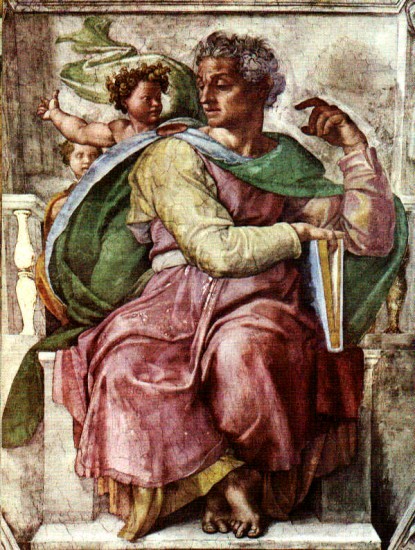
Isaiah by Michelangelo
Chapter 13 contains a prophecy against Babylon. In Chapter 14 God promised Compassion on Israel. It also contains a prophecy against Assyria. Chapters 17 through 23 contain prophecies against Syria, Ethiopia, Egypt, Babylon, Arabia, and Tyre.
Chapter 21:10 (RSV) refers to threshing: “O my threshed and winnowed one, what I have heard from the LORD of hosts, the God of Israel, I announce to you.” By way of clarification for the agriculturally impaired, this is a reference to the way useful grain was obtained. In step one, wheat was trampled under foot to break open the seeds, and expose the grain inside–threshing. In step two, the seeds were thrown into the air–winnowing. The worthless chaff blew away, while the valuable grain fell to the ground, where it could be gathered.2 Israel would experience the same process. The, sinful and rebellious people would be cast aside as worthless, while the people faithful to God would be gathered to replenish Israel.
Discussion points: Isaiah 10:1-4 contains a condemnation of rulers who oppress the people. What, if any, application does this passage have to modern society?
[1] You are doomed! You make unjust laws that oppress my people. [2] That is how you keep the poor from having their rights and from getting justice. That is how you take the property that belongs to widows and orphans. [3] What will you do when God punishes you? What will you do when he brings disaster on you from a distant country? Where will you run to find help? Where will you hide your wealth? [4] You will be killed in battle or dragged off as prisoners. Yet even so the Lord’s anger will not be ended; his hand will still be stretched out to punish. Isaiah 10:1-4 (Good News Translation)
Psalms: Psalm 54:1 to 60:12 Proverbs: Proverbs 23:1 to 23:16
NEW TESTAMENT READINGS: 2 Corinthians 11:16 to Galatians 3:9
Themes and stories: Paul recounts some of his many trials: imprisonment, floggings (often to near death), beatings with the rod, stoning, shipwreck, thirst, hunger, sleeplessness, and nakedness, to name a few. 2 Corinthians 11:23-33. Paul also mentions the thorn in his flesh in chapter 12 of 2 Corinthians. Though commentators have speculated as to the “thorn” being some sort of chronic affliction or disease, we don’t know for sure what it was. Apparently, it pained Paul. Paul prayed to God three times for removal of the affliction. God declined. This kept Paul more humble, which actually benefited his ministry.
In chapter 13 Paul admonished the Corinthians to examine themselves to see if they were living in the faith. And Paul’s final words of farewell:
[11] Finally, brethren, farewell. Mend your ways, heed my appeal, agree with one another, live in peace, and the God of love and peace will be with you. [12] Greet one another with a holy kiss. [13] All the saints greet you. 2 Corinthians 13:11-13 (RSV).
Galatians. Paul greeted the Galatians, but quickly addressed their problem of turning to “a different Gospel.” Paul assures them that he received his Gospel through revelation from none other than Jesus Christ, Himself (Galatians 1:12). Paul tells them how he had been called to share the Gospel with gentiles, as Peter had been called to share it with the Jews.
Paul criticized Peter for siding with those who said you had to first become a Jew (including circumcision), before you could be a Christian. Taken to it’s natural conclusion, this position can be said to imply that faith in Jesus Christ is not sufficient for salvation. That is, the “Judaizers” position necessarily implied that both faith in Jesus AND adherence to the Law were required for salvation.
Paul does not mince words in expressing to the Galatians that FAITH ALONE is sufficient for salvation:
Trust in Christ, Not the Law
[1] You crazy Galatians! Did someone put a hex on you? Have you taken leave of your senses? Something crazy has happened, for it’s obvious that you no longer have the crucified Jesus in clear focus in your lives. His sacrifice on the cross was certainly set before you clearly enough. [2-4] Let me put this question to you: How did your new life begin? Was it by working your heads off to please God? Or was it by responding to God’s Message to you? Are you going to continue this craziness? For only crazy people would think they could complete by their own efforts what was begun by God. If you weren’t smart enough or strong enough to begin it, how do you suppose you could perfect it? Did you go through this whole painful learning process for nothing? It is not yet a total loss, but it certainly will be if you keep this up! Galatians 3:1-3 (The Message)
Discussion points: What are the “marks of a true apostle” that Paul is referring to in 2 Corinthians 12:12? And why is Paul writing about this topic in the first place?
Paul’s Concern for the Corinthians
[11] I have made a fool of myself, but you drove me to it. I ought to have been commended by you, for I am not in the least inferior to the “super-apostles,” even though I am nothing. [12] I persevered in demonstrating among you the marks of a true apostle, including signs, wonders and miracles. [13] How were you inferior to the other churches, except that I was never a burden to you? Forgive me this wrong! 2 Corinthians 12:11-13 (NIV)
See Also:
[17] These signs will accompany those who believe: in my name they will cast out demons; they will speak with new languages; [18] they will take up serpents; and if they drink any deadly thing, it will in no way hurt them; they will lay hands on the sick, and they will recover.”” Mark 16:17 (WEB)
DISCUSSION POINTS AND VERSES — Christian Men’s Breakfast only3
The discussion notes ( PDF / TEXT ) for breakfast on Saturday, September 17, 2011 are now online — ”Prophet”. This week we’ll review some of the prophecies of Isaiah. In the New Testament, we finish Paul’s letter to the Corinthians and begin his letter to the Galatians. Discussion verses: Isaiah 10:1-4 and 2 Corinthians 12:11-13
FOOTNOTES:
The notes, summaries and points on this page are intended as bookmarks of important matters which are covered in this week’s readings. They are not intended as complete summaries of readings. Please forgive me if some of my summaries are not 100% on point. Read the manual–i.e. Bible–so that you will get a more clear understanding of the material. Thank you. –Tom Truex↩
In the earthly part of the 20th century, this job was greatly advanced to the point where the task was mechanized and powered by steam engines. In parts of the USA, groups of neighboring farmers pooled their resources (labor and machinery) as threshing teams – traveling from farm to farm, in turn, to complete the threshing. My grandfather maintained the steam engine on some of these teams. Our family used to accompany him in the 1960’s to a popular annual fair where the old timers gathered to run their obsolete steam giants, and swap tales about a time gone by. I’m not sure if that gathering had a more common name, but I remember it referred to as “the Threshermen’s Convention.” ↩
This is the “One Year Bible Challenge:” to read the entire Bible in one year. Assuming a normal reading level, this can be done by spending about 10-15 minutes per day, each and every day. See ReadTheWholeBible.COM for more information. If you would like details so you can join us, or if you have any other questions, please call Tom Truex. Or send an email by using the CONTACT form on K-Line.ORG.
OLD TESTAMENT READINGS: Genesis 44:1-Exodus 7:25
Themes and stories: Joseph gives his brothers more food to carry them through the seven year famine. The brothers still don’t recognize Joseph. Joseph finally reveals his identity to them. Joseph gives them more provisions to survive the great famine. Jacob’s family moves to Egypt. Pharaoh gives permission for them to settle in the Land of Goshen.
Joseph purchased, on behalf of Pharaoh, land and livestock from the Egyptians as they sold their possessions in order to have food to survive the famine.
Jacob prophesied the future of his descendants. Then Jacob died. His sons returned his body to Canaan so he could be buried in the same tomb as his father, Isaac, and grandfather, Abraham. Joseph’s brothers were concerned that Joseph still held a grudge against them for selling him into slavery many years before. They thought he might punish them, now that their father had died. But Joseph treated them kindly. Joseph died at the age of 110 years, and was buried in Egypt.
Begin Exodus. The Israelites were fruitful and multiplied. The new king (Pharaoh) in Egypt didn’t know Joseph, but he feared the Israelites were becoming too numerous and too strong. He made the Israelites slaves and ordered the slaughter of the baby boys. Moses’ mother put baby Moses in a basket in the river. Pharaoh’s daughter found Moses and adopted him.
When Moses grew up, he saw an Egyptian beating a Hebrew slave. Moses killed the Egyptian. Moses fled to avoid detection for killing the Egyptian.
God spoke to Moses in a burning bush and chose Moses to deliver the Israelites from slavery in Egypt. Moses was afraid to be the one to lead them out of bondage. Moses asked God his name. The answer: “I AM.” Moses returned to Egypt and asked Pharaoh to let the Hebrews celebrate a festival in the wilderness. Instead, Pharaoh made Moses’ people work harder.
God told Moses to ask Pharaoh to let his people leave Egypt. God gave Aaron a staff that turned into a snake when he threw it down before Pharaoh. Still, Pharaoh’s heart was hardened, and he wouldn’t let the Israelites leave. God sent the first of the plagues to afflict the Egyptians—the water in the Nile River turned to blood.
Discussion points: Moses asked Pharaoh to let the Israelites out of his land. God gave Aaron a staff that turned into a snake when he threw it on the ground. Pharaoh wasn’t convinced. Pharaoh’s sorcerers performed the same trick “by their secret arts.” Exodus 6:28 to 7:13. Psalms: Psalm 18:37-23:6 Proverbs: Proverbs 4:11-5:23
NEW TESTAMENT READINGS: Matthew 14:13-19:12
Jesus feeds 5,000Themes and stories: Jesus feeds 5,000 men, plus women and children, with five loaves of bread and two fish. They had 12 baskets of leftovers.
Jesus walks on water. He healed all the sick people who were brought to him. He preaches about inner purity. He drove a demon out of a girl. Jesus fed another 4,000 (plus women and children) seven loaves of bread and a few small fish. This time there were seven baskets of leftovers.
Jesus’ teachings bring him into conflict with the Jewish religious leaders. Peter finally recognizes that Jesus is the Messiah. Jesus predicts his death. Jesus is “transfigured” on the mountain—and meets with Moses and Elijah. Jesus heals a demon-possessed boy. Peter catches a fish, and finds a coin in its mouth, with which to pay the temple tax. Jesus warns against temptation, and against looking down on others. He tells the parable of the unforgiving debtor. Jesus teaches about marriage and divorce.
Discussion points: How are we to treat a fellow believer who sins? Matthew 18:15-20.
REVIEW / STUDY QUESTIONS:
Where was Goshen, and what was it’s significance (Hint: Not in Indiana.)? Genesis 45:10.
Why would the Israelites want to know God’s name? Exodus 3:13-15.
How were Pharaoh’s sorcerers and magicians able to duplicate Moses miracle? Exodus 7:11.
Jesus and the religious leaders are in conflict over tradition. But aren’t religious traditions good? Matthew 15:1-3.
What is the “rock” in Matthew 16:18?
DISCUSSION POINTS AND VERSES — Christian Men’s Breakfast only2
The discussion notes ( PDF / TEXT ) for breakfast on Saturday, January 29, 2011 are now online — ”God can use EVEN YOU!”. Did you ever feel like you aren’t really important enough to accomplish anything for God? You aren’t the first person to feel this way. Yet throughout history, God has frequently chosen the least likely of his servants to carry out his instructions. Keep an open mind. God might need YOU! Discussion verses: Exodus 6:28 to 7:13 and Matthew 18:15-20.
FOOTNOTES
The notes, summaries and points on this page are intended as bookmarks of important matters which are covered in this week’s readings. They are not intended as complete summaries of readings. Please forgive me if some of my summaries are not 100% on point. Read the manual–i.e. Bible–so that you will get a more clear understanding of the material. Thank you. –Tom Truex↩